How to Use AI for Research (Without Letting It Do the Thinking For You)
There’s a version of using AI for research that goes well, and a version that ends with a retraction, a rejected grant application, or a footnote citing a paper that doesn’t exist. The difference between the two isn’t whether you use AI at all — it’s understanding exactly which parts of the research process it’s genuinely good at helping with, and which parts still require a human doing the actual thinking. Get that split right, and AI becomes a legitimately useful research tool. Get it wrong, and it quietly hands you confident, well-formatted nonsense that ends up in your work (How to use AI for research).
What AI Is Actually Good at When You’re Researching Something
Start with where it earns its keep. AI is genuinely strong at the front end of research — the part where you’re still orienting yourself in an unfamiliar topic. Ask it to explain a concept you don’t understand, map out the major subtopics within a broad question, generate a list of search terms and related concepts you wouldn’t have thought of on your own, or summarize a long document you provide directly. As we’ve covered in our breakdown of how ChatGPT actually works, the model is generating fluent, structured explanations by predicting plausible text — which happens to be exactly the skill that makes it useful for turning a vague, half-formed question into something you can actually go investigate.
That last use case — summarizing a document you’ve handed it directly — deserves particular attention, because it’s structurally different and meaningfully safer than asking the model to recall facts from memory. When an AI tool is working from a source you’ve provided, it’s doing retrieval and compression rather than pure generation from training data, and that grounding measurably reduces the risk of fabrication. Asking “summarize this PDF I uploaded” is a fundamentally different, more reliable task than asking “tell me what this study found,” where the model has to reach into its training data and hope it remembers correctly.
Where It Reliably Falls Apart
The failure mode is just as consistent as the strength, and it shows up almost exactly where research gets specific. Researchers at Columbia University’s Tow Center for Digital Journalism tested eight AI search tools on their ability to accurately identify and cite news articles and found the tools collectively produced incorrect answers in more than 60% of tests, frequently generating citations that looked entirely legitimate but didn’t hold up under scrutiny. Research work is disproportionately exposed to this failure mode, because research questions are, almost by definition, narrow, specific, and precise — exactly the territory where a model is most likely to fill a gap in its training data with a fluent, plausible-sounding guess rather than an honest “I don’t know.”
The practical rule that follows from this is simple: never treat an AI-generated citation, statistic, or quote as verified just because it’s formatted correctly and delivered with confidence. If you’re going to use a citation in real research, click through and confirm it exists and says what the AI claims it says. Our guide to fact-checking AI answers walks through exactly how to do this efficiently rather than re-verifying every sentence with equal, exhausting paranoia.
What the Research World Itself Has Decided
This isn’t just casual advice — it’s increasingly formal policy from the institutions that set the standards for how research gets done and published. The Committee on Publication Ethics, one of the most widely followed bodies among academic journals and publishers, states plainly in its official position that AI tools cannot be listed as an author of a paper because they cannot take responsibility for the submitted work, and that authors who use AI tools anywhere in the writing, data analysis, or figure preparation process must transparently disclose how and which tool was used. Crucially, COPE is explicit that the human authors remain fully responsible for every part of a manuscript, including sections an AI tool helped produce — using the tool doesn’t transfer accountability for errors it introduces.
Government funding agencies have gone further, particularly around the parts of research that involve confidential material. The National Institutes of Health issued an official policy notice prohibiting its scientific peer reviewers from using generative AI tools to analyze grant applications or formulate critiques, explicitly warning that uploading or sharing content from an NIH application or its critique to an online AI tool violates peer review confidentiality and integrity requirements. The reasoning generalizes well past grant review specifically: unpublished research findings, confidential peer feedback, and proprietary data are exactly the kind of material that shouldn’t be typed into a consumer AI tool, for reasons we’ve covered in more detail in our guide to what data you should never give AI.
A Practical Way to Actually Use It
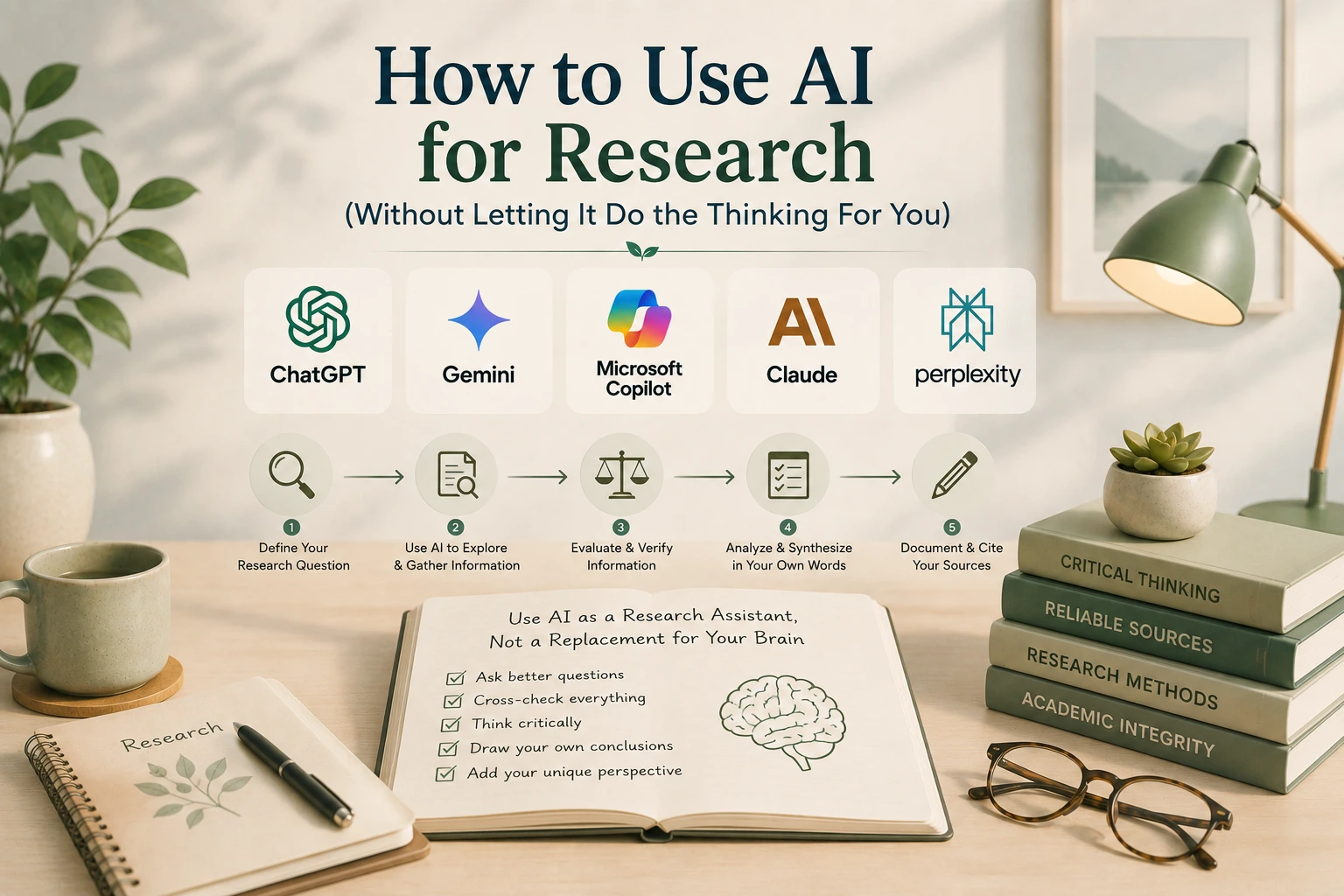
Put together, this points toward a workflow rather than a single rule, and it’s worth walking through concretely.
Use it to scope the question, not answer it. At the start of a research project, before you’ve settled on your specific angle, AI is excellent for generating a map of the territory — related subtopics, competing schools of thought, terminology you’ll need to search for elsewhere. Treat this output as a starting point for your own search, not as findings.
Feed it documents rather than asking it to remember them. Whenever possible, provide the actual source material — a PDF, an article, a dataset — and ask the model to work from what you’ve given it. This grounds the response in something verifiable and cuts the risk of fabrication substantially compared to asking it to recall a source from memory.
Verify every citation before it goes anywhere near your work. Treat an AI-generated reference as a lead to check, not a fact to cite. This is a small, consistent habit, not an exhausting one, once it becomes routine.
Keep confidential and unpublished material out of consumer tools. If you’re reviewing someone else’s unpublished work, working with proprietary data, or handling information under a confidentiality agreement, that material generally shouldn’t be typed into a general-purpose AI chatbot, following the same logic NIH applied to its own peer review process.
Disclose your AI use where it’s expected. Whether you’re publishing academically, submitting a report at work, or writing for a publication with its own AI policy, transparency about where and how you used AI tools is quickly becoming the professional norm rather than the exception, and it protects you if a mistake in the AI-assisted portion later surfaces.
A Quick Example of the Difference in Practice
It helps to see the split applied to something concrete. Say you’re researching how a particular industry has changed over the past decade. Using AI to ask “what are the major forces that typically reshape an industry like this — regulation, technology, consumer behavior, competition — and which of those seem most relevant here?” is a scoping question. It helps you build a mental map and figure out what to actually go look for. The answer doesn’t need independent verification because you’re not going to cite the AI’s framing as a finding; you’re using it to organize your own search.
Compare that to asking “what percentage did this industry grow last year?” and taking the number at face value. That’s no longer scoping — it’s treating the model as a source of fact, in exactly the narrow, specific, high-risk territory where hallucination concentrates. The fix isn’t avoiding the second question. It’s recognizing the moment the conversation shifted from “help me think” to “tell me a fact,” and adjusting your trust accordingly the instant that shift happens.
The Line That Actually Matters
Underneath all of this is one consistent distinction: AI is well-suited to accelerating the mechanical, exploratory parts of research — orienting yourself, summarizing material you’ve already found, generating questions and search terms — and poorly suited to being the source of the actual claims, evidence, and conclusions your research rests on. The moment a specific fact, figure, or citation from an AI conversation is about to become part of something you’ll publish, submit, or stand behind, that’s the moment it needs independent verification, not continued trust in how confident the answer sounded.
That distinction isn’t a limitation to work around reluctantly — it’s close to how good research has always worked, AI or not. A research assistant who drafts a helpful outline and flags interesting angles is valuable. A research assistant whose unverified claims end up in your final work without anyone checking them is a liability, regardless of whether that assistant is a person or a language model.
Building the Habit Into How You Already Work
None of this requires a formal checklist taped above your desk. The habit that matters most is a single reflexive question, applied at the moment a fact is about to leave the chat window and enter something real: has this been verified anywhere other than here? If yes, use it with confidence. If no, that’s the specific point where five extra minutes of checking saves you from the exact kind of error that shows up in retracted papers, sanctioned legal filings, and rejected grant applications — not because AI is unreliable in general, but because this particular kind of claim is precisely where it’s least trustworthy.
Researchers who get real value out of these tools over time tend to develop an instinct for this almost automatically — they stop treating every AI response the same way and start noticing, within a sentence or two, whether they’re reading something exploratory and low-stakes or something that’s about to become a citation. That instinct is really the whole skill, and it gets sharper with use rather than more cautious over time, because it’s grounded in understanding how the tool actually works rather than a blanket rule to distrust it.
Frequently Asked Question
Is it okay to use AI tools like ChatGPT for research?
Yes, for certain parts of the process. AI is genuinely useful for exploring an unfamiliar topic, generating search terms, and summarizing documents you provide directly. It becomes risky when used as the source of specific facts, statistics, or citations without independent verification, since these are exactly the areas where AI models are most prone to generating confident but incorrect information.
Can AI be listed as an author on a research paper?
No. The Committee on Publication Ethics states that AI tools cannot be listed as an author because they cannot take responsibility for the submitted work. Authors who use AI tools in writing, data analysis, or figure preparation must transparently disclose how and which tool was used, and remain fully responsible for the accuracy of the entire manuscript.
Why does AI struggle with research citations specifically?
Research questions tend to be narrow and specific, which is exactly the territory where AI models are most likely to fabricate plausible-sounding but incorrect citations. A Columbia University Tow Center study found AI search tools produced incorrect answers in more than 60% of tests when asked to identify and cite news articles.
Can I use AI to help review or analyze a grant application?
Not if you’re a peer reviewer for the NIH. The National Institutes of Health has an official policy prohibiting scientific peer reviewers from using generative AI tools to analyze applications or formulate critiques, and explicitly warns that uploading application content to an AI tool violates confidentiality requirements. The same caution applies to any confidential or unpublished research material handled outside official NIH review.
What’s the safest way to have AI summarize research material?
Provide the actual source document directly and ask the AI to summarize what you’ve given it, rather than asking it to recall a source from memory. This grounds the response in verifiable material and substantially reduces the risk of fabricated or inaccurate information compared to relying on the model’s training data alone.
Do I need to disclose using AI in my research or writing?
Increasingly, yes. Publishing organizations like COPE require authors to transparently disclose which AI tools were used and how, and many employers and publications now have their own AI disclosure policies. Even where it’s not formally required, disclosure protects you if an error in AI-assisted content is later discovered.
Conclusion
Using AI for research well comes down to matching the tool to the right stage of the process: let it help you explore, summarize, and orient, and keep human verification firmly in charge of anything that becomes an actual claim in your finished work. That split is what separates a genuinely useful research habit from one that quietly imports errors nobody catches.
The institutions that take research integrity most seriously — journal publishers, federal funding agencies — have already converged on this same basic principle: AI can assist, disclosure is required, and responsibility for the final work never transfers to the tool. Building that same discipline into your own process is what makes AI worth using for research in the first place.