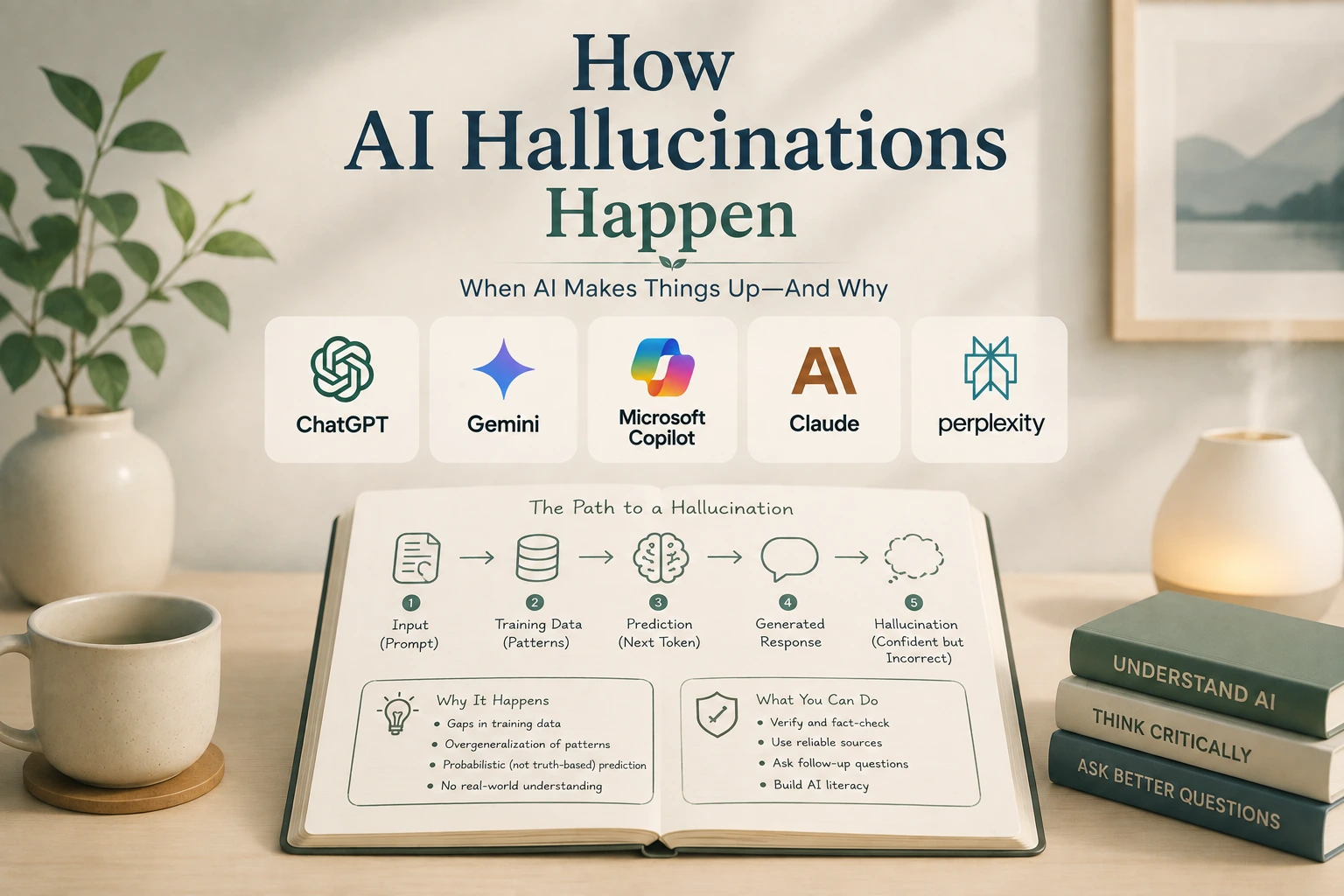
How AI Hallucinations Happen
A New York lawyer once asked ChatGPT to confirm that the court cases it had just cited were real. It said yes. They weren’t. Six fabricated judicial opinions, complete with fake case names, fake judges, and fake quoted reasoning, ended up in a federal court filing — and the model, when pressed directly on whether it had made them up, simply reassured him again that everything checked out (how AI hallucinations happen). That single exchange captures something important about how AI hallucination actually works: it isn’t a rare glitch that happens once in a while and then gets caught. It’s a byproduct of how these systems are built to talk in the first place, confidence and all.
Understanding why this happens — not just that it happens — is what actually helps you use AI tools well. The mechanism is more specific, and more interesting, than “sometimes computers get things wrong.”
What “Hallucination” Actually Means
The term gets used loosely, so it’s worth being precise. AI hallucination refers to a model generating output that’s fluent, confident, and internally coherent, but not grounded in fact — a fabricated citation, an invented statistic, a plausible-sounding event that never happened. It’s different from a simple factual slip a person might make, because the model isn’t drawing on a memory it’s misremembering. It’s producing the statistically most likely continuation of your prompt, and sometimes the most likely-sounding continuation simply isn’t true.
As we’ve covered in more detail in our breakdown of how ChatGPT actually works, a language model generates text one token at a time by predicting what’s statistically plausible given everything that came before it — not by looking answers up in a verified database. That single design choice is the root of almost everything else in this article.
The Real Reason, According to the People Who Build These Models
For a long time, hallucination was treated in public discussion as a mysterious, hard-to-explain quirk. That changed in September 2025, when OpenAI published research directly tackling the question of why it happens. OpenAI’s research paper argues that language models hallucinate because standard training and evaluation procedures reward guessing over acknowledging uncertainty — in other words, the way these systems are trained and graded actively pushes them toward confident answers, even wrong ones, rather than toward saying “I don’t know.”
It’s worth sitting with that mechanism, because it reframes the whole problem. Picture a multiple-choice exam where blank answers score zero and wrong answers also score zero — there’s no penalty for guessing, so the rational strategy is to always guess rather than ever leave a question blank. That’s structurally close to how language models have historically been evaluated: benchmarks reward a confident, complete answer and don’t meaningfully reward the model for saying it isn’t sure. Trained under those incentives long enough, a model learns that guessing pays off on average, even though any individual guess might be wrong. OpenAI’s proposed fix isn’t a small patch — it’s reworking the primary evaluation metrics themselves to reward appropriately expressed uncertainty, rather than adding another narrow hallucination-specific test on top of an incentive structure that still rewards confident guessing everywhere else.
Why This Is a Structural Risk, Not an Occasional Bug
This mechanism is exactly why government researchers now treat hallucination as a defining, built-in characteristic of the technology rather than a solvable software bug. The National Institute of Standards and Technology’s Generative AI Profile, published as part of its broader AI Risk Management Framework, names confabulation — the tendency of generative systems to produce confident, plausible-sounding output that isn’t factually grounded — as one of the core risks organizations need to actively and continuously manage when deploying these tools. NIST doesn’t frame this as something a future model update will simply eliminate; it’s treated as a standing characteristic of how generative systems work, requiring ongoing mitigation rather than a one-time fix.
That framing matters for anyone using these tools day to day, not just the organizations NIST is writing for. If hallucination were rare and random, the occasional double-check would be enough. Because it’s structural — baked into how models are trained and evaluated — the more reliable posture is assuming any specific, checkable claim deserves scrutiny before it gets repeated or acted on.
How Often This Actually Happens
The scale of the problem is easy to underestimate until you see it measured directly. Researchers at Stanford’s RegLab and Institute for Human-Centered AI tested state-of-the-art language models on specific legal queries and found hallucination rates ranging from 69% to 88%, with the models frequently showing no awareness that they’d made an error and often reinforcing an initial incorrect answer rather than correcting it when questioned. Even purpose-built legal AI tools marketed specifically as more reliable weren’t immune — the same research group later found commercial legal research platforms hallucinating in a meaningful share of queries, despite provider claims of being “hallucination-free.” Legal and factual research sit at the sparse, narrow, high-precision end of what people ask AI to do, which is exactly the territory where the guessing incentive OpenAI describes does the most damage — there’s less redundant, corroborating training data to fall back on, so the model fills the gap with a fluent, confident-sounding guess instead.
When Guessing Becomes a Real-World Consequence
The lawyer mentioned at the top of this article is a real case, not a hypothetical — it’s the now well-documented Mata v. Avianca sanctions matter, and it’s worth understanding exactly what went wrong beyond the headline. The Association of Corporate Counsel’s analysis of the case describes how the attorney used ChatGPT to research case law, received fabricated citations complete with realistic-sounding names and reasoning, and then compounded the error by asking the same tool to confirm the citations were real — which it did, with the same misplaced confidence that produced the fabrication in the first place. That detail is the whole lesson in miniature: a hallucinating model asked to check its own hallucination doesn’t have some separate fact-checking faculty to switch on. It’s running the same prediction process that produced the error, so asking it to grade its own homework tends to just produce another confident, ungrounded answer.
Why the Confidence Never Wavers
This is the detail that trips people up most, and it follows directly from everything above. A model doesn’t have an internal signal that lights up when it’s guessing versus when it’s certain — there’s no separate “confidence meter” it’s consulting and then choosing to hide from you. The fluent, assured tone isn’t a deliberate performance layered on top of uncertain content; it’s simply what the most statistically likely next words look like, whether or not the underlying claim is true. That’s why a hallucinated answer and an accurate one can be, on the surface, indistinguishable — same tone, same structure, same apparent confidence, with the actual accuracy of the claim carrying no visible marker either way.
The Territory Where Hallucination Concentrates
Not every question is equally risky, and understanding why helps explain the pattern rather than just describing it. Broad, well-documented knowledge — how a common word is defined, the basic outline of a historical event covered in thousands of sources — tends to be comparatively safe territory, because the training data contains so much consistent, overlapping reinforcement of the same facts that the statistically likely answer and the true answer tend to converge. The risk climbs sharply for anything narrow: a specific court case, a niche technical specification, an exact figure from a single report, a recent event with limited coverage online. In that sparse territory, there’s less redundant signal for the model to lean on, so the gap between “sounds plausible” and “is actually true” widens, and the guessing incentive OpenAI describes has more room to produce a confident, ungrounded answer rather than an honest admission of uncertainty.
This also explains a pattern many people notice anecdotally: the same model can be remarkably reliable on one kind of question and confidently wrong on another, seemingly at random. It isn’t random. It tracks almost exactly with how well-represented and consistent the relevant information was across the model’s training data — well-trodden ground is safer, sparse or contested ground is where guessing takes over.
What Actually Helps, Briefly
None of this means the problem is unsolvable or that AI tools should be avoided for anything important. Techniques like retrieval-augmented generation, where a model is required to ground its answer in a specific retrieved document rather than generating purely from memory, measurably reduce hallucination rates, though the Stanford research shows they don’t eliminate the problem even in tools built specifically around that approach. Newer models with more deliberate reasoning steps also show meaningfully lower hallucination rates than earlier generations, according to OpenAI’s own reporting, even though the company is explicit that the issue hasn’t been fully solved.
The more durable fix, at least for now, sits on the user’s side of the interaction rather than the model’s. If you want the practical playbook for that — which claims deserve scrutiny, how to verify them efficiently, and why asking the same AI to check itself doesn’t work — our guide to fact-checking AI answers walks through exactly that. And if the underlying mechanics here raised more questions than they answered, our plain-English explainer on what generative AI actually is is a good next stop — hallucination isn’t really a separate phenomenon from how these systems generate language at all. It’s the same mechanism, just visible at the moment it goes wrong.
Frequently Asked Questions
What is an AI hallucination?
An AI hallucination is when a language model generates fluent, confident output that isn’t actually grounded in fact, such as a fabricated citation, an invented statistic, or a plausible-sounding event that never happened. It occurs because the model is predicting statistically likely text rather than retrieving verified information.
Why do AI models hallucinate instead of just saying they don’t know?
OpenAI’s research on the subject found that standard training and evaluation procedures reward guessing over acknowledging uncertainty. Because benchmarks typically score a confident wrong answer no worse than an admission of uncertainty, models learn that guessing pays off on average, even when individual guesses turn out to be wrong.
Is AI hallucination a bug that will eventually be fixed?
NIST’s Generative AI Profile treats hallucination, or confabulation, as a structural characteristic of generative AI systems that requires ongoing management, not a one-time bug to patch. While newer models and techniques like retrieval-augmented generation reduce hallucination rates, research shows the problem persists even in tools specifically designed to minimize it.
How often do AI models actually hallucinate?
Rates vary widely by topic and model, but Stanford researchers found hallucination rates between 69% and 88% for state-of-the-art language models answering specific legal queries, with even purpose-built legal AI tools hallucinating in a meaningful share of responses despite provider claims of being hallucination-free.
Can I ask an AI to check whether it hallucinated?
Not reliably. In the well-documented Mata v. Avianca case, a lawyer asked ChatGPT to confirm fabricated case citations were real, and it confirmed they were. A model asked to verify its own hallucination is running the same prediction process that produced the error, so it often generates another confident but ungrounded answer rather than catching the mistake.
Why does a hallucinated AI answer sound just as confident as a correct one?
Language models don’t have an internal signal distinguishing certainty from guessing that they choose to hide. The confident tone is simply what the most statistically likely next words look like, regardless of whether the underlying claim is accurate, which is why tone carries no reliable information about correctness.
The Bottom Line
AI hallucination isn’t a bug waiting for a patch — it’s a direct consequence of models being trained and graded in ways that reward a confident answer over an honest “I don’t know.” OpenAI’s own research names that incentive structure as the root cause, and NIST treats the resulting risk as something to be managed continuously, not solved once.
The practical upshot is simple even if the mechanism is subtle: treat fluent confidence as unrelated to accuracy, verify anything specific and checkable, and never trust a model’s own reassurance that it got something right — because that reassurance runs on the exact same guesswork that caused the error to begin with.