How Does ChatGPT Actually Work?
There’s a particular moment almost everyone has with ChatGPT the first time they use it seriously — you type something half-formed, hit enter, and a coherent, contextually appropriate answer appears in seconds. It feels less like using software and more like talking to something. Which raises the obvious question: what’s actually happening in that pause between hitting enter and the first word appearing? Not the marketing version. The actual mechanics.
The short answer is that ChatGPT isn’t thinking, in any sense a person would recognize. It’s predicting. Extremely well, at extraordinary scale, informed by a staggering amount of training — but at its core, it’s a very sophisticated next-word guessing machine. Understanding how that guessing works, and where its limits are, changes how you use the tool.
What “GPT” Actually Stands For
The letters matter more than most people realize. GPT stands for Generative Pre-trained Transformer, and each word describes a distinct piece of the system. Generative means it produces new content rather than just classifying or retrieving existing content. Pre-trained means it learned its core capabilities from a massive body of text before it ever answered a single user question. Transformer refers to the specific neural network architecture that makes the whole thing possible — and this is where the real engineering story starts.
Before 2017, most language AI ran on architectures that processed text sequentially, one word at a time, which made them slow and prone to “forgetting” the earlier parts of long passages. That changed with a paper published by a team of researchers, titled “Attention Is All You Need”, which introduced the transformer architecture built entirely around a mechanism called self-attention. Instead of reading a sentence word by word, a transformer looks at an entire passage at once and calculates how much every word should “attend to” every other word, letting it capture relationships across long stretches of text in parallel rather than in sequence. Nearly every major language model built since, including the one behind ChatGPT, is a descendant of that architecture.
Training Happens in Two Very Different Stages
This is the part most explainers gloss over, and it’s the part that actually determines how ChatGPT behaves. Training happens in two distinct phases, and they teach the model completely different things.
Pre-training is the first and by far the more computationally expensive stage. The model is shown enormous volumes of text — books, articles, websites, code — and given one task, over and over: predict the next word. It isn’t told facts directly; it absorbs statistical relationships between words, phrases, and concepts by attempting billions of these predictions and adjusting internal parameters, known as weights, each time it’s wrong. By the end of pre-training, the model has a broad, general sense of language and world knowledge, but no particular skill at holding a conversation or following instructions. Left at this stage, a model is more likely to continue a prompt in an unpredictable direction than to actually answer it helpfully.
Fine-tuning is what turns that raw prediction engine into an assistant. OpenAI’s own account of this process explains that a purely pre-trained model isn’t reliably aligned with what a user actually wants — it might generate something untruthful, unhelpful, or off-topic, simply because predicting the next word on internet text and safely doing what a user asked are two different goals. To close that gap, OpenAI uses a technique called reinforcement learning from human feedback, or RLHF. Human reviewers rank multiple model responses to the same prompt from best to worst, and that ranking data trains a separate “reward model,” which is then used to nudge the language model toward the kinds of answers people actually rate highly. This is the stage that teaches the model to follow instructions, decline inappropriate requests, and admit uncertainty rather than confidently making something up — imperfectly, but far better than the raw pre-trained version. OpenAI has described how the resulting dialogue format lets ChatGPT handle follow-up questions, push back on incorrect premises, and reject requests it shouldn’t fulfill.
What Happens the Moment You Hit Enter
Once training is finished, generating a response is a different process from training, and it’s worth walking through, because it demystifies a lot of what feels like magic.
Your prompt is first broken into tokens — chunks of text that are sometimes whole words and sometimes word fragments. Those tokens get converted into numerical representations the model can process mathematically. From there, the model runs its transformer layers across your entire prompt plus everything generated so far, calculating attention scores that determine which earlier tokens are most relevant to producing the next one. The output of that calculation is a probability distribution over its entire vocabulary — essentially a ranked list of every possible next token, each with a likelihood score attached.
The model then samples from that distribution to pick the next token, appends it to the growing response, and repeats the entire process to generate the token after that. This happens many times per second, which is why longer responses stream in gradually rather than appearing all at once — each word really is being freshly calculated based on everything that came before it, not pulled from a pre-written answer sitting in a database somewhere.
Why It Sounds So Confident Even When It’s Wrong
This mechanism explains one of ChatGPT’s most disorienting quirks: it can state something completely false with exactly the same fluent, confident tone it uses for something true. There’s no internal fact-checking step built into how a token gets chosen — the model is selecting the statistically most plausible next word given its training, not verifying claims against a database of known facts.
The National Institute of Standards and Technology’s Generative AI Profile, published as part of its broader AI Risk Management Framework, names this directly as one of the defining risks of generative systems: confabulation, more commonly called hallucination, where a model produces confident, plausible-sounding output that isn’t factually grounded. NIST’s guidance treats this as a structural characteristic of how these models generate text, not an occasional bug, which is part of why fact-checking anything load-bearing that comes out of a chatbot remains a genuinely necessary habit rather than an overcautious one.
How ChatGPT Compares to Google Gemini and Anthropic’s Claude
ChatGPT isn’t the only major chatbot built this way, and it’s worth being clear about what’s shared architecture and what’s actual product philosophy, because the two get blurred constantly in casual coverage. All three of the leading assistants — OpenAI’s ChatGPT, Google’s Gemini, and Anthropic’s Claude — are transformer-based language models trained on massive text corpora and refined with human feedback. Where they diverge is in design priorities and training method, and those differences show up in how each one actually behaves.
Google’s Gemini, built by Google DeepMind, was designed from the outset to be what the company calls natively multimodal. Google’s own announcement of the model explains that rather than training separate models for text, images, audio, and video and stitching them together afterward, Gemini was pre-trained jointly across those data types from the start, then fine-tuned further on multimodal data. That joint training is the technical reason Gemini tends to move fluidly between, say, reading a chart and reasoning about the numbers in it, rather than treating image understanding as a bolted-on feature.
Anthropic’s Claude shares the same transformer foundation but takes a distinct approach to the fine-tuning stage. Instead of relying solely on human-labeled preference rankings the way standard RLHF does, Anthropic trains Claude against a written document called Claude’s Constitution — a detailed, publicly published set of principles the model is trained to reason from directly, covering things like honesty, harm avoidance, and how to weigh competing priorities. The idea, in Anthropic’s own framing, is that giving a model explicit reasons behind a value tends to generalize better to new, unanticipated situations than a purely inferred set of preferences would.
None of this makes one model definitively “better” than another in some absolute sense — it means they’ve been shaped by different bets about what matters most: breadth of native modality, explicit written values, or the specific instruction-following pipeline OpenAI has iterated on for years. For everyday use, the practical takeaway is that the same underlying caution applies across all of them: they’re all predicting plausible text, none of them are infallible, and the differences in tone or caution you notice between ChatGPT, Gemini, and Claude are downstream of real, documented differences in how each one was trained rather than just personality quirks.
How Widely This Is Actually Being Used
It’s easy to talk about ChatGPT in the abstract, but the adoption numbers are worth sitting with. Pew Research Center’s 2026 survey of U.S. adults found AI chatbot use climbing from roughly a quarter of adults in 2023 to about half the country today, with usage rising fastest among groups that were slower to adopt it initially. That figure spans the category broadly — ChatGPT, Gemini, Claude, and others — rather than any single product, which is itself telling: this has stopped being a one-company story and become a shift in how a large share of the population interacts with information generally. Whatever is happening under the hood, it’s no longer a niche curiosity — it’s become one of the more quietly transformative pieces of everyday software in a very short window of time.
Why This Matters for How You Actually Use It
None of this is trivia. Knowing that ChatGPT works by predicting plausible next tokens, rather than reasoning from verified facts, should change what you trust it to do unsupervised versus what you double-check. It’s genuinely strong at tasks with a lot of statistical regularity behind them — drafting, summarizing, explaining, restructuring, brainstorming variations. It’s weaker, structurally, at anything requiring verified precision, like specific citations, dates, or numbers, unless it’s been given the source material directly.
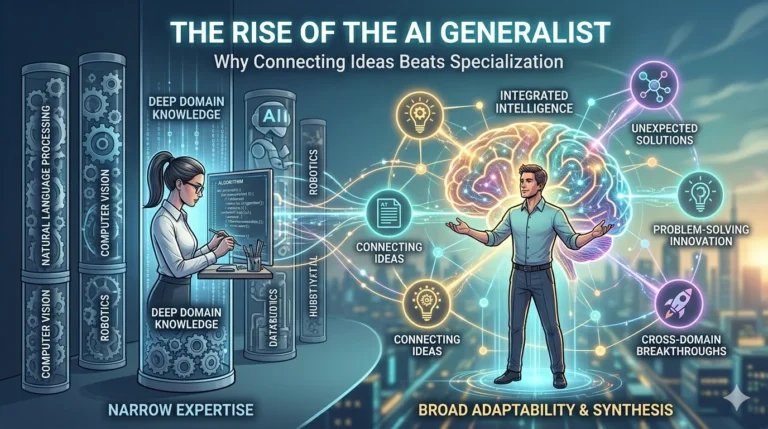
That’s a distinction worth sitting with more broadly, and it’s one we’ve explored from a few different angles — including in What Is Generative AI? A Plain-English Guide to How It Actually Works, which covers the broader category ChatGPT belongs to, and in The Rise of the AI Generalist, which looks at how tools like this are shifting the value of connecting ideas across fields rather than replacing deep expertise. There’s also a real cost to factor in beyond accuracy — our piece on The Cognitive Cost of AI looks at why tools built to save time are, for a lot of knowledge workers, doing the opposite.
ChatGPT isn’t mysterious once you take it apart. It’s a transformer-based language model, pre-trained on enormous amounts of text to predict likely word sequences, then fine-tuned with human feedback to behave like a helpful assistant rather than a raw text-completion engine.
It doesn’t know things the way a person knows things — it’s exceptionally good at producing plausible language, and increasingly good at doing that in ways that hold up under scrutiny. Knowing the difference is the whole game.
Frequently Asked Question
What does GPT stand for in ChatGPT?
GPT stands for Generative Pre-trained Transformer. It’s generative because it produces new content rather than retrieving existing answers, pre-trained because it learns its core language ability from a massive body of text before ever being fine-tuned, and a transformer because of the specific neural network architecture, built around self-attention, that powers it.
Does ChatGPT actually understand what it’s saying?
Not in the way a human understands language. ChatGPT generates responses by predicting the most statistically plausible next word based on patterns learned during training, rather than reasoning from verified facts or genuine comprehension. This is why it can sound confident while still being factually wrong.
How is ChatGPT trained?
Training happens in two main stages. Pre-training exposes the model to enormous amounts of text and teaches it to predict the next word, building broad language and world knowledge. Fine-tuning, which uses a technique called reinforcement learning from human feedback (RLHF), then trains the model to follow instructions, decline inappropriate requests, and behave more like a helpful assistant.
Why does ChatGPT sometimes make things up?
This is called confabulation, or hallucination. Because the model selects words based on statistical likelihood rather than verifying facts, it can generate confident, fluent, but incorrect information. NIST’s Generative AI Profile identifies this as a structural risk of generative AI systems rather than an occasional glitch.
What is the transformer architecture?
The transformer is the neural network design introduced in the 2017 paper “Attention Is All You Need.” It uses a mechanism called self-attention to process an entire passage of text at once, weighing how relevant every word is to every other word, rather than reading text sequentially like earlier models did.
How many people use ChatGPT or similar AI chatbots?
Adoption has grown rapidly. Pew Research Center found that AI chatbot use among U.S. adults rose from around a quarter in 2023 to roughly half of all adults today, making it one of the fastest-adopted consumer technologies in recent memory.
How is ChatGPT different from Google Gemini and Anthropic’s Claude?
All three are transformer-based language models trained with human feedback, but they differ in design and training philosophy. Gemini was built natively multimodal from the start, trained jointly across text, image, audio, and video. Claude is fine-tuned against a written set of principles called Claude’s Constitution rather than relying solely on human preference rankings. ChatGPT relies on OpenAI’s reinforcement learning from human feedback pipeline. The differences in tone and behavior between them come from these documented training choices, not personality alone.
The Bottom Line
ChatGPT isn’t mysterious once you take it apart. It’s a transformer-based language model, pre-trained on enormous amounts of text to predict likely word sequences, then fine-tuned with human feedback to behave like a helpful assistant rather than a raw text-completion engine.
It doesn’t know things the way a person knows things — it’s exceptionally good at producing plausible language, and increasingly good at doing that in ways that hold up under scrutiny. Knowing the difference is the whole game.