What Is an AI Agent? The Difference Between “Can Answer” and “Can Act
Ask a regular AI chatbot to find you the cheapest flight to Lagos next Tuesday, and it’ll tell you how to go check — maybe even suggest a few sites. Ask an AI agent the same question, and it can actually open a browser, search multiple airlines, compare prices, and come back with a booking ready for your approval. That’s the entire distinction in one example, and it’s the reason 2026 has turned “AI agent” from a term mostly used inside AI labs into one of the fastest-growing searches in the entire AI category — up 124% over the past year.
This isn’t a subtle rebrand of “chatbot.” It’s a real architectural shift in what these systems can do, and it’s already changing how browsers themselves work — which matters for anyone running a website, not just people curious about the technology.
The Actual Definition: Autonomy, Tools, and Multi-Step Planning
An AI agent is an AI system that can take a goal, break it into steps, use tools to complete those steps, and adjust its plan based on what happens along the way — with some degree of autonomy, rather than requiring a human to approve each individual action.
Three things separate an agent from a standard chatbot:
- Tool use. An agent can call external tools — search engines, APIs, calculators, booking systems — rather than only generating text from what it already knows.
- Multi-step planning. An agent can break “book me a flight” into sub-steps (search options, compare prices, check your calendar, confirm availability, complete the booking) and work through them in sequence, not just answer in one shot.
- Adaptive behavior. If step two returns an unexpected result — the cheapest flight is sold out — an agent can revise its plan and try something else, rather than simply reporting the failure and stopping.
A chatbot answers. An agent does, within whatever boundaries and permissions it’s been given.
Why This Became a Big Deal in 2026 Specifically: WebMCP
The technical piece that turned “AI agents” from a lab concept into something touching every website is WebMCP (Web Model Context Protocol) — a new web standard that Google and Microsoft jointly announced at Google I/O 2026. As Google described it in the announcement, WebMCP is a proposed W3C standard, co-developed with Microsoft, that gives websites a structured way to expose callable actions directly to browser-based AI agents — instead of forcing those agents to screen-scrape a page or simulate human clicks to figure out what a site does.
The problem WebMCP solves is a real, documented one. Before it, an AI agent trying to use a website had exactly two unreliable options: scrape the raw HTML and guess at what buttons and forms mean, or rely on a separate backend API the website’s developers had to build and maintain specifically for AI access. Chrome’s own developer documentation describes WebMCP’s purpose plainly: it provides JavaScript APIs and HTML form annotations so agents know exactly how to interact with a page’s features, supporting the user’s actual experience rather than working around it.
WebMCP builds directly on MCP (Model Context Protocol), the open standard Anthropic introduced in 2024 for connecting AI assistants to external data and tools. WebMCP extends that same idea to the browser itself — your website effectively becomes a small MCP server, publishing a menu of things an agent can reliably do on it.
What This Looks Like in Practice
Developer coverage of the standard gives a concrete sense of scale: a travel booking tool exposed through WebMCP might declare a structured action with a name, a description, and defined inputs — something like origin, destination, travel date, and passenger count — so an agent calling it knows exactly what to provide and what it’ll get back, instead of guessing at form fields designed for a human’s eyes. Chrome shipped a developer preview of WebMCP in February 2026, with broader rollout continuing through the rest of the year. As of this writing, Apple and Mozilla haven’t announced official support, which means the standard is currently strongest in Chrome and Chrome-based agentic browsers specifically — a real limitation worth knowing if you’re evaluating how quickly to act on this, not a settled, universal standard yet.
Agentic Browsers Are Already Here, Not Hypothetical
This isn’t a future-tense technology. Agentic browsers — tools that browse the web and complete tasks on a person’s behalf — are already shipping: Perplexity’s Comet, OpenAI’s Atlas, and The Browser Company’s Dia are all live products built around exactly this capability. Each one represents the same underlying shift: a growing share of web traffic isn’t a human clicking through pages anymore — it’s an agent, acting with a human’s permission, trying to complete a task as efficiently as possible.
Why This Matters Beyond the Technology Itself
The practical consequence for anyone publishing content or running a website: AI agents are becoming a genuine category of visitor, alongside human readers and search engine crawlers. A site that’s well-structured for agents to understand — clear content, well-formed markup, and increasingly, explicit WebMCP tool declarations — is positioned to be the one an agent actually chooses to route a task through, the same way clean, well-structured sites won search rankings in the SEO era. A site that’s confusing or poorly structured risks simply being invisible to this entire emerging category of user, regardless of how good the content underneath actually is.
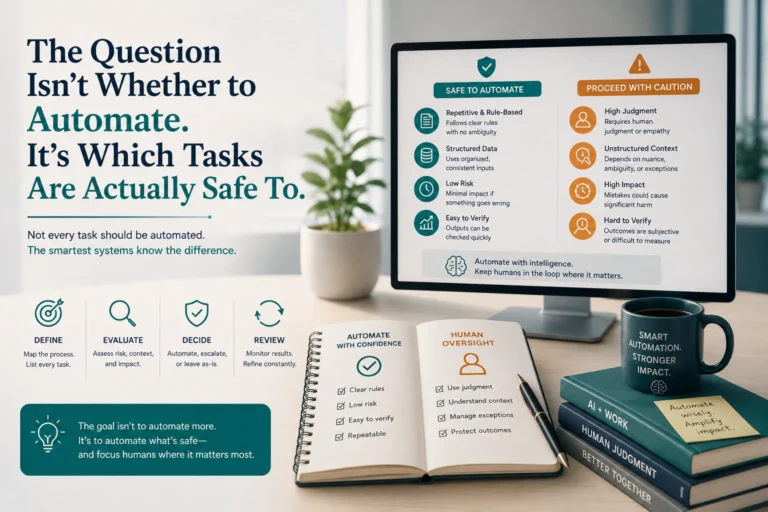
This connects directly to something we’ve written about before: the challenge of knowing which decisions are actually worth handing to an AI system in the first place. If you haven’t read it, our piece on why “should AI make this decision” is the wrong question to ask goes deeper on that distinction — and it’s directly relevant here, since WebMCP is fundamentally about which actions a site is willing to hand off to an agent’s judgment versus keep behind a human-only interface.
The Honest Risks Worth Knowing
Agentic AI isn’t risk-free, and it’s worth being direct about that rather than treating it as pure upside:
- Authorization mistakes matter more now. If a website implements WebMCP action endpoints carelessly, it could inadvertently expose sensitive operations — like completing a purchase or changing account settings — to a misconfigured or malicious agent. Getting authorization logic right at the developer level isn’t optional.
- Fragmentation is a real possibility. If major browsers beyond Chrome decline to adopt the standard, the web risks splitting into a Chrome-native, agent-ready tier and a standard tier — meaning site owners may eventually face a real decision about which experience to prioritize.
- Agent reliability still varies. Even with structured tools available, agents can still misinterpret a task, select the wrong tool, or act on an outdated understanding of what a site offers — which is exactly why most current implementations favor a “human-in-the-loop” approach, where an agent proposes an action and a person confirms it before anything irreversible happens.
If the broader question of what AI systems should and shouldn’t be trusted with on their own interests you, our earlier look at the biggest AI privacy risk not being a hacker but a setting most people never check is a useful companion read — a lot of the same “who actually has permission to act here” questions apply to agents as much as they do to data privacy.
Frequently Asked Questions
What’s the real difference between an AI chatbot and an AI agent?
A chatbot answers questions using what it already knows or can look up in a single step. An AI agent can take a goal, break it into multiple steps, use external tools to complete those steps, and adjust its approach based on results along the way — essentially the difference between a system that can tell you something and one that can actually go do something.
What is WebMCP, in plain terms?
WebMCP is a new web standard, announced by Google and Microsoft at Google I/O 2026, that lets websites declare a structured list of actions AI agents can reliably call — instead of agents having to scrape a page’s HTML and guess what buttons and forms are for. It’s rolling out through Chrome starting in 2026.
Do I need to change my website to support AI agents?
Not necessarily right away — agents can still read a static, well-structured site even without WebMCP declarations. But a site with no declared WebMCP interface can’t be directly called as a tool by agents using the new standard, meaning agents will read it rather than interact with it. Whether that gap matters depends on whether your site has actions worth exposing (search, booking, account actions) beyond simply being read.
Are agentic browsers like Comet and Atlas actually being used, or is this still experimental?
They’re real, shipping products, not research previews — Perplexity’s Comet, OpenAI’s Atlas, and The Browser Company’s Dia are all live as of 2026. Adoption is still in an early, fast-growing phase rather than mainstream-default, but it’s no longer accurate to describe agentic browsing as purely hypothetical.
Is WebMCP the same thing as MCP (Model Context Protocol)?
They’re related but distinct. MCP, introduced by Anthropic in 2024, is a standard for connecting AI assistants to external data and tools generally. WebMCP extends that same underlying idea specifically to the browser and the web — letting a website itself function as a structured set of tools an agent can call, built on the same conceptual foundation MCP established.
What’s the biggest risk with letting AI agents act on a website?
Incorrectly implemented authorization logic is the most commonly cited concern — if a site exposes an action like a purchase or account change without proper safeguards, a misconfigured or malicious agent could potentially trigger it. This is a major reason most current agentic systems favor a “human-in-the-loop” design, where the agent proposes an action and a person confirms it before anything irreversible happens, rather than full autonomous execution.
Conclusion
The shift from “AI that answers” to “AI that acts” isn’t a marketing distinction — it’s a real architectural change, and WebMCP is the concrete piece of infrastructure turning it into something that touches ordinary websites in 2026, not just AI research labs. Whether or not you ever interact with an agentic browser directly, the sites you read are increasingly being visited by one on someone else’s behalf.
The practical takeaway isn’t that every website needs to rush to implement every new agent-facing feature immediately — Apple and Mozilla haven’t even committed to the standard yet, and the risks around authorization are real. It’s that understanding the difference between a chatbot and an agent, and paying attention to which actions you’d actually want an agent completing on your behalf versus keeping firmly in human hands, is quickly becoming a genuinely useful piece of digital literacy, not a niche technical curiosity.