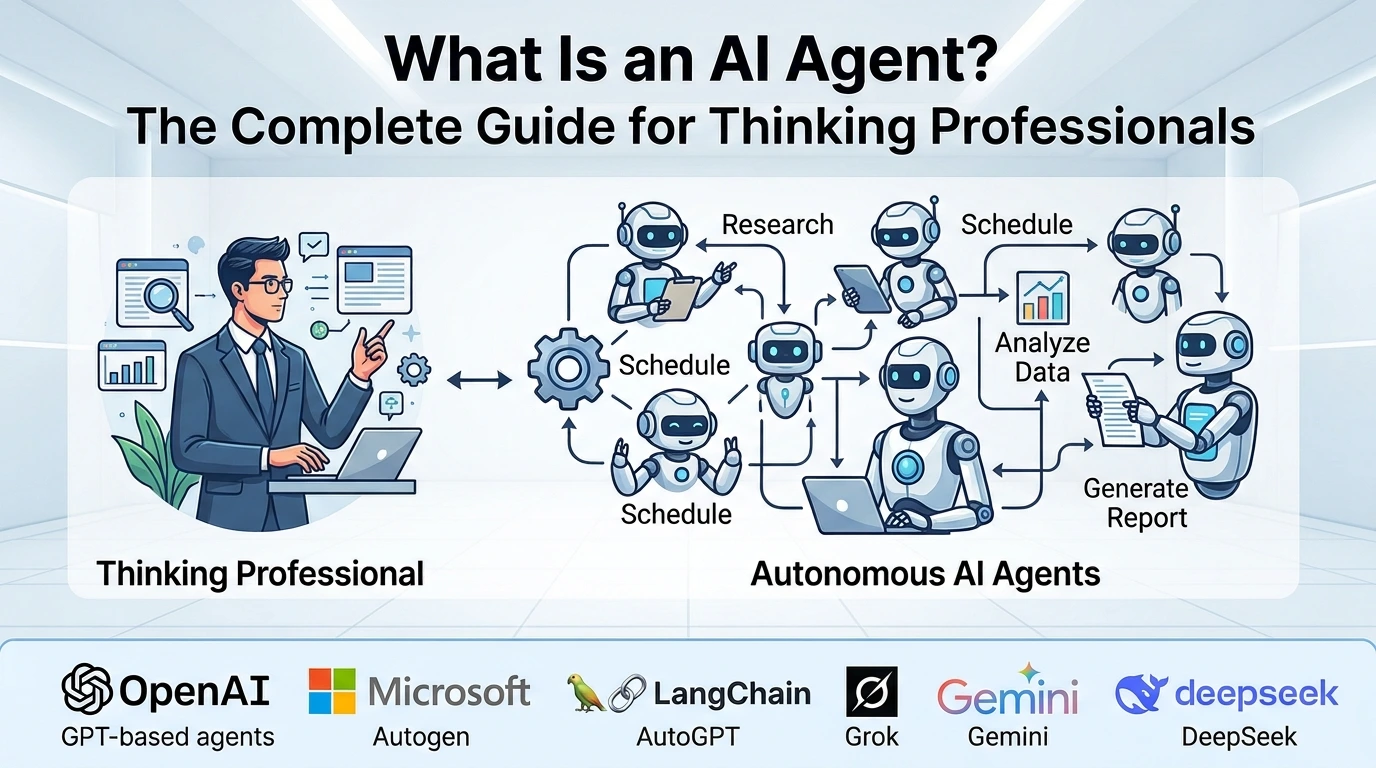
What Is an AI Agent? The Complete Guide for Thinking Professionals
The language shifted almost imperceptibly between 2024 and 2026. Where conversations about artificial intelligence centred on chatbots and generative models — tools you prompt, tools that respond, tools that wait — the vocabulary that has taken over in every serious technology conversation now centres on something different: agents. Not a tool you query but a system that pursues. Not something that answers but something that acts. The distinction sounds subtle until you encounter one in practice, at which point it feels less like a new feature and more like a new category of thing. What is an AI agent?
An AI agent is software that can pursue a goal autonomously by planning a series of steps, using tools like web search or code execution, and adapting its approach based on what it observes — an AI agent in 2026 has crossed the threshold from experimental to genuinely production-ready for a meaningful set of professional use cases. That definition carries weight only when you understand what makes it different from everything that came before it. The ChatGPT you’ve been using — responding to a question, generating a draft, providing an analysis — is not an AI agent in the sense this guide describes. It is, in the most precise technical framing, a reactive model: you prompt, it responds. An AI agent doesn’t wait for your next prompt. It plans, it executes, it observes the results, it adapts, and it continues until the goal is reached or it needs to ask you something meaningful.
For knowledge workers navigating 2026, this distinction is not academic. It determines which AI tools require your constant involvement and which can be trusted with a defined objective and left to work.
The Architecture: What Makes Something an Agent
Strip every product name, every marketing frame, and every piece of jargon from the conversation about AI agents, and what remains is a set of core properties that either exist in a system or don’t. Every functional AI agent runs on three foundations: perception — AI agents observe their environment actively by reading emails, monitoring databases, watching APIs, scanning documents, and tracking sensor data rather than waiting for humans to feed them information; reasoning — where large language models transformed how AI agents operate, enabling them to understand context rather than just match patterns; and action — the ability to execute decisions through external tools rather than merely generating text. These three foundations — perceive, reason, act — are what separate an agent from a language model, in the same way a pilot is separated from a navigation calculator by the ability to perceive conditions, make decisions, and actually move the plane.
The fourth property that most rigorous definitions include is memory. An AI agent that forgets everything between steps cannot maintain context across a multi-step workflow. Memory in this context takes several forms: short-term context within a single session, structured storage that persists across sessions, and retrieval mechanisms that allow the agent to query its own prior outputs or external knowledge bases when relevant. Agents also maintain state — they remember context across steps, use memory to inform future decisions, can persist across sessions, access external tools through APIs, and can spawn sub-agents to parallelize workloads — these properties of autonomy, goal-directedness, planning, memory, and tool use together form what practitioners mean by agentic AI. Sub-agents are particularly significant for understanding how complex agent systems scale: rather than a single agent handling every aspect of a complex task, an orchestrating agent delegates components to specialised sub-agents that run in parallel, returning their outputs for synthesis.
The fifth and perhaps most distinguishing property is the continuous loop. AI agents are autonomous systems that operate in a continuous loop of plan, act, observe, and adapt until the task is complete — perceiving context, reasoning about the goal, planning a sequence of actions, executing those actions through tools, observing the results, and iterating. The loop is what makes an agent genuinely autonomous in a way that a language model prompt-and-response is not. If a web search returns no useful results, the agent doesn’t stop and report failure. It adapts its query, tries a different search, or shifts to a different information source. That adaptive loop — what researchers call the perceive-plan-act-observe cycle — is the operational signature of an agent system.
The Five Categories: Not All Agents Are Equally Autonomous
The term “AI agent” covers a spectrum of sophistication that ranges from systems barely more capable than traditional software to architectures approaching genuine strategic reasoning. Understanding where a specific tool sits on that spectrum is essential for calibrating what to trust it with. The field has developed five recognised categories, each representing a different level of sophistication.
Simple reflex agents act on the immediate state of their environment using conditional rules — if this condition, then this action. A spam filter that flags emails containing certain keywords is operating on this level. The agent has no memory, no planning, and no ability to reason about context beyond the current input. Simple but reliable within narrow parameters.
Model-based reflex agents maintain an internal representation of how the world works, allowing them to handle situations where the current state is partially observable. A self-driving car’s lane-keeping system that accounts for road curvature and previous vehicle positions operates on this level. The model gives the agent a basic capacity to anticipate rather than merely react.
Goal-based agents represent the first genuinely planning-capable category. These agents are given an explicit goal and work backward to identify the sequence of actions that will achieve it. They can evaluate multiple paths and select the most efficient. A travel booking agent instructed to “find the cheapest flight from Lagos to London that arrives before noon” is operating at this level — it searches, compares, filters, and selects based on a defined objective.
Utility-based agents go further by optimising not just for binary goal achievement but for maximising a preference function. They can handle trade-offs: speed versus cost, accuracy versus speed, risk versus reward. This is the category most relevant to professional knowledge work — an agent managing a content calendar that balances publication frequency, topic diversity, and SEO performance across competing constraints is operating with utility rather than simple goal logic.
Learning agents incorporate feedback mechanisms that allow them to improve their performance over time. When an agent’s action produces an unexpected result, the learning system updates its model of how the world behaves and revises future decisions accordingly. This is the category that makes AI agents genuinely adaptive rather than static — and the category where the most consequential deployment questions arise, because a learning agent that receives bad feedback can learn the wrong lessons with increasing confidence.
What Changed in 2025–2026 That Made Agents Real
The conceptual framework for AI agents is not new — autonomous software systems that perceive, reason, and act have been described in academic AI literature since the 1990s. What changed in 2025 and 2026 is that the underlying models became capable enough to actually execute the framework reliably in real conditions. Autonomous agents became commercially viable in 2025 and 2026 because frontier models improved tool reliability, context handling, and multi-step reasoning simultaneously — the shift from conversational AI to operational AI happened when models became capable of maintaining state, recovering from intermediate failures, and coordinating external systems with acceptable reliability. Prior generations of models could generate plausible text but couldn’t reliably follow a 30-step workflow, recover from an API error at step 14, and continue to completion. The reliability improvement — not the intelligence improvement — is what made agents practical.
The tooling layer matured in parallel. Anthropic’s Model Context Protocol (MCP), widely adopted through 2025, standardised how AI models connect to external tools and data sources. MCP acts like USB-C for AI tool integration — before it, every system had different connectors; MCP defined one standard that works across tools and frameworks, and by 2026 most major AI frameworks and enterprise tools offer native MCP compatibility. When a single protocol governs how agents connect to web search, code execution, file systems, databases, and external APIs, the complexity of building and deploying agents drops significantly. The agent developer focuses on reasoning and goal specification rather than bespoke integration code.
Google’s Agent-to-Agent protocol (A2A), introduced in April 2025, added the ability for agents to discover and delegate to other agents — each agent publishing what it can do and how to reach it, enabling multi-agent systems where specialised agents collaborate on complex tasks that would overwhelm a single system.
By the end of 2026, Gartner projects that 40% of net-new enterprise applications will include task-specific AI agent capabilities, up from less than 5% in 2025. That projection reflects what is already observable in every major enterprise software platform: Microsoft Copilot Studio, Salesforce Agentforce, and AWS Bedrock Agents are all agent-building environments that ship inside products millions of organisations already use. Agents are not a separate technology you adopt. They are increasingly the architecture inside the tools you’re already paying for.
The Governance Reality: What Federal Guidance Actually Says
The deployment of AI agents in consequential contexts is not a regulatory grey area in 2026. The US executive AI governance order of 2025 directed NIST and the FTC to develop agency-specific AI risk frameworks — and by 2027, most large enterprises deploying AI agents in regulated industries will face some form of formal audit or certification requirement, making early compliance investment a strategic advantage. This direction is consistent with the existing NIST AI Risk Management Framework — NIST-AI-600-1 — which identifies autonomy, goal-directedness, and tool-use capability as amplifying factors in AI risk profiles, requiring additional documentation of human oversight mechanisms, failure modes, and operational boundaries for systems exhibiting these properties.
The FTC has made clear that there are no exceptions to federal consumer financial protection laws for new technologies — meaning an AI agent that interacts with consumers, provides advice, makes recommendations, or takes consequential actions is subject to the same deceptive practice standards and consumer protection obligations as a human performing the equivalent function. For organisations deploying customer-facing AI agents in 2026, that standard means the agent’s outputs are legally attributable to the deploying organisation — the same accountability framework that applies to your human employees applies to your agents.
The practical governance implication is specific: include checkpoints where humans review agent decisions before consequential actions execute, monitor agent outputs for drift from intended behaviour, maintain audit logs of agent decision chains, and define clear boundaries around what the agent is and is not authorised to do. No human oversight remains the most common failure mode — even in 2026, fully autonomous AI agents make mistakes that damage customer relationships or business operations; including checkpoints where humans review decisions, especially for high-stakes actions, is the most consistently recommended mitigation.
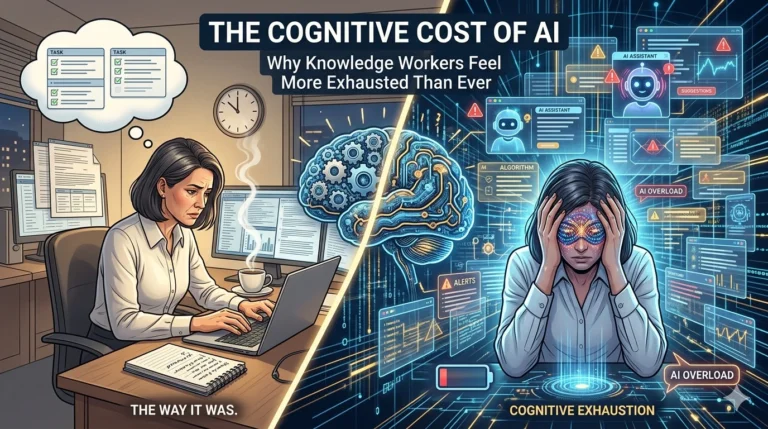
For knowledge workers building their own cognitive workflows, the governance question is personal as well as organisational. Omnisly’s exploration of the cognitive cost of AI and why knowledge workers feel more exhausted than ever addresses what happens when AI tools — including early-stage agents — expand the sphere of what you feel responsible for without reducing the underlying decision load. And the Stoic framework for managing AI-driven workflows explored in Seneca, Marcus Aurelius, and stoic tools for navigating AI decision fatigue offers a philosophical operating system for the moment when your agent returns 47 completed steps and asks you which branch to pursue next.
Frequently Asked Questions
What is the difference between an AI agent and a chatbot?
A chatbot responds to a prompt and waits for the next one — it is reactive and stateless between turns, meaning each interaction is essentially independent. An AI agent pursues a goal across multiple steps without requiring a human prompt at each step — it plans a sequence of actions, executes them using external tools, observes the results, adapts based on what it observes, and continues until the goal is reached or a human decision point is required. ChatGPT in standard use is a chatbot: it responds to your prompt. OpenAI’s Operator product, launched in 2025, is an AI agent: it receives a goal and takes actions on the web autonomously. The structural difference is autonomy — the chatbot waits for you, the agent works toward something. The practical implication for professional users is that agents can be given a defined objective and left to produce results, while chatbots require ongoing human direction through every step of a complex task.
What are the five types of AI agents?
AI researchers and practitioners recognise five categories of increasing sophistication. Simple reflex agents act on immediate inputs using fixed rules — spam filters and thermostat controls are examples. Model-based reflex agents maintain an internal model of the environment, allowing them to handle partially observable situations more intelligently. Goal-based agents can plan a sequence of actions to achieve a specific objective, evaluating paths and selecting the most efficient route. Utility-based agents go further by optimising for a preference function that handles trade-offs between competing objectives — relevant for professional workflows balancing multiple constraints simultaneously. Learning agents incorporate feedback mechanisms that update their model of the world based on the results of their actions, improving performance over time. Most commercially deployed AI agents in 2026 operate in the goal-based or utility-based categories for professional workflows, with learning capabilities layered on top in more advanced deployments.
Are AI agents safe to use in professional settings?
AI agents are production-ready for a meaningful set of professional use cases in 2026, but they require governance structures that match their capability level. The most consistently recommended safeguard is human review at consequential decision points — agents should not take irreversible actions without a human checkpoint. The US executive AI governance order of 2025 directed NIST and the FTC to develop agency-specific AI risk frameworks, and NIST’s AI Risk Management Framework (NIST-AI-600-1) specifically identifies autonomy and tool-use capability as amplifying risk factors requiring additional oversight documentation. Practical risks include agents making multiple API calls when fewer would work, creating compounding costs at scale; agents receiving feedback that reinforces incorrect behaviour over time; and agents in customer-facing contexts producing outputs that carry the same legal accountability as human-generated content under FTC consumer protection standards. The organisations deploying agents most effectively in 2026 treat them as junior team members who need clear scope, defined boundaries, and active oversight rather than as autonomous systems that operate independently.
What is the Model Context Protocol (MCP) and why does it matter for AI agents?
The Model Context Protocol is a standardisation layer developed by Anthropic that governs how AI models connect to external tools, data sources, and services. Before MCP, every AI integration required bespoke connection code between the model and each external tool — a web search integration, a file system integration, a database integration were each custom engineering projects. MCP provides one standard protocol that works across tools and frameworks, significantly reducing the complexity of building and deploying AI agents. By 2026, most major AI frameworks and enterprise tools offer native MCP compatibility. The practical implication for knowledge workers is that agents built on MCP-compatible platforms can access a growing ecosystem of tools without custom integration work, making agent-based workflows significantly more accessible to non-engineers who can configure agents through interfaces rather than code. Google’s A2A (Agent-to-Agent) protocol, introduced in April 2025, extends this further by standardising how agents communicate with and delegate to other agents in multi-agent systems.
How should a knowledge worker start using AI agents in 2026?
The most effective entry point is a well-defined, bounded task with a clear success condition and low consequences for error — research aggregation, content outlining, data extraction, calendar management, or email triage are frequently recommended starting categories. Define the objective clearly before configuring the agent: the quality of your goal specification is the single most consequential variable in agent performance, more important than which platform or model you use. Start with a platform that already provides an agent-building environment — Microsoft Copilot Studio, Salesforce Agentforce, AWS Bedrock Agents, or standalone tools like Cursor for code — rather than building from scratch. Monitor the agent’s outputs actively for the first several sessions to identify where its reasoning drifts from your intent and where checkpoints are needed. Gartner projects 40% of net-new enterprise applications will include AI agent capabilities by the end of 2026, meaning most professional software platforms are adding agent functionality regardless of whether you specifically seek it out — understanding what agents are and how they work is becoming baseline professional literacy in the same way that understanding cloud software was a decade ago.
The Bottom Line
In 2026, agentic AI is no longer experimental — it is in production across software engineering, finance, healthcare, and business operations. The knowledge worker who understands what an AI agent is, which category of agent suits which type of task, and what governance is required to deploy one responsibly is operating with a significantly clearer mental model than the majority of professionals who are encountering agents through product marketing rather than through conceptual understanding.
The operational advantage this clarity produces is not primarily technical. It’s judgment-based: knowing when to give an agent a goal and step back, when to build in a checkpoint, when a task is too consequential for autonomous execution, and when the agent’s output requires verification rather than assumption. Those judgment calls are what determine whether AI agents are a leverage tool or a liability — and they are judgment calls that no agent can make on your behalf.
This article is for informational and educational purposes only. AI capabilities, regulatory requirements, and platform features evolve rapidly. Always verify current specifications directly with providers and consult qualified professionals for guidance specific to regulated industry deployments.