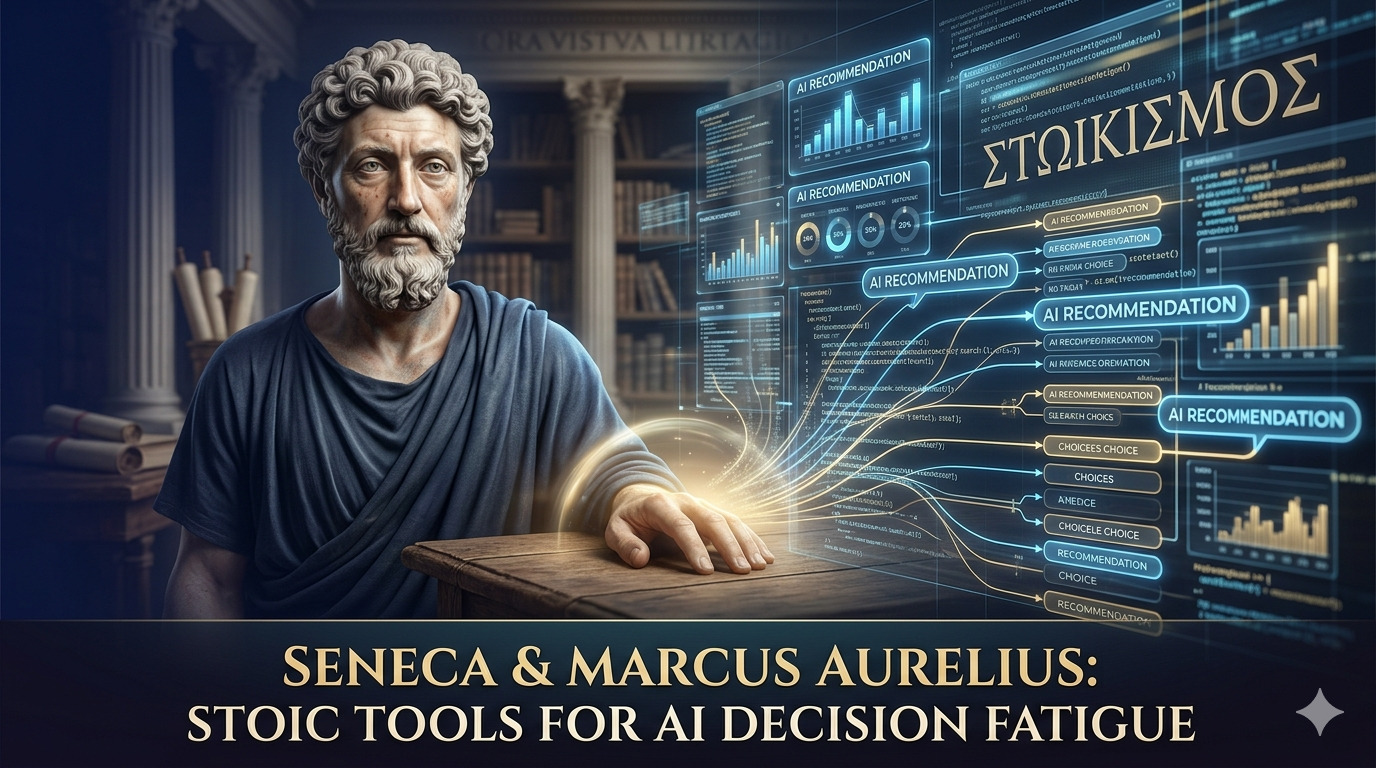
Seneca & Marcus Aurelius: Stoic Tools for AI Decision Fatigue
At some point in the last two thousand years, a Roman Stoic philosopher who managed an empire’s worth of obligations from dawn to dusk, advised an increasingly erratic emperor, and still found time to write 124 letters on the philosophy of daily life looked at his schedule and wrote: “It is not that we have a short time to live, but that we waste a great deal of it.” Lucius Annaeus Seneca said this circa 65 AD. He did not have Slack notifications, an AI inbox assistant suggesting three different tones for his reply, or seventeen browser tabs open across two monitors. And yet the diagnosis is so precise it almost feels personal.
This is the strange gift of Stoicism in 2026: its most urgent teachings aren’t about mortality or virtue in the abstract. They’re about attention. About the cognitive architecture of a day. About what happens to human judgment when it is subjected to an unrelenting stream of decisions — and what two of Rome’s most disciplined minds worked out, without neuroscience or behavioural psychology, about how to protect the quality of thinking across a demanding life. Seneca addressed the attention problem with what amounts to a philosophical operating system. Marcus Aurelius solved the memory and reflection problem with a journaling practice so structurally sophisticated that Notion template designers are still borrowing from it in 2026. Used together — and mapped onto the tools knowledge workers actually use — they form something genuinely useful. Not a self-improvement aesthetic. A working system.
Seneca on the Real Problem With AI Workflows
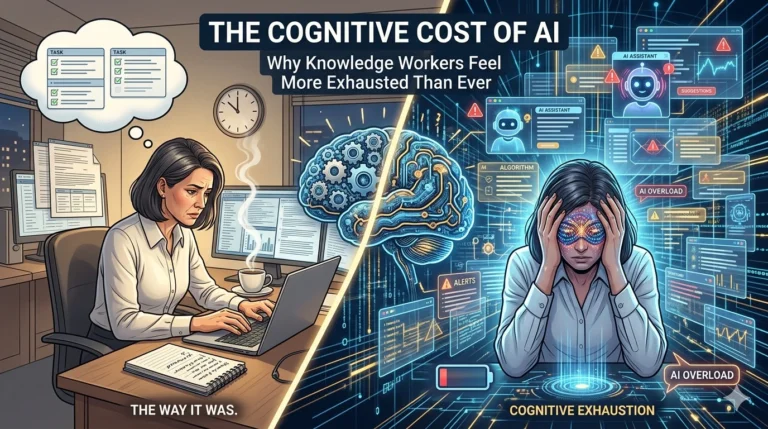
The conversation about AI productivity in 2026 tends to focus on output: how much more you can produce, how many tasks you can delegate to a model, how fast the loop from idea to finished work has become. What it underweights is the cost side of the equation. A Harvard Business Review study by Julie Bedard and colleagues at Boston Consulting Group surveyed nearly 1,500 full-time employees and found a meaningful share reporting symptoms of acute cognitive fatigue linked to heavy AI tool use — particularly when managing multiple AI systems simultaneously. Workers described mental fog, headaches, slower decision-making, and the sense that their thinking had become crowded. Researchers called it “AI brain fry.” Columbia Undergraduate Law Review
Seneca had a name for the underlying mechanism, though he didn’t frame it in neurological terms. In Letters to Lucilius, Letter 1, he wrote: “Hold every hour in your grasp. Lay hold of today’s task, and you will depend less upon tomorrow’s. While we are postponing, life speeds by.” What he was identifying — with remarkable precision — is the cost of deferred attention. Every time you toggle between an AI summary, a Slack thread, and a half-finished document, you are not multitasking. You are paying a switching tax on your cognitive budget, and the accumulation of those taxes is what drains the quality out of decisions made at 4pm.
Decision fatigue represents a shift from deliberative System 2 thinking — slow, analytical, requiring high cognitive resources — to automatic System 1 thinking. As mental energy depletes, the brain defaults to the path of least resistance. The prefrontal cortex, which governs planning, self-control, and complex judgment, is the first to show the effects of sustained cognitive load. Seneca’s practical response to this — recorded across his essays and letters — was structural rather than motivational. He didn’t tell Lucilius to try harder. He told him to reclaim time actively, to identify where attention was being dispersed without purpose, and to assign protected blocks to the work that required genuine thought. SmartDev
Applied to an AI-driven workflow in 2026, the Senecan principle produces a specific intervention: the AI tool should reduce decisions, not add them. If your current AI stack requires you to decide which prompt to use, which output to trust, which tool to route the task to, and which summary to verify — you have added cognitive load in the name of efficiency. The Stoic test for any productivity tool is Seneca’s own criterion: does this return time to me, or does it create the illusion of productivity while consuming the very resource I was trying to protect? The Stoic Decision-Making Framework for high-pressure conditions developed at Omnisly explores exactly this distinction — Stoic triage as an operating principle for determining what deserves your irreplaceable cognitive energy and what should be systematised, delegated, or dropped entirely.
The practical Senecan AI protocol looks like this: one AI tool per category of cognitive work, a defined input format that eliminates prompt decision fatigue, and a strict policy of batch processing AI outputs rather than checking them continuously. Seneca’s most powerful operational insight is captured in Letters to Lucilius 101: “Let us postpone nothing. Let us balance life’s books each day.” The daily balancing metaphor is not poetic — it’s a system. Close the cognitive loops at the end of each day rather than carrying them forward, where they accumulate interest in the form of background anxiety and degraded executive function. In workflow terms, this is the case for a daily AI inbox sweep rather than continuous monitoring — the same logic that makes end-of-day task closure dramatically more effective than leaving things open in the background. Traverse Legal
Marcus Aurelius and the Second Brain He Actually Built
Meditations was not written to be published. It was not called Meditations — Marcus Aurelius titled it To Himself, written in Greek while commanding the Germanic frontier, and it was never intended to be read by anyone but its author. What we have is the private notebook of a working emperor: unpolished, repetitive, structurally peculiar, and almost certainly the most influential journaling practice in Western history. It is also, read carefully, a second-brain architecture two millennia ahead of Tiago Forte.
Marcus Aurelius exercised several distinct methods of journaling. He reflected on his actions and whether he was living in accordance with his principles. He expressed gratitude for people and the lessons he had learned. And crucially — he rewrote Stoic teachings in his own words to deepen understanding. These weren’t separate practices; they were integrated into a single reflective system, written in private, without performance or audience. The structural insight is the absence of an audience. Most modern journaling fails because it’s contaminated by self-presentation — even in private, people perform for an imagined reader. Marcus wrote to himself with such brutal directness that historians occasionally describe Meditations as harsh: he calls himself lazy, distracted, ungrateful, and corrects himself with the same patient relentlessness a Stoic teacher would apply to a student. Thebulldog
Modern researchers studying the “Distanced-Self-Reflection Diary Method” — in which participants are asked to reflect on their struggles using the second person — found that this linguistic technique changes how people process and integrate difficult experiences. Marcus wrote almost entirely in the second person: “You have the power to eliminate this.” “Your soul takes on the colour of your thoughts.” The choice was not stylistic. It was therapeutic — creating just enough psychological distance from the problem to evaluate it rationally rather than react emotionally. Vantagepoint
This is where Notion and second-brain systems get genuinely interesting as an implementation layer, because the distance technique Marcus used can be built directly into a template. The Marcus Aurelius Method as adapted for modern Stoic journaling involves three distinct check-ins: a morning preparation session examining yesterday’s actions and setting today’s intentions, a midday recalibration reviewing whether current behaviour aligns with stated principles, and an evening review assessing what went well, what failed, and what was learned. The four Stoic virtues — courage, justice, temperance, and wisdom — serve as evaluation axes rather than abstract aspirations. Alchemycrew
Mapped onto a Notion database or an Obsidian daily note, this looks like a three-section page with a morning property block (intention + one virtue focus), a linked note for midday capture (any moment where you noticed a gap between principle and action), and an evening review template with four prompts. The evening prompts, drawn from Meditations and adapted:
- What did you do today that you would endorse if you reviewed it in a year?
- Where did you react instead of responding — and what was the actual trigger?
- What would Marcus have written to himself about your behaviour today? (Use second person.)
- What one principle needs reinforcing tomorrow?
The second-brain integration is where the power compounds: each evening review creates a tagged atomic note that feeds into a weekly synthesis, which becomes the raw material for a monthly review, which — over time — produces something Meditations itself represents: a personal philosophy developed through practice, not inherited through consumption. “You could leave life right now. Let that determine what you do and say and think,” Marcus wrote in Meditations 2.11. Paired with Seneca’s “Begin at once to live, and count each separate day as a separate life” from Letters to Lucilius 101, the two give you the morning and evening bookends of a journaling system built on urgency and accountability in equal measure. The Schenk Law Firm
The burnout dimension of this deserves explicit mention. Knowledge workers running on empty cannot produce meaningful reflection — the cognitive prerequisites for genuine journaling are not available when the executive function is depleted. The Quiet Burnout Recovery Playbook for knowledge workers in 2026 identifies the recovery of reflective capacity as a leading indicator of sustainable performance, not a lagging one. This is why the Marcus system’s structural elegance matters: it is designed to be executable even on low-energy days, because the prompts do the cognitive scaffolding. You don’t have to decide what to write about. The system tells you. The Quiet Burnout Recovery Playbook at Omnisly makes the connection explicit — that a structured evening reflection practice is one of the highest-leverage interventions available to knowledge workers managing sustained cognitive load, precisely because it closes the day’s loops rather than carrying them into sleep. MoneyGeek
Where Seneca and Marcus Converge: The Operating System Underneath
The reason these two practices work so well together is that they address different layers of the same problem. Seneca is an operating system for the day — a set of principles for managing attention, protecting cognitive capacity, and making decisions about what deserves your irreplaceable focus. Marcus is a logging and review system — a method for capturing what the day produced, evaluating it against principles, and generating the data that makes next week’s operating system better than this week’s.
“Nothing, Lucilius, is ours, except time,” Seneca wrote in Letter 1. The full sentence is the most compressed productivity philosophy in the Western canon: not hours you can optimise, not outputs you can maximise — time, as the only genuinely scarce resource, and attention as the only genuine way to spend it well. Marcus agrees, but adds the accountability layer: the journal as the place where you verify, daily, whether the choices you made with your time were actually consistent with the person you intend to be. Norton Rose Fulbright
Together they form something that no AI tool currently provides: a workflow that has human judgment at its centre, uses technology at its edges, and treats the quality of thinking as the primary metric — not the volume of output. The Modular Mind framework at Omnisly — which applies systems design to cognitive architecture — is the natural complement to this Stoic foundation. Where Seneca and Marcus provide the philosophical operating principles, the modular systems approach provides the implementation layer: discrete, interchangeable habits that survive schedule disruption and build toward automaticity across weeks rather than requiring heroic consistency every single day.
The combination is not ancient wisdom applied to modern tools for novelty’s sake. It is a coherent response to a genuine problem: that the information density of 2026 work is systematically degrading the quality of human judgment, and that the two most practically effective thinkers in the Stoic tradition solved this problem — in different ways, with different tools — two thousand years before anyone described it as “decision fatigue.”
Frequently Asked Questions
Seneca’s most directly applicable teaching comes from Letters to Lucilius, Letter 1, where he writes: “Nothing, Lucilius, is ours, except time.” His diagnosis of the ancient attention problem — that we allow time to be stolen from us through distraction, postponement, and unfocused busyness — maps precisely onto what modern researchers now call decision fatigue: the documented decline in prefrontal cortex function after sustained executive decision-making. Seneca’s practical response was structural: reclaim time actively, identify where attention is being dispersed without purpose, and protect blocks of focused thought from interruption. Applied to an AI workflow in 2026, the Senecan principle is that any tool should reduce decisions, not add them. If your AI stack requires more choices than it eliminates, it is consuming the very resource you were trying to protect.
Marcus Aurelius journaled in three distinct modes: daily action reflection (did he live in accordance with his principles?), gratitude and lesson capture (what did people and events teach him?), and philosophical rewriting (restating Stoic principles in his own words to deepen internalization). The structural innovation was the second-person voice — writing “you” instead of “I” — which modern researchers have validated as the “Distanced-Self-Reflection Diary Method,” creating enough psychological distance from difficult experiences to evaluate them rationally rather than react emotionally. Unlike most modern journaling advice, which prioritizes self-expression, Marcus’s system was built for self-correction: the journal as daily audit, not daily diary. The Meditations were titled “To Himself” and never intended for publication, which is why they remain the most useful private reflection document in Western history.
Create a daily note template with three sections: a morning block (one intention for the day and one Stoic virtue to focus on, drawn from courage, justice, temperance, and wisdom), a midday capture field (a single sentence noting any moment where you observed a gap between your stated principles and your actual behaviour), and an evening review with four prompts: (1) What did you do today that you would endorse in a year? (2) Where did you react instead of respond, and what was the real trigger? (3) Write one sentence to yourself in the second person about your behaviour today. (4) What one principle needs reinforcing tomorrow? Tag each daily note for weekly synthesis. After four weeks, your review database becomes the raw material for a personal philosophy built through practice — which is exactly what Meditations is at scale.
The Stoic framework applied to AI tool fatigue asks one question before adopting any new tool: does this return time and cognitive capacity to me, or does it create the illusion of productivity while consuming the resource I am trying to protect? Seneca’s criterion — “while we are postponing, life speeds by” — applies directly to tool adoption: every AI system that requires you to learn a new interface, manage a new output format, or make decisions about which summary to trust is a time debt, not a time investment. The Stoic protocol for AI workflows is: one tool per category of cognitive work, a defined input format that eliminates prompt decision-making, and batch processing of outputs rather than continuous monitoring. Harvard Business Review research confirms that managing multiple AI systems simultaneously is a primary driver of the “AI brain fry” cognitive fatigue now widespread among knowledge workers in 2026.
The evidence is consistent and comes from multiple directions. The Distanced-Self-Reflection Diary Method — which replicates Marcus Aurelius’s second-person journaling technique — has been studied with 555 participants and found to change how people process and integrate difficult experiences, reducing the emotional reprocessing loop that characterises burnout. Closing daily cognitive loops through structured evening reflection — the equivalent of Seneca’s “balance life’s books each day” — prevents the background anxiety accumulation that degrades next-day executive function. A 2025 meta-analysis in Mindfulness Journal links structured daily reflection practices to higher habit retention rates and improved psychological recovery from sustained cognitive demand. The Marcus Aurelius system’s key advantage over unstructured journaling is that the prompts do the cognitive scaffolding — it is executable on low-energy days, which is precisely when burnout recovery requires it most.
The Bottom Line
“Life is long, if only you knew how to use it,” Seneca wrote in On the Shortness of Life, Section 2. The sentence has been quoted so often it risks losing its edge. Read it again in the context of a 2026 knowledge worker managing three AI tools, forty-two unread notifications, and a journaling app they opened twice before abandoning: the problem Seneca named is not a shortage of hours. It is a shortage of intentional architecture around how those hours are spent. Roots
Marcus Aurelius had less control over his schedule than almost anyone reading this. He commanded armies, administered an empire, mediated disputes, and dealt with a succession of crises that would constitute a full career’s worth of catastrophe for any modern professional. He still journaled daily. Not because he had spare time. Because he understood that reflection was not a luxury that happened after the work — it was the precondition for doing the work at a level that didn’t gradually degrade the person doing it.
Together, they offer something the productivity industry hasn’t managed to package: a system that treats the human doing the work as the most important variable, cognitive quality as the primary output metric, and time as the only genuinely irreplaceable resource. The tools change. The operating system doesn’t have to.