
The Rise of the AI Generalist: Why Connecting Ideas Beats Specialization
For most of the twentieth century, the advice was consistent across industries, career counsellors, and business schools: pick a lane, go deep, become the person who knows more about one thing than almost anyone else. Specialisation was the rational response to a world that rewarded focused expertise and where the bottleneck in any knowledge-intensive field was the scarcity of people who genuinely understood it at depth. The specialist’s value came from something genuinely hard to acquire — years of accumulated domain knowledge that competitors couldn’t easily replicate.
That logic hasn’t disappeared. But something significant has shifted in how it plays out, and the shift has been accelerated by AI to a degree and at a speed that most career advice hasn’t caught up with. In 2026, PwC’s AI Business Predictions explicitly named the “rise of the generalist” as one of the defining workforce trends of the agentic AI era — describing a broad, organisation-wide move toward outcome-focused roles that can operate across functions rather than within a single disciplinary silo. This isn’t a prediction about the distant future. It’s a description of hiring patterns that are already visible in job listings, salary data, and the kinds of people being promoted into consequential positions at companies that have integrated AI deeply into their operations.
What’s driving it isn’t simply that AI can now do some of the things specialists used to do. It’s something more interesting than that — and it has implications for how people should think about learning, career design, and the cognitive skills most worth developing right now.
The Problem With Deep Expertise in a Wicked World
David Epstein’s Range: Why Generalists Triumph in a Specialized World, published in 2019 and now more relevant than when it was written, introduces a distinction that cuts through most career advice debates with unusual precision. He separates “kind” domains from “wicked” ones. Kind domains have clear rules, immediate and accurate feedback, and repeating patterns — chess is the classic example, where every move has a defined consequence and the same board positions recur in ways an expert can learn to recognise. Deliberate practice works brilliantly in kind domains. Early specialisation works brilliantly in kind domains. Tiger Woods was not wrong to start swinging a golf club at age two.
The Problem With Deep Expertise in a Wicked World
David Epstein’s Range: Why Generalists Triumph in a Specialized World, published in 2019 and now more relevant than when it was written, introduces a distinction that cuts through most career advice debates with unusual precision. He separates “kind” domains from “wicked” ones. Kind domains have clear rules, immediate and accurate feedback, and repeating patterns — chess is the classic example, where every move has a defined consequence and the same board positions recur in ways an expert can learn to recognise. Deliberate practice works brilliantly in kind domains. Early specialisation works brilliantly in kind domains. Tiger Woods was not wrong to start swinging a golf club at age two.
Wicked domains are the rest of it — complex, unpredictable, with incomplete or delayed feedback, shifting rules, and problems that don’t neatly resemble previous ones. Financial markets. Organisational strategy. Product development. Policy. Scientific research at the frontiers where the questions haven’t yet been formalised. Most knowledge work, in other words. In wicked domains, Epstein found through extensive research, the qualities that make specialists so valuable in kind domains — cognitive entrenchment, the deep grooves of a well-practised expertise — can actively impair performance. Experts who go deep in a single discipline can become so certain of their frameworks that they apply them to novel situations where those frameworks don’t fit, and do so with increasing confidence precisely as their accuracy declines.
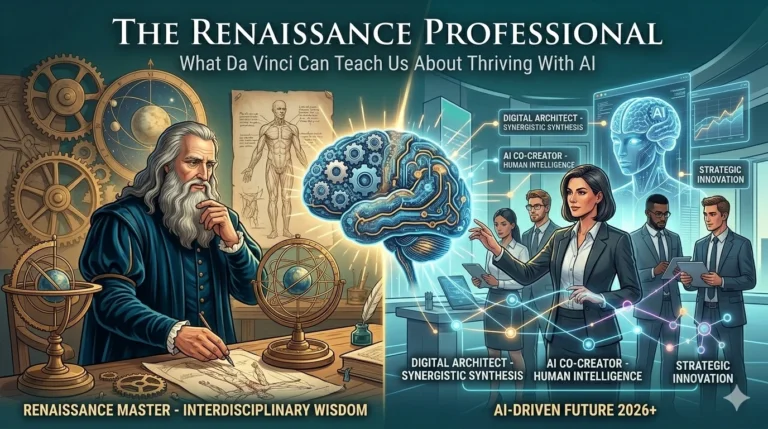
The interdisciplinary thinker, by contrast, has something that makes them structurally better suited to wicked problems: analogical thinking — the ability to import a mental model from one domain and apply it to a problem in another. In one of the most cited studies of expert problem solving ever conducted, an interdisciplinary team of scientists found that successful problem solvers were more able to determine the deep structure of a problem before matching a strategy to it, while less successful solvers classified problems only by their surface features. The generalist, who has seen enough different domains to recognise deep structural patterns beneath different surface presentations, is doing something cognitively different from the specialist who pattern-matches to their own field’s established categories.
As Epstein quotes in Range: “You have people walking around with all the knowledge of humanity on their phone, but they have no idea how to integrate it. We don’t train people in thinking or reasoning.” That line has become more pointed since AI arrived, because AI has dramatically increased the amount of knowledge any individual can access on demand — while making the ability to integrate and reason across that knowledge even more valuable, not less.
What AI Does to the Generalist/Specialist Trade-Off
The conventional threat model for AI’s impact on careers assumed that automation would target generalists first, since specialists’ deep expertise was assumed to be harder to replicate than a generalist’s surface-level breadth. The actual pattern that has emerged in 2026 is nearly the opposite. AI is most immediately effective at tasks with clear structures, well-defined outputs, and repeating patterns — which is to say, it is most effective precisely in the kind of tasks that previously required years of specialist training to perform reliably. Routine legal research. Standardised financial analysis. Template-based code generation. Medical image classification against known diagnostic categories.
Specialists often resist AI adoption because it threatens their core expertise. Generalists see it differently — they view it as a force multiplier that lets them operate across even more domains with greater speed and less friction. A Chief of Staff who uses AI to run research, draft communications, analyse data, and coordinate across teams isn’t just more productive. They’re playing an entirely different game from the specialist whose deep knowledge in one function AI can increasingly approximate. According to 2025 job market data, AI Integration roles have grown 25% year-over-year, while pure specialist roles in copywriting, translation, and routine analysis have contracted. The roles commanding the highest compensation in 2026 — AI Product Manager at $165k–$240k, Chief of Staff (Tech) at $150k–$210k, Growth Operator at $140k–$200k — all require exactly the multi-domain fluency that defines the AI generalist.
PwC’s workforce analysis frames this as the end of the pyramid structure that has organised most large organisations for decades: deeper functions, taller org charts, narrower roles. In that model, the specialist’s job was to go down into a function and come back up with answers. In the agentic AI era, where AI can go down into a function on behalf of anyone with the right prompting skills and contextual judgment, the premium shifts to the people who know what questions to ask across functions — and who can make sense of the answers in relation to one another. Experienced specialists can expand their reach, combining their creativity, experience, and strategic insight with the scale and speed of AI agents. That expansion, however, requires the horizontal range that specialisation historically discouraged.
The Stoic framework explored in Omnisly’s guide to Stoic decision-making for high-pressure conditions is structurally aligned with the generalist advantage: the capacity to triage what deserves your irreplaceable human judgment versus what can be delegated, automated, or systematised is exactly the kind of cross-domain metacognitive skill that AI has made more valuable, not less. The person who can ask “what kind of problem is this?” before deciding how to address it will consistently outperform the person who applies a single domain’s tools to every situation they encounter.
The Cognitive Architecture of the AI Generalist
Understanding why connecting ideas beats specialisation in 2026 requires understanding what connecting ideas actually involves neurologically, because it’s a specific cognitive skill rather than just a personality type or a learning preference. The researchers who study analogical thinking in problem-solving consistently find that the ability to transfer knowledge across domains depends on the richness of your schema library — the collection of abstracted mental models you’ve built from exposure to multiple domains over time.
This is Epstein’s core empirical finding: the most impactful inventors cross domains rather than deepening their knowledge in a single area. He found studies showing that technological inventors increased their creative impact by accumulating experience in different domains compared to peers who drilled more deeply into one — they benefited by proactively sacrificing a modicum of depth for breadth as their careers progressed. The same pattern appeared in artistic creators. The underlying mechanism is that exposure to how problems are structured in multiple domains creates a richer toolkit of abstracted patterns that can be applied analogically to novel situations. The specialist has more tools for problems that resemble problems they’ve seen before. The generalist has more tools for problems that don’t.
What AI has changed is the cost of knowledge acquisition. Before accessible AI, developing genuine range required either an unusually long career with deliberate domain-switching, or an unusually broad educational background, or both. In 2026, the research and synthesis work that used to require years of reading and exposure can be compressed dramatically — which means the barrier to developing useful cross-domain fluency has dropped significantly. The human who can prompt an AI system intelligently to help them understand the deep structure of an unfamiliar domain, then integrate that understanding with their existing schema library, can develop the range that used to take decades in a fraction of the time.
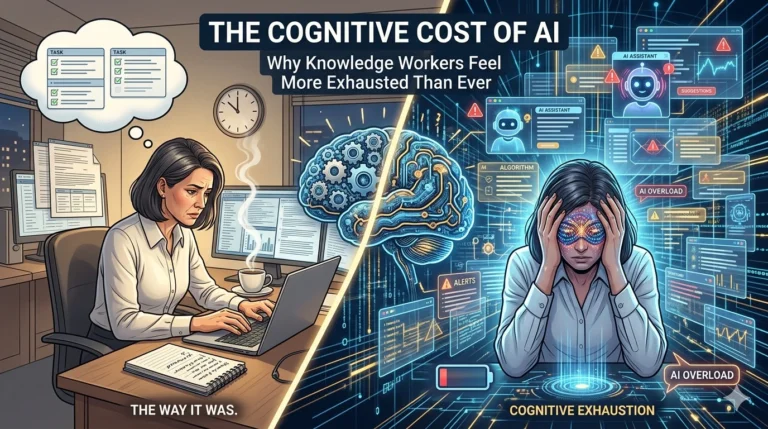
This is where the cognitive cost side of the equation matters. The Omnisly analysis of the cognitive cost of AI for knowledge workers makes clear that AI supervision creates a specific kind of fatigue — the always-on judgment required to evaluate AI outputs continuously. The AI generalist is not immune to this. The difference is in how they manage it: by treating AI as a domain-expansion tool rather than a task-delegation mechanism, and by maintaining the human judgment layer as the integrating function rather than the verification function. Verification is exhausting. Integration is the job.
The M-Shaped Professional: What the AI Generalist Actually Looks Like
The T-shaped professional — deep expertise in one domain, broad fluency across others — was the dominant model for the decade before AI. The concept working its way through talent conversations in 2026 is the M-shaped professional: someone with deep expertise in two or more genuinely disparate fields, and the cross-domain integration skills that let them operate at the intersection. Code and psychology. Design and operations. Finance and narrative. The value isn’t in any single spike. It’s in the ability to translate between them in ways that neither pure specialist can do alone.
The M-shaped model matters because AI is not yet good at translation between domains. It can go deep in a single domain on demand. It can synthesise across domains if the integration frame is provided by the human. What it cannot do reliably is identify which domains are relevant to a problem that appears to be purely in one field, or recognise when the most useful solution imports a model from somewhere unexpected. That judgment — analogical, contextual, experience-dependent — is the irreducible human contribution that the AI generalist provides, and it is the skill that has the longest runway before AI can approximate it.
The building blocks of M-shaped range are specific and acquirable. Start with one domain you understand at genuine depth — not as a collection of facts but as a set of mental models about how problems in that domain are structured. Then deliberately sample adjacent and non-adjacent domains until you find a second one where you can develop comparable depth. The intersection becomes your most valuable territory. The Modular Mind framework at Omnisly — which applies systems design thinking to personal cognitive architecture — is a practical template for building this kind of cross-domain competency in discrete, manageable modules rather than treating “become a generalist” as a single overwhelming ambition.
The pattern Epstein documents across athletes, artists, scientists, and inventors is that the sampling period — the phase that looks inefficient and directionless from the outside — is precisely what builds the schema richness that makes the eventual focused contribution so distinctive. You cannot connect ideas you haven’t encountered. You cannot apply analogical thinking across domains you haven’t lived in long enough to understand their deep structure. The AI generalist’s greatest long-term advantage is not tool fluency. It’s the accumulated range that makes tool fluency genuinely generative rather than merely efficient.
Frequently Asked Questions
An AI generalist is a professional who combines cross-domain knowledge with the ability to leverage AI tools fluently across multiple business functions — strategy, operations, content, data analysis, product development — without being limited to a single specialty. Unlike a traditional generalist, who traded depth for breadth and often found themselves outcompeted by specialists for high-value roles, the AI generalist uses AI to achieve specialist-level output in multiple domains simultaneously. The shift matters because AI has lowered the execution cost of specialist knowledge tasks, making the value premium shift from domain depth to cross-domain integration — the ability to identify which domains are relevant to a problem, apply the right tools, and synthesise the outputs into coherent strategic direction that pure specialists in any single domain cannot produce alone.
In Range: Why Generalists Triumph in a Specialized World, Epstein distinguishes between “kind” domains — chess, golf, where rules are clear and feedback is immediate — and “wicked” domains, where rules are unclear, feedback is delayed, and problems rarely repeat in recognisable patterns. He found that specialists excel in kind domains but underperform in wicked ones, where the cognitive entrenchment from years of deep domain focus can actually impair performance by causing experts to apply their frameworks to problems where those frameworks don’t fit. Generalists, who have broader schema libraries from exposure to multiple domains, are better equipped for analogical thinking — applying a mental model from one domain to solve a structurally similar problem in another. Most real knowledge work, from strategy to innovation to policy, is a wicked domain. Epstein’s research found that the most impactful inventors cross domains rather than deepening their knowledge in a single area, and that technological inventors increased their creative impact by accumulating experience across fields compared to peers who specialised further.
The M-shaped professional is an evolution of the T-shaped model (deep in one domain, broad across others). An M-shaped professional has genuine depth in two or more genuinely disparate fields — for example, coding and psychology, or finance and narrative communication — plus the cross-domain integration skills that allow them to operate productively at the intersection of those domains. The concept is gaining traction in 2026 because AI has made single-domain depth less differentiating: AI tools can approximate specialist knowledge in well-defined domains on demand. The human value that AI cannot replicate is the ability to recognise which domains are relevant to a novel problem and translate intelligently between them — which requires having genuinely internalised at least two domain frameworks, not just surface familiarity with many. According to 2025 job market data, the highest-compensating roles emerging in the AI era — AI Product Manager ($165k–$240k), Chief of Staff (Tech) ($150k–$210k), Growth Operator ($140k–$200k) — all require multi-domain M-shaped competency rather than single-domain specialisation.
No — but the value proposition of specialisation is shifting. In domains with clear rules, repeating patterns, and well-defined outputs, AI increasingly approximates what specialists do; this is most visible in routine legal research, standardised financial modelling, template-based code generation, and medical image classification. In domains requiring deep contextual judgment, ethical reasoning, physical presence, or creative insight at the knowledge frontier, specialist expertise remains essential and is being augmented rather than replaced by AI. The most durable career positions in 2026 combine genuine domain depth in at least one area — the vertical bar of the T — with enough cross-domain fluency to act as an integration layer between that expertise and other functions. PwC’s 2026 AI Business Predictions describe this as a move toward broader, outcome-focused roles where specialists expand their reach by combining their creativity and experience with the scale and speed of AI agents.
David Epstein’s research suggests the most effective path is a deliberate “sampling period” before committing deeply to any single domain — and that this period, which can feel inefficient from the outside, is precisely what builds the schema richness that makes eventual contributions distinctive. Practically, in 2026 this means: identify one domain where you already have genuine depth (not just familiarity), then deliberately engage with a second non-adjacent domain until you understand its deep structure, not just its surface vocabulary. Use AI to compress the knowledge acquisition phase — AI can help you understand the architecture of an unfamiliar domain in hours rather than months. Then practise analogical thinking explicitly: when you encounter a problem in your primary domain, ask whether its deep structure resembles a problem you’ve seen in the second domain, and whether the solution framework transfers. This cross-domain translation capacity is the irreducible human contribution that the AI generalist provides, and it compounds with each additional domain you develop genuine fluency in.
The Bottom Line
The question “generalist or specialist?” was always slightly wrong, because it assumed these were stable categories in a stable environment. What 2026 has made clear is that the environment is not stable, and the most valuable cognitive architecture is the one that’s most adaptive to an unpredictable domain — which is, as Epstein documented exhaustively, the generalist’s native territory. Wicked domains, where most meaningful work happens, reward range. AI has made that reward larger, not smaller, by lowering the execution cost of specialist knowledge while leaving the integration and translation work entirely to humans.
The AI generalist isn’t the person who knows a little about everything and is AI-assisted across all of it. They’re the person who has built genuine range across multiple domains, uses AI as a force multiplier at each intersection, and can do what neither a pure specialist nor an AI can do alone: synthesise across the gaps between fields to find solutions that don’t exist inside any single discipline’s established categories.
That capacity — for connection, translation, and analogical insight across domains — is not a soft skill. It’s the primary cognitive output that the most valuable knowledge workers in 2026 are producing. And it is, almost certainly, what the most valuable ones will be producing for the foreseeable future.
External Sources
- David Epstein — Range Official Author Site (https://davidepstein.com/range/)
- PwC — No More Pyramids: Rise of the Generalist, Agentic AI Workforce (https://www.pwc.com/us/en/tech-effect/ai-analytics/agentic-ai-workforce-redesign.html)
- VentureBeat — Hiring Specialists Made Sense Before AI, Now Generalists Win (https://venturebeat.com/ai/hiring-specialists-made-sense-before-ai-now-generalists-win)
- Chief of Staff Network — The Generalist Advantage (https://www.chiefofstaff.network/blog/the-generalist-advantage-why-the-future-belongs-to-multi-skilled-operators)
- The Global Frame — How to Become an AI Generalist 2026 (https://theglobalframe.com/ai-generalist-career-skills-guide/)
- JOSPT — Range Applied to Expert Problem Solving (https://www.jospt.org/do/10.2519/jospt.blog.20200909/full/)
- Graham Mann — Range Book Notes, Wicked vs Kind Domains (https://grahammann.net/book-notes/range-why-generalists-triumph-in-a-specialized-world-david-epstein)