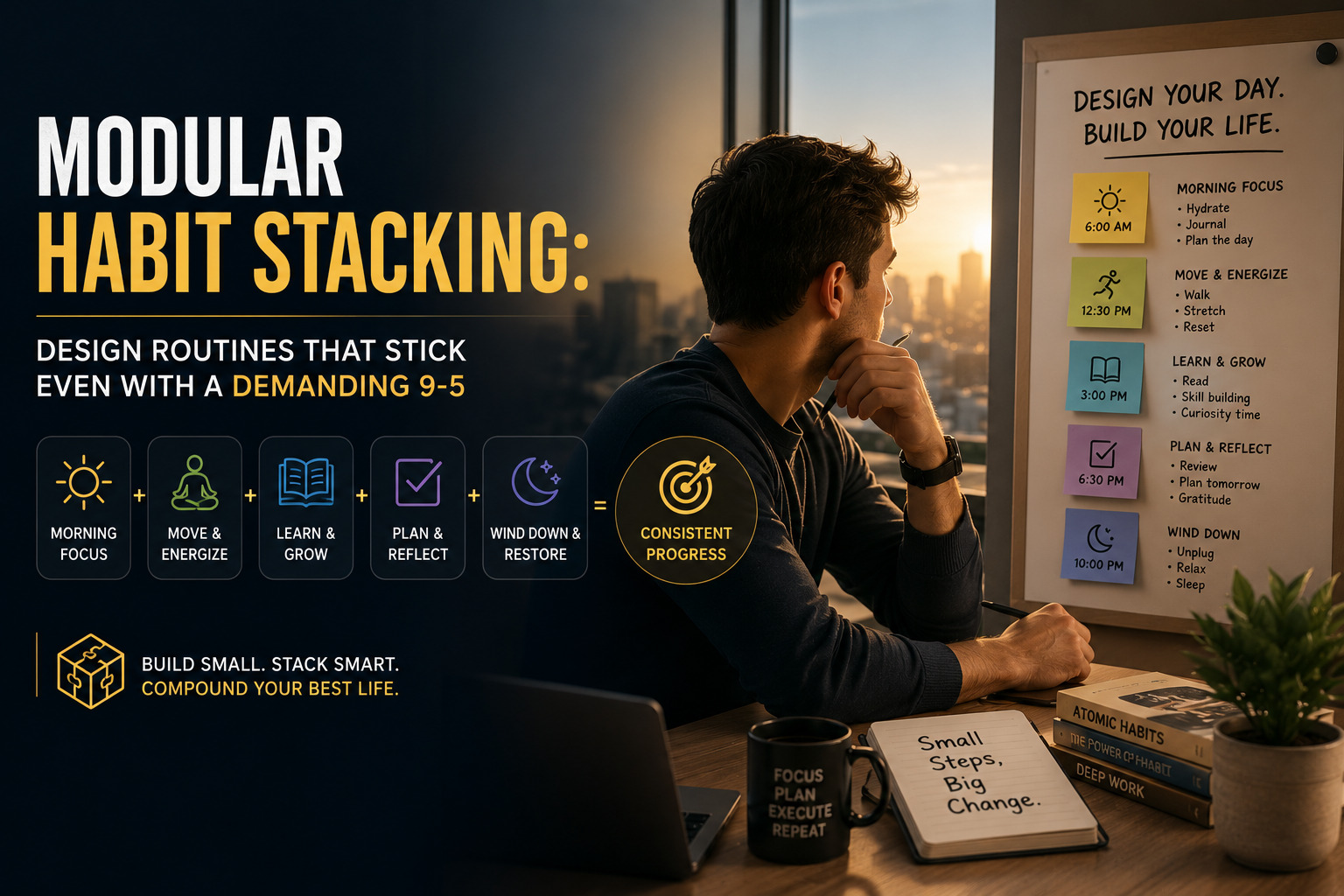
Modular Habit Stacking: Design Routines That Stick Even With a Demanding 9-5
There’s a particular kind of frustration that hits somewhere around February each year — or Monday morning, or the third week of a new routine — when the system you designed for yourself during a calm, optimistic moment collides with the reality of a demanding job, back-to-back meetings, a commute that took forty minutes longer than expected, and the cumulative weight of a thousand small decisions that have quietly drained everything you had left. The habit dies not because you lacked discipline. It dies because you designed it for a different person — a version of yourself with more time, more energy, and a schedule that actually behaved the way you planned it.
This is the problem that modular habit stacking solves, and it’s a systems design problem before it’s a motivation problem. A 2025 study in the Journal of Applied Psychology found a 64% higher success rate with habit stacking compared to creating standalone habits. Cue-based learning forms the foundation — your brain uses existing automatic routines as reliable signals to trigger new behaviors, which reduces the conscious decision-making load to near zero. But the standard advice about habit stacking — “attach a new habit to an existing one” — is the equivalent of being handed a single LEGO brick and told to build a house. The concept is right. The implementation for a life that looks anything like a modern 9-5 requires considerably more architectural thinking. NPR
What Software Engineers Know That Productivity Writers Don’t
Modular design is a foundational concept in software engineering. Rather than writing a single monolithic block of code that performs every function the system needs, you build discrete, interchangeable modules — each doing one thing well, each capable of being replaced, updated, or rearranged without breaking everything else. When something fails, you fix the module. You don’t rewrite the entire system.
This is exactly how durable habit routines work, and the reason most people’s self-improvement attempts fail is that they build monoliths instead. The 6am routine that requires waking early, journalling, exercising, meditating, and preparing a nutritious breakfast is not a habit stack. It’s a monolith — an all-or-nothing architecture that collapses entirely the morning your alarm doesn’t go off or your child wakes up sick. When one component fails, the whole morning is “ruined,” and the psychological aftermath of that failure makes the next morning harder, not easier.
Omnisly’s deep dive into The Modular Mind: How to “Code” Your Habits Using Systems Design applies exactly this thinking to personal development — the idea that we’re not a single steering wheel but a collection of subsystems, and that designing for the modular reality of how we actually work is more powerful than trying to force unified willpower against a resistant world. The insight is architectural: stop trying to be consistent and start trying to build a system that makes consistency the path of least resistance.
BJ Fogg, founder of the Stanford Behavior Design Lab, formalised “anchor habits” in his Tiny Habits method — the recipe being “After [ANCHOR], I will [NEW BEHAVIOR],” followed by a brief celebration. Fogg has been teaching this model since 2011, and the research supports it: the existing habit acts as the cue for the new one, so you don’t add a new alarm or reminder — you let an existing routine do that work. The modular extension of this is to stop thinking in terms of single anchor-to-habit pairs and start thinking in terms of anchor clusters — grouped by time of day, energy state, and location — so that the failure of one component doesn’t cascade through the entire system. Datatechandtools
The Cognitive Budget Problem That Nobody Is Talking About Honestly
Here’s what the productivity industry tends to gloss over: the human brain has a finite daily budget for deliberate decision-making, and a demanding job spends that budget aggressively before you’ve even got home. Decision fatigue represents a shift from deliberative System 2 thinking — slow, analytical, requiring high cognitive resources — to automatic System 1 thinking. As mental energy wanes, the brain defaults to the path of least resistance, leading to choices that are faster and easier but often less optimal. The key anatomical player is the prefrontal cortex, the seat of executive functions including planning, self-control, and complex decision-making. By 5:30pm on a Tuesday, your prefrontal cortex has done a full day’s work. Expecting it to also govern a new exercise habit, a journalling practice, and a healthy cooking routine on the same evening is like asking your most productive employee to stay and work a double shift every single day. SmartDev
Time Anchors, Location Anchors, and the Stack That Travels
One of the underappreciated insights from habit science is that anchors don’t have to be time-based. Location and context are equally powerful cues — sometimes more powerful, because they don’t depend on clocks. Habit stacking relies on cue-based behaviour. This reduces the need for conscious decision-making. Over time, repetition increases automaticity and the brain begins to link the two habits, making the new habit part of the same neural pathway as the old one — associated with neural processes involving the basal ganglia, a brain region linked to routine behaviours. Damiencharlotin
Designing for Failure: The Recovery Protocol as a Core Module
Most habit systems are designed for success. Modular habit stacking, done properly, is equally designed for failure — because failure is not an exception to the system. It’s a scheduled event that the architecture needs to handle gracefully. Habit researcher Phillippa Lally’s landmark University College London study found that missing one day did not measurably hurt habit formation. Missing several days in a row did slow progress. The median time to automaticity was 66 days, with a range of 18 to 254 days depending on the individual and the habit. Datatechandtools
The Minimum Viable Stack for a Demanding Schedule
Applied practically, here is what a modular habit stack looks like when designed for a genuinely demanding schedule — one with variable hours, unexpected demands, and a cognitive budget that reaches its floor before dinner. The principle is ruthless minimalism: three modules per day, each taking under ten minutes individually, each anchored to an existing automatic behaviour.
Module One — Morning Anchor: After making your first drink of the day, spend five minutes planning the single most important task. Not a full planning session. One task. The anchor is the drink preparation; the module is the decision. This stack fires whether you’re at home or in the office, early or slightly late, caffeinated or not quite yet.
Module Two — Transition Anchor: After you close your laptop or finish your last work call, take three slow breaths before checking your phone. The anchor is the end-of-work signal; the module is a physiological state reset. Creating routines for recurring transitions reduces the mental load associated with context-switching — a principle applied by high-performing executives who batch low-stakes decisions to preserve cognitive capacity for high-stakes ones. Traverse Legal
Frequently Asked Questions
Modular habit stacking is a systems design approach to building routines in which each new behavior is treated as a discrete, interchangeable module attached to an existing automatic anchor — such as making coffee, commuting, or brushing teeth. Unlike a monolithic morning routine that requires everything to work perfectly to produce any benefit, a modular stack is designed so that each module functions independently. If one module fails on a given day, the others continue to fire. The term draws on software engineering principles: build small, self-contained components that do one thing well and can be replaced or rearranged without breaking the overall system.
A normal routine is time-based and typically sequential — you do A, then B, then C, starting at a fixed time. Habit stacking is cue-based and anchor-dependent: each behavior is triggered by the completion of the previous one, or by a contextual signal like a location or sensory event, rather than by the clock. A 2025 study in the Journal of Applied Psychology found a 64% higher success rate with habit stacking compared to standalone habit formation. The cue-based architecture reduces conscious decision-making to near zero once automaticity develops, making the routine far more resilient to schedule disruption than time-based alternatives.
According to a landmark study by Phillippa Lally and colleagues at University College London, published in the European Journal of Social Psychology, the median time to habit automaticity is 66 days — but the range spans from 18 to 254 days depending on the individual and the complexity of the habit. Missing a single day does not measurably hurt the process. Missing several consecutive days does slow progress, which is why having a predefined recovery protocol — a minimum viable version of the habit to perform within 24 hours of missing it — is a critical component of any durable habit stack design.
The most common structural failure is designing habits for a cognitive and energy state that a demanding schedule depletes before the habit fires. Decision fatigue — the documented decline in prefrontal cortex function after sustained executive decision-making — means that habits placed at the end of a cognitively demanding day have far less psychological fuel available than the same habits placed at the beginning. The modular fix is to map your habits to your actual energy curve: high-effort habits in the morning before cognitive load accumulates, low-effort habits in the evening when the decision-making budget is spent. A demanding job doesn’t make habit formation impossible — it makes thoughtful architectural design essential.
Three modules per day, each under ten minutes, each anchored to a behaviour you already perform without fail: (1) After making your first drink of the morning, identify your single most important task for the day — two minutes maximum. (2) After your last work commitment ends, take three slow, deliberate breaths before touching your phone — thirty seconds. (3) After brushing your teeth at night, write one sentence about something that went well — thirty seconds. Total daily time investment: under five minutes. Each module fires independently from a fail-proof anchor, survives schedule disruption, and contributes to planning, stress recovery, and positive psychology respectively — covering the three domains most impacted by a demanding 9-5 job.
The Bottom Line
The reason most habit advice fails people with demanding schedules isn’t that the advice is wrong. It’s that it was designed for a lifestyle with slack in it — a calendar with breathing room, a cognitive budget that isn’t spoken for before noon, a schedule that cooperates with your best intentions. According to a 2025 study by the American Psychological Association, individuals who adopt consistent habit-forming techniques are 50% more likely to meet their long-term objectives — and in 2026, with remote work, AI integration, and constant connectivity making effective habits even more vital, the need for systems that actually survive real working conditions has never been more urgent. Embroker