
|

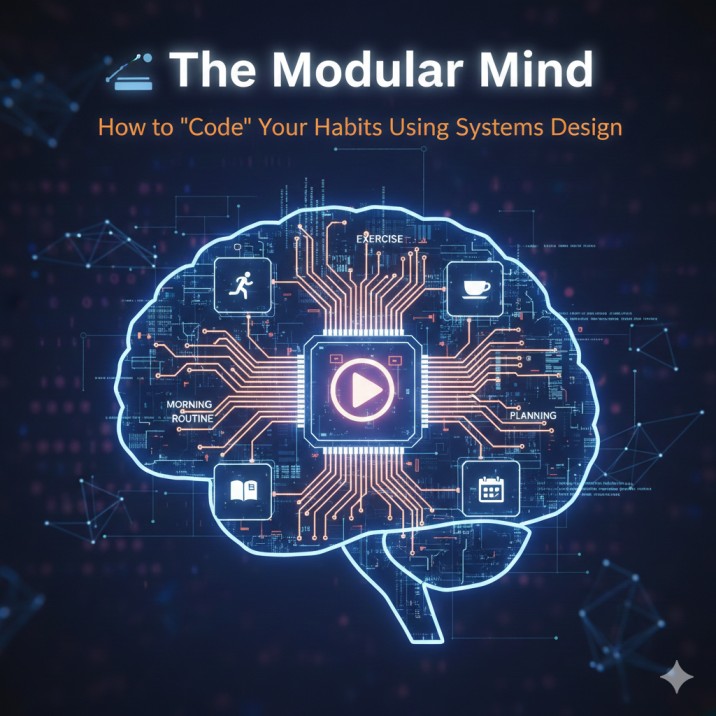
The Modular Mind: How to “Code” Your Habits Using Systems Design

Software engineers figured something out decades ago that productivity writers are only now catching up to – the modular mind: the biggest enemy of a complex system isn’t any individual failure. It’s coupling — the condition where one failing component takes everything else down with it. The morning routine that collapses entirely because you woke up late. The entire discipline of the week dissolving after one missed gym session. The quarterly goal abandoned because a bad November distorted the whole calendar. These aren’t willpower failures. They are architectural failures. You built a monolith and called it discipline.

The engineers who built Amazon’s original system made exactly the same mistake. A single connected codebase meant that adding a feature required understanding the whole thing. Then they built walls — modules with defined inputs, defined outputs, and no knowledge of each other’s internal workings. The same principle that made Amazon scale is the principle that makes habits stick under the pressure of an actual life.

Cognitive architectures help engineers think beyond single AI models by treating intelligence as a system design problem — a principle that, when applied to the design of personal behaviour systems, transforms how we think about habit failure and habit resilience. This guide is about applying that principle concretely. Not as a metaphor. As an operating method.

Why Your Habits Are a Tangled Codebase

Consider the anatomy of a typical productivity system: you wake at 6am, journal, exercise, meditate, shower, eat a healthy breakfast, do deep work by 8:30, take structured breaks, batch emails, review your day at 5pm, and prepare tomorrow’s priorities before 9pm. This is sold as a morning routine. What it actually is, from a systems perspective, is a monolithic architecture — one long sequential chain in which every step depends on the successful completion of the previous one, with no isolation between components.

The most influential cognitive framework in computational psychology is ACT-R, developed by John Anderson at Carnegie Mellon — which describes cognition as a set of interacting modules: declarative memory for facts, procedural memory for skills, and a central goal system that coordinates behaviour without requiring any single module to know the internals of another. The brain, in other words, was not designed as a sequential chain. It was designed as a modular system. When your procedural memory for riding a bike is operational, it doesn’t require your declarative memory for the physics of balance to also be working. The modules are independent.

Your habits can be the same. But only if you design them that way.

The Core Principle: Encapsulation

The central concept borrowed from software design is encapsulation — the idea that each module should contain its own logic, its own state, and its own failure conditions, without leaking those details into adjacent modules.

The Modular Cognition Framework, established in academic cognitive science, defines the architecture of the mind through a key principle: each module is designed with predefined interaction points through which it communicates with other modules — but the inner working of each module is unknown to others, and each module can only interact using those predefined channels. Applied to habits, this means your morning module doesn’t need to know what the evening module is doing. Your deep work module doesn’t need the gym to have happened. Each module activates on its own trigger, does its own thing, and hands off cleanly — or fails cleanly, without contaminating adjacent modules.

A December 2025 modular cognitive architecture framework for assisted reasoning found that 21 participants rated modular divisions as highly intuitive and useful for organising thought and expanding analytical viewpoints — confirming that when modular structure is made explicit, people understand and use it naturally. The structure isn’t foreign to how the mind works. It’s how the mind already works when we don’t override it with poorly designed systems.

Building Your Habit OS: The Four Core Modules

Here is a working architecture for a knowledge worker’s daily system. These four modules cover the full operational cycle of a productive day, and they are deliberately designed to be independent — meaning that if one fails, the others still run.

Module 1: The Boot Module (Morning Activation)

Purpose: Transition from sleep state to operational cognitive state.

Inputs required: Physical wakefulness only. Nothing from yesterday’s performance.

Internal operations: Hydration (500ml water), 10 minutes of physical movement (walk, stretch, or equivalent), one written priority for the day. Total time: 20 minutes.

Output/completion signal: You have written down the single most important thing you will do today.

Failure mode: If you wake up late, the Boot Module compresses to its minimum viable version — water and one written priority. It does not require the full 20 minutes to complete. The output is the same. The deep work session still starts.

Key design rule: The Boot Module does not include email, news, or social media. These are inputs from external systems, and they belong to different modules. Mixing them into Boot corrupts its purpose.

Module 2: The Core Module (Deep Work Production)

Purpose: Execute the highest-value cognitive work of the day.

Inputs required: The completion signal from Module 1 (your written priority) and a protected time window. Nothing else.

Internal operations: Single task from the priority written in Module 1. No context-switching. 90-minute default duration with a hard stop regardless of progress.

Output/completion signal: You have spent 90 minutes on the priority task. Whether you finished it is irrelevant to whether the module completed.

Failure mode: If Module 1 failed entirely, Module 2 still activates at its scheduled time. The priority can be set at the start of Module 2 if it wasn’t set at the start of the day. The module runs independently.

Key design rule: The Core Module is not extended beyond 90 minutes. Overriding this creates a monolithic structure that bleeds into Module 3 and destroys the whole architecture.

Module 3: The Recovery Module (Cognitive Maintenance)

Purpose: Restore prefrontal cortex function degraded by sustained cognitive effort.

Inputs required: Completion signal from Module 2.

Internal operations: Physical movement outdoors or physical movement without screens for 20 to 30 minutes. No work-related content. Carnegie Mellon University’s Human-Computer Interaction Institute found in 2026 that the average focus recovery time after digital interruption is 26.8 minutes — making a 30-minute non-screen physical break the minimum viable recovery period for sustained knowledge work.

Output/completion signal: 20 to 30 minutes of non-screen physical activity completed.

Failure mode: If the full 30 minutes isn’t available, the module compresses to 10 minutes of any physical movement. The module does not skip. Skipping Module 3 degrades Module 4.

Module 4: The Shutdown Module (Day Closure)

Purpose: Close open cognitive loops and prevent carry-over into recovery time.

Inputs required: Completion signal from Module 3. End of structured work window.

Internal operations: A written answer to three questions — What did I complete today? What is incomplete and needs to move to tomorrow? What is the single most important thing for tomorrow? Estimated time: 10 minutes.

Output/completion signal: Tomorrow’s Module 1 priority is already written. You know your shutdown is complete because it has a defined output.

Failure mode: If Module 4 is missed entirely, Module 1 tomorrow writes the priority fresh. The system does not require yesterday’s Module 4 to function. It starts fresh.

The Interface Layer: Connecting Modules Without Coupling Them

The genius of modular design is in the interfaces — the minimal handoff between modules. The architectural recommendation in enterprise modular design is to define clear internal module boundaries from the start and only share the minimum necessary information between modules, never the internal state — this is what makes the system resilient to failure in one component. In your habit architecture, the interface between modules is always the same: a single completion signal, ideally written or physical, that marks the boundary.

The boundary is physical or written for a reason. The human working memory is not a reliable interface — telling yourself “that module is done” doesn’t reliably fire the next module. Writing the completion signal (your priority, your shutdown note) or completing a physical action (putting on your gym shoes, making coffee) creates an external cue that the next module’s trigger can reliably read.

Research from June 2026 published on arXiv shows that large language models develop modular neural architectures that mirror human brain specialisation — suggesting that modularity is not an artificial constraint but a fundamental property of intelligent systems operating under resource constraints. Your brain is already trying to modularise. Poor habit design fights that tendency. Good habit design works with it.

Version Control: Upgrading Without Breaking the System

Software developers don’t rewrite their entire codebase when they want to improve something. They update a module, test it in isolation, and deploy it without touching the others. Your habit architecture should work the same way.

If your Boot Module isn’t working — you’re skipping the movement, the priority is vague — you debug that module alone. You change the movement to something easier. You change the priority format to a fill-in-the-blank template. You don’t also restructure the Core Module and the Shutdown Module at the same time. That’s not optimisation. That’s the monolith failing again under a different name.

The practical versioning protocol: review one module per month. Identify one friction point. Change one element. Run it for three weeks. Evaluate before touching anything else. This is how robust systems evolve — incrementally, with clear causality between the change and the outcome.

For knowledge workers integrating AI tools into their workflows, the modular principle becomes even more important. When an AI tool is added to your Core Module, it changes that module’s internal operation without needing to touch Module 1 or Module 3. The AI becomes a component within the module, not a replacement for the system’s architecture. Our exploration of the rise of the AI generalist and how to build durable advantage through multi-domain thinking addresses how this kind of system-level thinking compounds over time. And the cognitive cost of poorly integrated AI tools — explored in our analysis of why knowledge workers feel more exhausted than ever in the AI era — is often traceable to AI being added to a monolithic workflow rather than a modular one.

For the full practical implementation of modular habit stacking, our companion guide on designing routines that stick even with a demanding 9-5 using modular stacking provides the implementation detail that this architectural overview points toward.

Frequently Asked Questions

What is a modular habit system and how is it different from a routine?

A modular habit system is a set of independent behavioural units, each with defined inputs, internal operations, and outputs, that connect through minimal interfaces rather than sequential dependency. A routine is a chain — each step follows the previous one, and failure at any step typically breaks the chain. A modular system is resilient by design: each module activates on its own trigger and has its own defined failure mode, meaning the failure of one module does not cascade into the others. The practical difference is that on a difficult day — late waking, disrupted schedule, unexpected demands — a modular system continues running in reduced form, while a routine collapses entirely. The modular approach applies the software engineering principle of encapsulation to personal behaviour design.

How many modules should a daily habit system have?

Four is the recommended starting number for a knowledge worker’s daily system: a Boot Module for morning activation, a Core Module for deep work production, a Recovery Module for cognitive maintenance, and a Shutdown Module for day closure. This covers the complete operational cycle without creating so many modules that the interface layer itself becomes cognitive overhead. Adding more modules is appropriate when a specific function consistently breaks under the four-module architecture — but the rule is to start minimal and add modules only when there is evidence of a gap, not proactively. Each additional module adds an interface point that must be maintained, which itself has a cognitive cost. The goal is a system that runs reliably in the background, not one that requires constant conscious management.

What is the completion signal and why does it matter?

A completion signal is the specific output that marks a module as done and triggers the transition to the next state. It is physical or written rather than cognitive — the brain’s working memory is not a reliable interface between modules because it is subject to interference, distraction, and state-dependent degradation. A written priority (Boot Module output), the closure of a specific application (Core Module output), a physical return from a walk (Recovery Module output), or a written shutdown note (Shutdown Module output) are all reliable completion signals because they exist outside the cognitive system and can be read unambiguously by the next module’s trigger. Without a defined completion signal, modules tend to blur into each other, recreating the monolithic sequential structure that modular design is specifically trying to avoid.

How do I handle days when multiple modules fail simultaneously?

A genuine multi-module failure day — illness, emergency, travel disruption — triggers what systems designers call a graceful degradation protocol: the system runs in minimum viable mode rather than optimal mode. For a four-module habit architecture, minimum viable mode is: one written priority for the day (minimum Boot Module), any period of focused work on that priority (minimum Core Module), and a shutdown note confirming what was done (minimum Shutdown Module). The Recovery Module compresses to any five minutes of non-screen physical movement. The critical rule is that minimum viable mode is still the system running — not the system suspended until conditions improve. Suspending the system until conditions are ideal is the decision that produces the multi-week collapses that most people experience after a disrupted period. The system runs in degraded form; it does not pause.

Can modular habit design work for creative or non-structured professional roles?

Modular design is particularly well-suited to creative and non-structured roles because its architecture is outcome-based rather than time-based. The Core Module specifies what the session is for — the highest-value creative or intellectual work — not what specific task will fill the time. A writer’s Core Module produces words on the primary project; a designer’s produces progress on the primary design problem; a researcher’s produces engagement with the primary research question. The module doesn’t dictate the content of the work, only its category and its duration. This makes the architecture compatible with the non-linear, variable, and exploratory nature of creative work, while still providing the structural reliability that prevents creative professionals from spending their peak cognitive hours on email, meetings, and administrative tasks that belong in different modules.

Conclusion

The monolith fails under stress because it has no isolation. Every component knows about every other component, which means every failure propagates everywhere. Your habits fail for exactly the same reason when they are designed as a single chain rather than as a system of independent modules.

The architectural principle that made Amazon scale — autonomous teams with authority over specific product domains, each operating through defined interfaces without visibility into each other’s internals — is the same principle that makes a daily habit system resilient under the conditions of an actual working life. You are not lacking discipline. You may be running a poorly architected system.

The four modules above are a starting point, not a prescription. Debug the ones that fail. Compress the ones that are too heavy. Define the interfaces more precisely where you find yourself confused about where one module ends and the next begins. Version one of your modular habit system will not be the final version. That’s the point. You’re building something you can improve without rebuilding from scratch.

This article is for informational and educational purposes only. Always consult qualified health or mental performance professionals for personalised guidance on cognitive wellness and productivity strategies.

Similar Posts

Leave a Reply

Your email address will not be published. Required fields are marked *