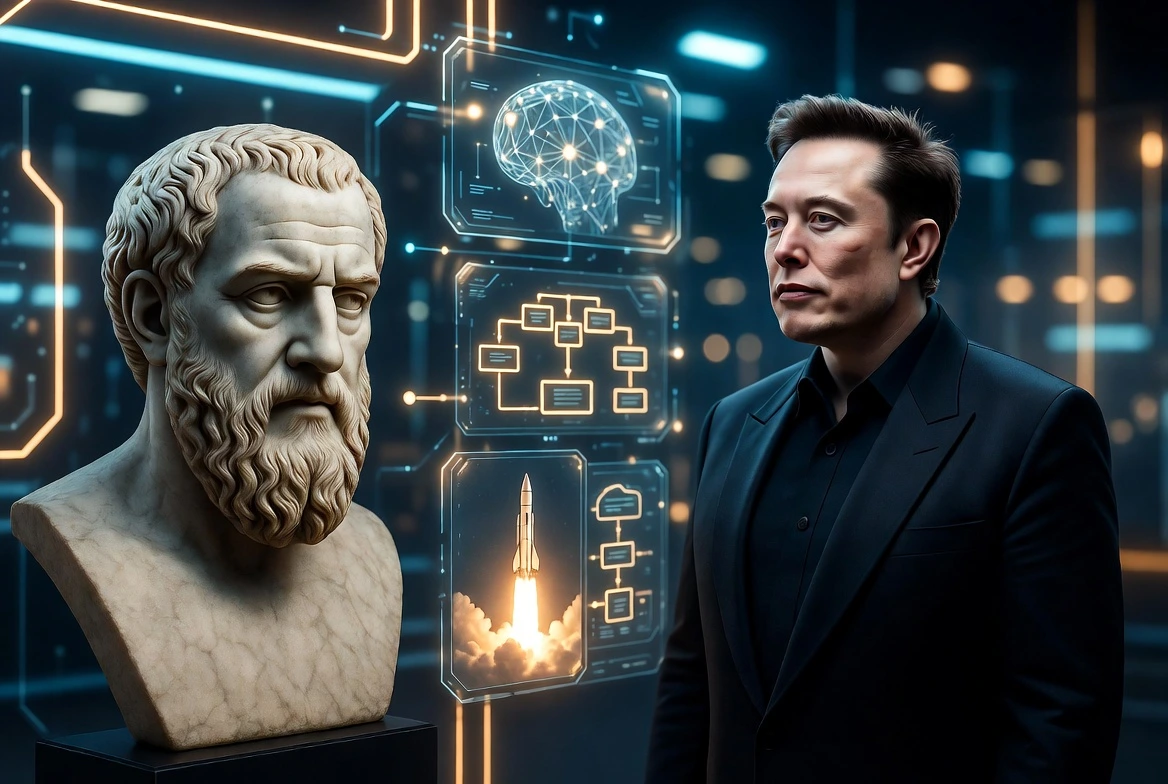
Elon Musk, Epictetus & Lean Thinking: What Ancient Philosophy Teaches Modern Founders in 2026
Last week, as Tesla quietly shelved yet another ambitious but ultimately wasteful project, Elon Musk reminded his team: “The best part is no part.” The line hit me harder than any earnings call or rocket launch ever has. It wasn’t just corporate jargon — it felt like a direct echo from nearly 2,000 years ago.
Around 100 AD, Epictetus, a former slave who became one of the most influential Stoic philosophers, taught his students something remarkably similar: Focus only on what is within your control. Everything else is noise. Waste no mental energy on it.
At first, the connection between a 21st-century tech billionaire launching rockets and brain chips and a lame, enslaved philosopher in ancient Rome seems almost absurd. But the more time I’ve spent studying both, the more I’ve become convinced that they are speaking the same language — one that modern founders desperately need in 2026.
I’ve been thinking about this intersection a lot lately while watching founders burn out, companies bloat with unnecessary features, and startups chase vanity metrics while bleeding cash. What if the real competitive advantage in the AI era isn’t more technology, but ancient wisdom applied with ruthless discipline?
Where Stoicism and Lean Thinking Converge
Stoicism, at its core, is about radical clarity and emotional discipline. Epictetus famously drew the Dichotomy of Control — a mental model that separates what is up to us (our judgments, values, and efforts) from what is not (external events, market reactions, competitor moves).
Lean Thinking, born in the Toyota Production System and popularized in the startup world by Eric Ries in The Lean Startup, is equally obsessed with elimination. It calls anything that doesn’t create value for the customer waste (muda). This includes overproduction, unnecessary features, waiting time, excess processing, and even unused talent.
The philosophical overlap is beautiful. Both Stoicism and Lean demand that we strip away everything non-essential. Musk has repeatedly said he wants to “delete, delete, delete” until only the necessary remains. Epictetus would have nodded in approval.
On Omnisly, we’ve explored similar ideas before. In The Rational Architect: How Stoicism and Silicon Valley’s Lean Startup Method Share a Core Philosophy, we examined how both mindsets prioritize clarity. This piece goes deeper into the practical application for founders in today’s brutal environment.
Five Powerful Lessons Modern Founders Can Steal
The real magic happens when you blend these two philosophies. Here are the five lessons I’ve found most transformative:
1. Master First Principles Thinking Musk’s famous method of boiling problems down to fundamental truths rather than reasoning by analogy feels straight out of a Stoic handbook. Epictetus constantly urged people to question their assumptions about reality. In 2026, with AI throwing thousands of plausible ideas at us daily, the founder who can cut through the noise to reach physics-level truth holds an enormous advantage.
2. Ruthless Elimination of Waste Lean calls it muda. Stoicism calls it unnecessary attachment. Musk simply says delete. Whether it’s product features, meetings, processes, or even team members — if it doesn’t create real value, it must go. I’ve watched too many founders add complexity when they should have been subtracting it.
3. Obsess Over What You Can Control This is Epictetus’ greatest gift. Musk applies it by pouring insane energy into engineering and iteration speed while accepting that broader market sentiment, regulation, and timing are largely outside his control. This mental model protects founders from emotional destruction during downturns and hype cycles.
4. Treat Failure as Data, Not Identity Stoics practice premeditatio malorum — premeditating misfortune so they’re not destroyed when it arrives. Lean turns failures into rapid learning cycles through Build-Measure-Learn. Together, they create what Nassim Taleb calls antifragility — systems that actually get stronger from stress.
5. Build for Legacy, Not Optics Musk’s decades-long bets on sustainable energy and Mars colonization mirror the Stoic focus on virtue and long-term contribution over fleeting praise. In an era of short-term VC pressure and social media performance, this long-view mindset is becoming rare — and incredibly powerful.
SpaceX and Tesla: Living Proof
Look at SpaceX’s journey. Near bankruptcy in 2008, multiple failed launches, public ridicule — yet they kept deleting assumptions about what rockets “should” be. They focused on fundamentals (reusability) and iterated relentlessly. The result transformed an entire industry.
Tesla faced constant skepticism about electric vehicles being viable. Instead of following Detroit’s playbook, they applied first principles and Lean manufacturing at scale in their Gigafactories. They deleted traditional assumptions about how cars should be built. Both companies embody the Stoic-Lean mindset: extreme clarity, waste elimination, and emotional discipline under pressure.
The Stoic Lean Canvas: A Practical Framework
After studying both philosophies, I created a simple framework I call the Stoic Lean Canvas. You can use it in your next strategy session:
- Mission — What is the one thing you’re willing to suffer for?
- Value Proposition — What real waste are you eliminating for customers?
- Control Map — What can you actually influence vs. what must you accept?
- Elimination List — What are you deleting this month?
- Iteration Protocol — How will you turn obstacles into fuel?
- Virtue Check — Are you acting with discipline, courage, and focus?
It’s deliberately simple. That’s the point.
Common Mistakes Founders Make
Even with these powerful ideas, many founders stumble. They confuse activity with progress. They chase shiny new tools instead of deleting old ones. They seek validation instead of truth. They build features nobody asked for because “everyone else is doing it.”
The biggest mistake? Treating Stoicism as passive acceptance rather than active discipline, or using Lean as an excuse to move slowly instead of moving with ruthless focus.
Conclusion
In 2026, as AI reshapes everything and economic pressures intensify, the founders who will thrive aren’t necessarily the smartest or best funded. They’ll be the ones who combine ancient wisdom with modern execution — the Stoic Lean operators who maintain clarity amid chaos.
The tools have changed. The principles haven’t.
Start small this week. Delete one unnecessary process. Question one long-held assumption. Spend ten minutes distinguishing between what you control and what you don’t.
The philosophy is 2,000 years old. The application belongs to you.
FAQ
Q: Is Elon Musk actually a Stoic? A: Musk has never formally identified as one, but his emphasis on first principles, resilience, long-term thinking, and eliminating waste shows clear philosophical alignment with Stoic ideas.
Q: Can non-technical founders apply these principles? A: Yes. The Stoic-Lean mindset is universal. Whether you’re building a SaaS product, a consumer brand, or a services business, eliminating waste and focusing on controllables creates massive leverage.
Q: How do you balance ambition with Stoic acceptance? A: Stoicism isn’t about giving up on big goals. It’s about pursuing them with maximum effort while staying emotionally detached from outcomes you can’t control. That detachment often leads to better performance, not less.
Q: Where can I read more on Omnisly? If you enjoyed this piece, you might also like: