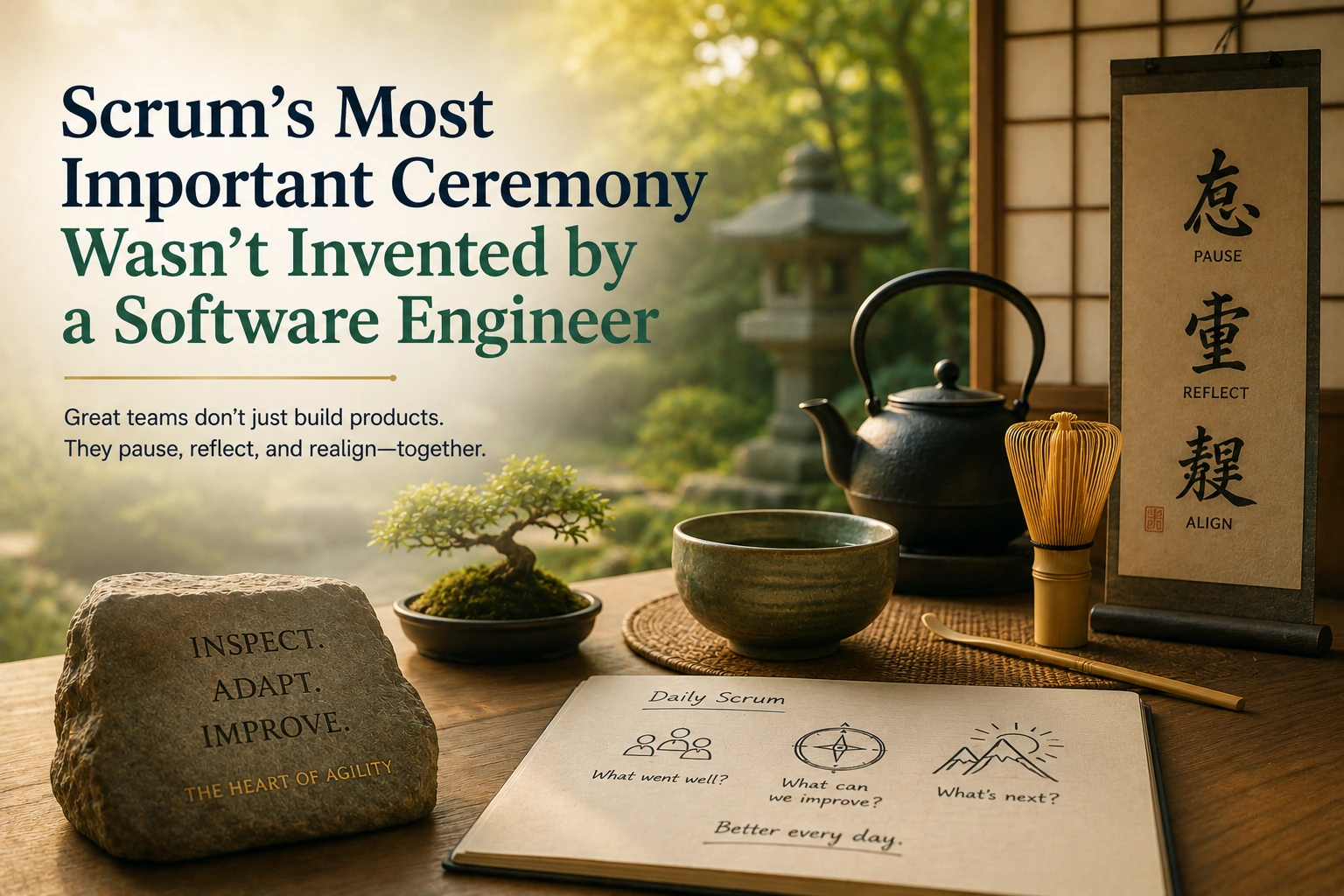
Scrum’s Most Important Ceremony Wasn’t Invented by a Software Engineer
Every two weeks, agile teams sit down, look back at what happened, and ask what to do differently next time. It’s called a sprint retrospective now, and it’s treated as a modern management innovation, complete with sticky notes and a facilitator trained in the format. It’s neither modern nor especially innovative. It’s a corporate rebranding of a habit Stoic philosophers were practicing nightly nearly two thousand years before anyone wrote a line of code — and the parts of Scrum that actually work best turn out to map onto Stoic principles with a precision that’s more than coincidental.
The Nightly Habit Behind the Modern Ceremony
Seneca, writing to a friend about his own daily practice, described asking himself each evening what fault he’d corrected that day, what habit he’d resisted, and in what way he’d become better — a structured self-examination performed consistently, not as a one-time reflection but as a repeated discipline built specifically around honest, non-defensive review of what actually happened. Marcus Aurelius practiced a close variant of the same habit throughout Meditations, using private writing as active self-correction rather than passive reflection.
Strip away the software terminology and a sprint retrospective is structurally identical: what went well, what didn’t, what should change going forward, repeated on a fixed cadence rather than left to chance. The value in both cases comes from the same source — regular, honest, structured review beats sporadic, defensive reflection, and a habit repeated on a schedule produces real behavioral change in a way an occasional insight never quite manages to.
Why the Team Version Requires Something the Individual Version Doesn’t
Here’s where the parallel gets genuinely useful rather than just clever. An individual practicing Stoic self-examination only has to be honest with themselves. A team practicing the same discipline together has a much harder problem: honesty requires psychological safety, because admitting a mistake in front of colleagues carries real social risk an individual journaling alone never faces. This is exactly the variable Google’s own internal research identified as decisive. Google’s Project Aristotle, a multi-year study analyzing more than 180 teams, found that psychological safety — measured specifically by whether team members agreed that mistakes were “not held against” them — was the single strongest predictor separating high-performing teams from the rest, ahead of factors like individual talent, seniority, or team structure.
That specific framing — mistakes not held against a person — is worth sitting with, because it’s essentially the team-level version of a core Stoic principle: judging the decision, not the person, and separating outcomes from the character of whoever made the call under uncertainty. A retrospective without psychological safety degrades into exactly what Stoic self-examination was designed to avoid: either defensive self-protection, where nobody admits what actually went wrong, or unproductive self-flagellation, where blame gets assigned rather than lessons extracted. Neither produces the honest, corrective review the ritual is supposed to deliver.
Blameless Postmortems and the Stoic View of Externals
This connects directly to one of the more mature practices in modern software engineering: the blameless postmortem, run after a significant incident or outage, explicitly structured to focus on systemic and process causes rather than individual fault. The underlying philosophy, even when nobody involved would describe it this way, is directly Stoic. A production outage, once it’s happened, is now an external fact — arguing about who to blame doesn’t change what occurred, and Stoic practice treats energy spent on unchangeable past events as fundamentally wasted, better redirected toward what remains genuinely actionable: understanding the systemic cause and preventing recurrence.
This is also where the Stoic distinction between what’s controllable and what isn’t does real, practical work inside a postmortem specifically. An individual engineer’s specific line of code that triggered an outage is, after the fact, no longer within anyone’s control — it happened. What remains controllable is the process that allowed that specific error to reach production undetected, and that’s precisely where blameless postmortems direct their actual analysis, rather than dwelling on an unchangeable past action by a specific person.
Sprint Planning as an Exercise in the Dichotomy of Control
The same underlying discipline shows up, less obviously, in how good sprint planning actually works. A team committing to a sprint’s worth of work is implicitly separating what’s within their control — the quality of their own estimates, how they sequence dependent tasks, how they communicate blockers as they arise — from what genuinely isn’t, like a third-party API changing behavior mid-sprint, a key stakeholder becoming unavailable, or a dependency team missing their own commitment. Teams that handle this well build in deliberate slack for the uncontrollable category rather than treating every sprint as though perfect execution of the plan is fully within their power. Teams that handle it badly treat any deviation from the original plan as a personal failure, which is precisely the anxious misallocation of energy Stoic philosophy specifically warns against.
This connects to a related workplace finding worth pairing with the Google research above. The CDC’s National Institute for Occupational Safety and Health identifies a lack of control over decisions affecting one’s work as one of the defining structural sources of job stress, distinct from workload volume alone — which means a sprint planning process that pretends everything is controllable, and then quietly blames the team when reality intervenes, isn’t just philosophically confused. It’s actively generating exactly the kind of chronic workplace stress the government’s own occupational health research identifies as genuinely damaging over time.
Standups as Daily Micro-Practice
Even the humble daily standup fits this pattern once you look at it through the same lens. At its best, a standup is a brief, honest check-in on what’s actually within a person’s control today — what got done, what’s blocking further progress, what needs to change about today’s plan given yesterday’s actual results — repeated daily the same way Stoic morning preparation was meant to be repeated, not as a status report performed for a manager’s benefit, but as a genuine daily recalibration of effort against reality. Standups that degrade into rehearsed status updates, disconnected from any honest assessment of blockers or changed priorities, have lost the actual function the ritual was supposed to serve, in almost exactly the way a Stoic practice performed mechanically, without honest self-examination behind it, loses its value too.
This is the same underlying discipline covered in our piece on the Stoic principles applicable to leadership generally, just applied at the team-ritual level rather than the individual executive level — the dichotomy of control isn’t a personal practice that stops mattering once other people are involved. If anything, it becomes more valuable in a team context, because it’s precisely what separates a functional retrospective or standup from a performative one.
Why This Isn’t Just a Clever Metaphor
It would be easy to treat this as a fun rhetorical connection rather than something with real practical weight, but the convergence between the two traditions is worth taking seriously as evidence, not just analogy. Two entirely separate bodies of thought — Stoic philosophy, developed across centuries by people with no access to modern organizational research, and Google’s internal, data-driven study of what actually makes teams effective — arrived at structurally identical conclusions: honest, non-defensive review beats avoidance, judging decisions rather than people preserves the ability to learn from mistakes, and distinguishing what’s controllable from what isn’t reduces wasted anxious energy. That kind of independent convergence, from sources with nothing else in common, is a stronger form of evidence than either tradition would provide alone.
This is also directly relevant to a broader theme worth connecting here. Our piece on the skills becoming more valuable in an AI-integrated workplace found that judgment under ambiguity is increasingly the actual differentiator for teams and individuals alike — and a team practicing honest, blameless, control-focused review on a consistent cadence is, in practice, building exactly that judgment collectively, the same way an individual builds it through the kind of deliberate reflection our productivity systems guide recommends at the personal level.
What This Looks Like When It’s Missing
It’s worth describing the failure mode directly, since most teams have experienced some version of it without naming it this way. A retrospective that quietly becomes a status update, where nobody raises a genuine concern because the last person who did was subtly made to feel like they’d caused a problem, has lost the psychological safety Google’s research identified as the entire load-bearing factor. A postmortem that spends more time identifying which engineer’s commit triggered an outage than examining why the review and deployment process allowed that commit through has reverted to exactly the blame-oriented dynamic blameless postmortems were specifically designed to avoid. A sprint planning session where the team silently absorbs every external disruption into unpaid overtime, rather than surfacing it honestly as an uncontrollable factor worth discussing, has collapsed the dichotomy of control back into a single, exhausting category: everything is somehow the team’s fault.
None of these failure modes look dramatic from the outside. The ceremony still happens on the calendar, on schedule, with all the right software tools tracking it. What’s missing is the actual honest content the ritual was built to produce, which is precisely why simply having the ceremony isn’t sufficient — the same way Marcus Aurelius clearly understood that owning a journal wasn’t the same thing as the difficult, ongoing work of writing honestly in it.
A Quick Audit of Your Own Team’s Rituals
A useful, honest exercise for any team lead: sit through your next retrospective and specifically notice whether mistakes get discussed with genuine curiosity about the systemic cause, or with visible discomfort and deflection. Notice whether sprint planning treats external blockers as a legitimate, expected category, or as a failure to be quietly absorbed into next sprint’s workload without acknowledgment. Most teams, examined honestly, have at least one ritual that’s technically happening on schedule but has lost the actual honest self-examination it was supposed to deliver — which is the team-level version of practicing Stoicism mechanically without the underlying discipline actually present.
Frequently Asked Question
How is a sprint retrospective similar to Stoic philosophy?
Both are structured, repeated practices of honest self-examination. Stoic philosophers like Seneca and Marcus Aurelius practiced nightly review of what went well, what didn’t, and what to change, which is structurally identical to a sprint retrospective’s format, just applied at the team level rather than individually.
What did Google’s Project Aristotle find about effective teams?
Google’s Project Aristotle studied more than 180 teams and found psychological safety, whether team members felt mistakes weren’t held against them, was the single strongest predictor of team effectiveness, ahead of factors like individual talent, seniority, or team structure.
Why do blameless postmortems focus on process instead of individual fault?
Once an incident has occurred, it’s an unchangeable external fact, and Stoic practice treats energy spent on unchangeable past events as wasted. Blameless postmortems apply the same logic, directing analysis toward the systemic process that allowed an error to reach production rather than dwelling on the individual action that can no longer be undone.
How does the dichotomy of control apply to sprint planning?
A team committing to a sprint separates what’s within its control, like the quality of its own estimates and communication, from what isn’t, like a third-party dependency changing mid-sprint. Teams that build in deliberate slack for uncontrollable factors, rather than treating every deviation as a personal failure, tend to handle disruption more sustainably.
Why does lack of control cause workplace stress on software teams specifically?
The CDC’s National Institute for Occupational Safety and Health identifies a lack of control over decisions affecting one’s work as a defining structural source of job stress, distinct from workload volume. A sprint planning process that treats all outcomes as controllable, and quietly blames a team for external disruptions, can generate exactly this kind of chronic stress.
How can I tell if my team’s retrospectives have become just a formality?
Watch whether mistakes are discussed with genuine curiosity about the underlying cause or met with visible discomfort and deflection. A retrospective that happens on schedule but lacks honest, non-defensive discussion has lost the actual self-examination the ritual is meant to provide, similar to practicing a habit mechanically without its underlying discipline.
Conclusion
The sprint retrospective, the blameless postmortem, and the daily standup aren’t modern management inventions dressed up in agile terminology — they’re structurally identical to Stoic self-examination practices developed nearly two millennia earlier, and Google’s own internal research on team effectiveness independently arrived at the same conclusion ancient philosophy did: honest review free of blame, focused on what was actually controllable, outperforms defensive avoidance every time.
Treating these rituals as genuine practice rather than corporate performance is what separates a team that actually improves from one that just goes through the motions on a fixed cadence. The philosophy and the modern research agree on what that actually requires — and neither one is asking for anything especially complicated, just consistent, honest repetition of a habit that’s worked for a very long time.