Leonardo da Vinci’s Real Invention Wasn’t the Flying Machine
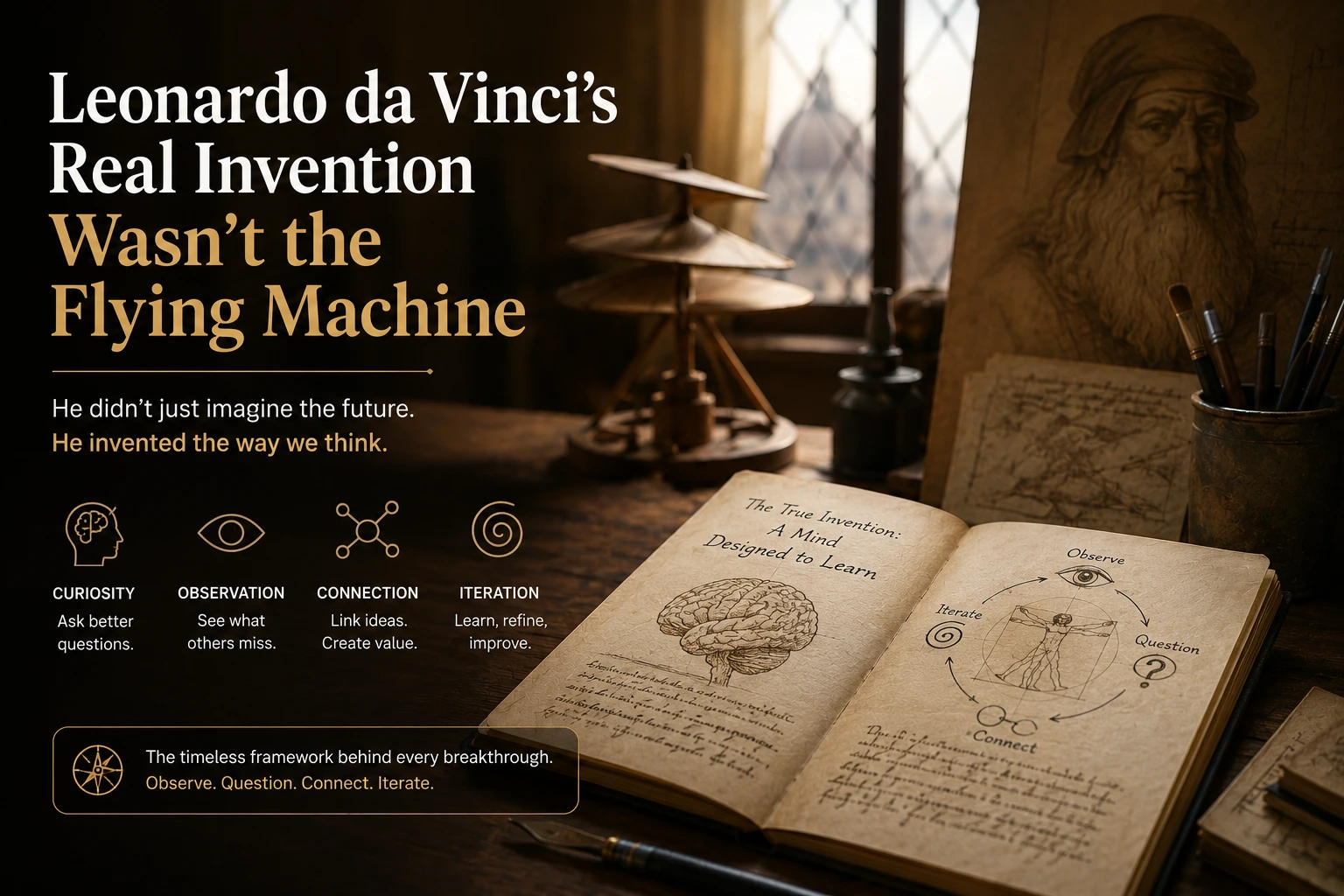
Turn through Leonardo da Vinci’s notebooks and the thing that jumps out isn’t any single sketch — not the flying machine, not the tank, not the anatomical studies that predated modern medical illustration by centuries. It’s the fact that all of it sits on the same pages, often in the same afternoon’s thinking, with no wall between the anatomy and the engineering and the art. He wasn’t keeping separate notebooks for separate interests. He was keeping one notebook where a study of a bird’s wing bones sat inches from a sketch of a mechanical wing, because in his actual thinking, those two things were never really separate problems to begin with.
That habit — refusing to silo knowledge by discipline — turns out to be backed by real research on how genuinely high-impact ideas actually get made, centuries after Leonardo had no way of knowing there was science behind what he was already doing instinctively.
What the Notebooks Actually Show
It’s worth being specific about what this looked like in practice, rather than treating “Da Vinci connected everything” as a vague inspirational claim. The Smithsonian’s National Air and Space Museum, which has exhibited Da Vinci’s Codex on the Flight of Birds, describes the manuscript as a collection of notes and sketches that foreshadows principles of mechanical flight specifically by exploring the flight patterns and behavior of actual birds. He didn’t study aeronautical engineering in one book and ornithology in another. He studied the bird because the bird was the engineering problem already solved by nature, and the notebook format let him move fluidly between careful biological observation and mechanical design on the same page, in the same sitting, without needing to file the thought into the “right” category first.
This pattern repeats across his surviving manuscripts. The Codex Atlanticus, the largest surviving collection at over a thousand pages, moves across weaponry, botany, mathematics, and hydraulic engineering, not organized into separate volumes by topic but genuinely interspersed, reflecting how the ideas actually occurred to him rather than how a librarian would later prefer to catalog them. The famous mirror-script wasn’t the only unusual thing about how he recorded ideas — the deeper unusual choice was refusing to separate the disciplines at the point of capture, before the thinking had even finished happening.
Why This Wasn’t Just an Eccentric Habit
For a long time, “connecting distant fields sparks creativity” was the kind of claim that sounded appealing but rested mostly on anecdote and famous examples like Da Vinci himself. That’s changed with large-scale, quantitative research on what actually predicts high-impact ideas. A landmark study published in Science, analyzing 17.9 million research papers spanning five decades and all scientific fields, found that the highest-impact work follows a specific, nearly universal pattern: it’s primarily grounded in highly conventional, deeply mastered combinations of prior knowledge, but simultaneously features an intrusion of unusual, atypical combinations drawn from elsewhere — and papers exhibiting this specific pattern were twice as likely to become highly cited, breakthrough work. Pure novelty alone didn’t predict impact. Pure conventionality alone didn’t either. The winning combination was deep, genuine mastery of a core domain, deliberately fused with an atypical idea imported from somewhere else entirely.
This is close to an exact scientific description of what Da Vinci’s notebooks were doing structurally, five centuries before anyone measured it at scale. His anatomical studies weren’t dabbling — they reflect genuine, sustained, careful observation, the conventional-mastery half of the pattern. The unusual combination came from refusing to keep that mastery walled off from his engineering questions, letting the depth in one domain directly inform, and occasionally solve, a problem in a completely different one.
The Specific Technique Worth Extracting
Beyond the general instinct to mix domains, Da Vinci’s actual working method offers something more concrete and transferable. His notebooks are full of running lists of questions — genuine, open, sometimes almost childlike inquiries about how something works, jotted down alongside whatever else he was investigating that day. He didn’t wait to have an answer before writing the question down, and he didn’t require the question to belong to whatever “project” he happened to be nominally working on. A question about water flow could sit next to a question about muscle structure, both waiting, unresolved, for whichever future observation happened to connect them.
This is a genuinely different practice than most modern note-taking, which tends to organize by project or topic first and capture ideas within that structure second. Da Vinci’s method inverted the priority: capture the observation or question first, in whatever unified space he was working in that day, and let the connections across domains emerge from proximity rather than forcing them into predetermined categories before they’d had a chance to actually connect.
Applying This to How Modern Knowledge Work Actually Gets Organized
Most modern productivity advice, including some of what makes genuine sense for day-to-day task management, pushes in exactly the opposite direction from what made Da Vinci’s notebooks work. Our guide to organizing digital files recommends shallow, well-labeled folder structures for retrieving specific documents quickly — genuinely good advice for files you need to find again fast. But a raw idea, a half-formed question, or an observation that might connect to something entirely unrelated later doesn’t benefit from being filed into a specific project folder the moment it occurs. It benefits from sitting in a shared, unsorted space alongside other unrelated thoughts, the way Da Vinci’s questions sat next to each other across disciplines, waiting for a connection that couldn’t be predicted or filed for in advance.
The practical version of this for most people is maintaining one genuinely mixed capture space — a single notebook, document, or note app collection — specifically for questions, observations, and half-formed ideas that don’t yet belong anywhere, separate from the project-organized systems used for actual execution. The instinct to immediately sort every new thought into its “correct” category is precisely the instinct Da Vinci’s actual working method rejected, and the research on atypical combinations suggests that instinct comes at a real cost to the kind of connection-making that produces genuinely high-impact ideas.
This Connects to a Broader Shift Worth Understanding
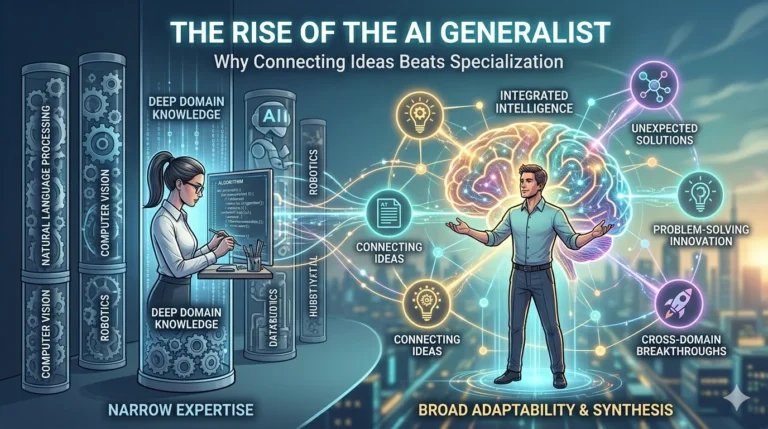
This same principle underlies a broader argument worth connecting here directly. Our piece on why connecting ideas across domains is starting to outcompete narrow specialization makes essentially the modern, career-focused version of the same case the Uzzi research demonstrates at scale: genuine depth in one area, deliberately connected to breadth elsewhere, outperforms either narrow specialization or shallow generalism alone. Our guide to actually becoming this kind of professional covers the practical mechanics of building that combination without diluting real expertise — which is, in effect, a modern operational version of what Da Vinci was doing by hand, across a single, unified notebook, five hundred years before either the research or the career framing existed to describe it.
Building Your Own Version of This Practice
A useful, concrete starting point: create one space, separate from your project-organized systems, specifically for capturing questions and observations that don’t yet have an obvious home. Don’t sort them by topic as you add them. Revisit the whole collection periodically, specifically looking for connections between entries that came from completely different contexts — a question from a work problem sitting near an observation from something you read for entirely unrelated reasons. The value isn’t in the individual entries. It’s in what surfaces when unrelated entries sit close enough together to be noticed at the same time, which is exactly the mechanism the Uzzi research suggests drives genuinely high-impact combinations, and exactly what a project-first filing system tends to structurally prevent.
Why This Habit Is Actually Hard to Maintain
It’s worth being honest about why so few people actually practice this, despite how simple it sounds in description. The instinct to categorize a new thought immediately is strong, and it’s not irrational — a sorted system feels more useful in the moment, because it promises the thought will be findable later, exactly when needed. An unsorted capture space offers no such promise. It asks you to tolerate genuine, uncomfortable disorder for an uncertain, delayed payoff: a connection that might emerge in a month, or a year, or possibly never, between two entries that had no obvious relationship when either was written down.
This is precisely the trade-off the Uzzi research quantifies without naming it explicitly. High-impact ideas came from the minority of work willing to tolerate that same discomfort — genuine depth in a core area, paired with material that didn’t obviously belong there yet. Most work, understandably, stays within safely conventional combinations, because atypical connections are inherently harder to justify in the moment they’re being made, before any payoff has materialized to prove the discomfort was worth it. Da Vinci’s notebooks suggest he was simply more comfortable than most people, across five centuries of comparison, sitting with that unresolved, unsorted state for as long as it took a genuine connection to surface.
A Quick Audit of Your Own Note-Taking Habits
A useful, honest exercise: look at how you currently capture ideas and observations. Is everything immediately sorted into a project folder, a specific app, or a category the moment it occurs to you? If so, you likely have a well-organized retrieval system and very little of the unsorted, cross-domain proximity that produced Da Vinci’s most distinctive connections. Consider deliberately building one small, mixed space specifically exempted from that organizing instinct, and see what surfaces after a few months of letting genuinely unrelated observations sit next to each other, unsorted, the way his notebooks did for decades.
Frequently Asked Question
What made Leonardo da Vinci’s notebooks unique compared to other historical journals?
Da Vinci didn’t separate his interests into different notebooks by subject. His pages mix anatomy, engineering, botany, and art within the same manuscripts, often on the same page, reflecting how the ideas actually occurred to him rather than how they would later be categorized by discipline.
Is there research supporting the idea that connecting different fields produces better ideas?
Yes. A study published in Science, analyzing 17.9 million research papers, found that the highest-impact work combines deep, conventional mastery of a core domain with an intrusion of unusual, atypical combinations drawn from elsewhere, and papers with this pattern were twice as likely to become highly cited breakthrough work.
Does pure novelty alone predict high-impact ideas?
No. The Science study found that pure novelty alone, without a foundation of conventional mastery, did not predict high impact. The winning pattern combined deep expertise in a core area with a deliberate, atypical connection to something outside it, rather than novelty or expertise in isolation.
How can modern note-taking apply Da Vinci’s approach?
Rather than immediately sorting every new idea into a specific project or category, maintaining one unsorted space for questions and observations, separate from project-organized systems, allows unrelated ideas to sit near each other and surface unexpected connections, similar to how Da Vinci’s notebooks mixed disciplines rather than separating them by subject.
Does this contradict advice about keeping organized, shallow folder structures?
Not exactly, since they serve different purposes. Organized folder structures are best for retrieving specific documents quickly. A separate, unsorted capture space for raw ideas and questions serves a different function, allowing cross-domain connections to emerge that a project-first filing system would structurally prevent.
What did Da Vinci’s notebooks actually contain?
His surviving manuscripts, including the Codex Atlanticus and the Codex on the Flight of Birds, cover subjects including anatomy, engineering, hydraulics, botany, weaponry, mathematics, and painting theory, often interspersed on the same pages rather than divided into separate volumes by topic.
Conclusion
Da Vinci’s notebooks weren’t valuable because he was unusually disciplined about capturing ideas — plenty of people keep detailed notes. They were valuable because he refused to separate disciplines at the point of capture, letting anatomy inform engineering and engineering inform art within the same unified space. Research on 17.9 million scientific papers independently confirms the underlying mechanism: the highest-impact ideas combine genuine depth with atypical, cross-domain connection, not novelty or expertise alone.
The practical lesson isn’t to imitate his mirror script or his flying machine sketches — it’s to build one genuinely unsorted space for questions and observations, resisting the reflexive instinct to file every new thought into its predetermined category before it’s had any chance to bump into something unrelated and spark a connection neither idea would have produced alone.