The Anti-Automation Manifesto: Tasks Humans Should Never Delegate to AI
Every meaningful technology shift in history has produced a version of the same conversation, and the AI era is no different. The conversation goes: here is what the new tool can do, here is what it should do, and — the part that tends to get postponed — here is tasks humans should never delegate to AI, regardless of whether it technically can. We are deep inside the first two conversations in 2026 and barely beginning the third. That postponement has consequences. When the question of what AI should not do gets skipped, it gets answered by default — by the accumulated individual decisions of millions of people who find it faster to delegate something to an algorithm than to do it themselves, without anyone stepping back to ask whether the speed premium is worth what’s being traded away.
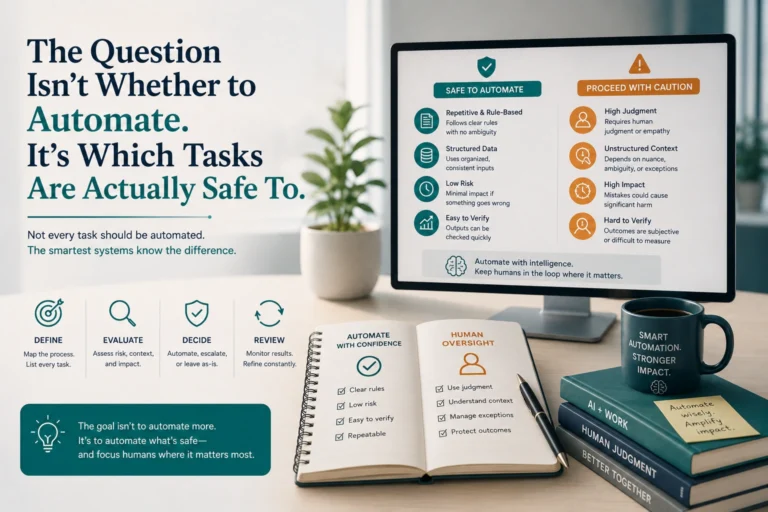
This is that third conversation. Not about AI’s limitations in a technical sense — the list of tasks AI performs poorly is shrinking, and arguing from current capability ceilings is a losing strategy since those ceilings keep rising. The more durable argument is about something different: the tasks where the human involvement is not instrumental but constitutive — where the fact that a person did it, thought about it, felt the weight of it, is inseparable from the value of the act itself. Where automating the process doesn’t just produce the same outcome faster, but produces a categorically different and lesser outcome regardless of the output’s technical quality. Those tasks exist. They are more numerous than the automation-maximalist position tends to acknowledge. And the case for protecting them is not sentimental — it is structural.
The EPOCH Framework and What It Actually Means
The Randstad Workmonitor 2026 report is worth reading carefully, because its implications extend well beyond the workforce planning context in which it was published. The research identifies the EPOCH framework — Empathy, Presence, Opinion, Creativity, and Hope — as the dimensions of human capability that machines have the most difficulty replicating, and argues that tasks or roles built around these capacities can drive growth in a post-AI workplace. The framework is conservative in its claims — it doesn’t argue that AI will never replicate these things, only that it currently can’t — but the practical implication runs deeper than the word “currently” suggests.
Consider Empathy. AI can produce empathic-sounding outputs with remarkable fluency. Research published in 2025 found that AI chatbots were rated as showing more empathy than human healthcare professionals in 13 of 15 comparative studies — a finding that reveals something important about the difference between the signal of empathy and the substance of it. The signal — the language, tone, and attentiveness — can be replicated. The substance — the shared human vulnerability that makes one person’s care for another’s suffering meaningful — cannot. Delegating empathy to an AI is not outsourcing a function. It is substituting a simulation of the function for the function itself, and hoping no one notices the difference. Some do. Some don’t. The stakes depend entirely on what the empathy was for.
Presence, the second EPOCH dimension, is the one most directly threatened by the automation instinct, because it is the one that requires the most from us. Being genuinely present with another person — in a difficult conversation, a moment of grief, a high-stakes professional interaction — is cognitively and emotionally demanding in ways that feel inefficient. The temptation to mediate that presence through an AI layer is real. The cost of doing so is the presence itself. You cannot automate your own attention and claim to have given it.
The Five Categories of Non-Delegable Human Work
What follows is not a list of things AI does poorly. It’s a list of things where human involvement is structurally constitutive of the outcome — where removing the human doesn’t just change the process, it changes what the thing fundamentally is.
1. Moral accountability decisions. Research published in PMC identifies the risk of diminished human autonomy when key decisions in healthcare, criminal justice, finance, and law enforcement are delegated to AI algorithms. This concern is not primarily about accuracy — an AI sentencing algorithm may be statistically more consistent than a human judge. It’s about accountability. A criminal sentence, a medical treatment decision, a loan denial, a hiring or firing decision — these are acts that require a human to own them. The person affected has the right not just to a defensible statistical outcome but to a human being who took responsibility for the decision and can be held to account for it. The European Data Protection Supervisor makes this distinction precisely: simply including a human in the decision-making process does not inherently ensure better outcomes, nor should it serve as a means to deflect accountability — and yet meaningful human oversight at key decision points remains essential. The EU AI Act operationalises this by classifying AI systems in these domains as high-risk and imposing human oversight requirements — a regulatory acknowledgment that moral accountability cannot be automated away.
2. Therapeutic relationships and grief. The clearest case for non-delegation in 2026 is the mental health and bereavement space, where the evidence is no longer just philosophical but clinical and in some cases fatal. Research published in the Journal of Evidence-Based Social Work confirms that AI is not a replacement for human empathy, clinical judgment, or therapeutic presence — it is a tool that can extend the reach of clinicians, but the therapeutic relationship itself requires human presence in ways that cannot be automated. The darker evidence is in the case record: a 2025 Wall Street Journal investigation documented the case of a troubled man whose deepening reliance on a chatbot relationship preceded a murder-suicide, and The Guardian reported on a mother’s lawsuit after she said an AI chatbot played a role in her son’s death. These are not arguments against AI in mental health support broadly — the access-to-care crisis is real and AI has a legitimate role in extending coverage. They are arguments against treating AI as a substitute for the human therapeutic relationship in high-risk contexts, where the stakes of getting it wrong are irreversible.
3. Final authorship and authentic creative voice. Legal experts interviewed in research published through ACM drew clear and consistent boundaries: participants would not delegate final legal writing to AI, emphasising the need for precise, personal responsibility, and professional voice — noting that reading judicial opinions through AI summaries risks missing the nuance and argumentative opportunities that define excellent legal work. The same principle applies in any domain where the authentic voice is the product. A letter of condolence, a personal apology, a creative work that represents your perspective — these are not outputs that can be improved by being indistinguishable from a general pattern of similar outputs. Their value is specific to the person who produced them. AI assistance with drafts and structure is qualitatively different from AI generation of the final text. The line is real, even if it requires deliberate effort to maintain.
4. Trust-building and relational work. The same legal research found that participants rejected automating client management and trust-building, describing justice as a relationship rather than a transaction — and flagging the risk that AI-mediated client relationships introduce deepfake and impersonation risks that further erode the relational foundation of professional practice. Trust is built through accumulated human interaction — through the evidence of consistent judgment, genuine engagement, and the kind of accountability that comes from being a person with a reputation rather than an algorithm with a version number. You can use AI to prepare for those interactions. You cannot use AI to have them on your behalf and claim to have built the trust yourself.
5. Ethical deliberation and moral development. Research published in PMC on how AI tools can and cannot help organisations become more ethical makes an argument that cuts against the intuition that AI can serve as an external moral check: because AI is a mirror that reflects our biases and moral flaws back to us, delegating ethical deliberation to AI doesn’t externalise the ethics — it just makes the existing biases harder to see. The act of thinking through an ethical dilemma — of experiencing the discomfort of competing obligations, feeling the weight of a decision, and arriving at a position you can defend — is part of what moral development is. Automating that process doesn’t produce better ethics. It produces the appearance of ethics without the underlying development that makes ethical reasoning reliable under novel conditions.
The Skill Atrophy Problem Nobody Is Pricing In
There’s a dimension to the delegation problem that the efficiency arguments consistently omit, and it’s the one that makes the stakes longer-term than most conversations acknowledge. When you delegate a task to AI regularly, you stop practising the cognitive skill the task requires. In the short term, this looks like efficiency. In the medium term, it looks like capacity loss. A widely articulated position in AI ethics research emphasises that GenAI should assist, not replace, human judgment — with accountability firmly placed on institutions rather than automated systems — and that the growing risk is not just that AI will make bad decisions, but that humans will lose the capacity to make good ones.
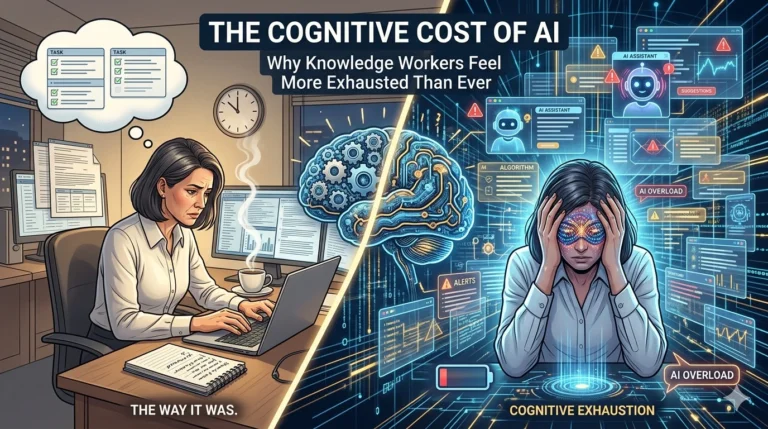
The cognitive cost side of AI adoption — explored in depth in our piece on the exhaustion that knowledge workers are experiencing from AI-supervised workflows — maps onto this problem precisely: when AI continuously produces outputs that require human verification rather than human generation, the kind of thinking that generates original insight gradually gets less exercise. The capacity doesn’t disappear overnight. It degrades slowly, in ways that are hard to notice until the situation arises that requires it fully formed — and it isn’t.
The legal profession’s resistance to delegating final authorship isn’t just professional conservatism. It’s a recognition that the act of writing arguments is how lawyers develop the judgment to evaluate arguments. The therapist who uses AI to generate empathic responses to clients is not just making a service delivery decision — they are practising a different cognitive skill from the one that makes therapeutic relationships work. The manager who uses AI to draft all difficult feedback is not just saving time — they are avoiding the practice of something that only becomes better through doing.
Research into human-AI collaboration through the lens of agency confirms that when AI influence increases in human moral decisions, human accountability and responsibility perceptions shift accordingly — meaning the delegation of moral work doesn’t just change the output, it changes the person doing the delegating. That change accumulates. The Stoic insight explored in our piece on Seneca and Marcus Aurelius as tools for navigating AI workflows is directly relevant here: what you practice is what you become. Delegating the difficult, human things is practicing their absence — and their absence is what you’ll have available when the situation most demands their presence.
Refusing to Automate as a Legitimate Choice
Perhaps the most quietly radical observation in recent AI ethics research is this: a widely noted perspective in the 2026 AI ethics landscape holds that refusing to deploy GenAI can itself be an ethically justified decision — that the question is not always “how do we implement this responsibly” but sometimes “should we implement this at all”. This is a significant shift in framing from the default assumption that AI adoption is always positive if governed correctly, and it matters for individuals as much as for institutions.
Choosing not to automate something is a statement about what that thing is worth. It’s a claim that the human involvement is not incidental overhead but constitutive value. Sometimes that claim is right. Often it’s the only honest account of what makes the thing meaningful. The parent who is present for the difficult conversation rather than asking an AI what to say is not being inefficient — they are making a statement about the relationship that no efficient AI-mediated alternative could make on their behalf. The professional who writes their own apology letter, even imperfectly, is doing something that cannot be replicated by a well-prompted language model.
None of this is a brief for AI-refusal as a general posture. Our analysis of how the AI generalist builds durable advantage through AI fluency argues for exactly the opposite: deliberate, strategic AI adoption is the defining professional advantage of the 2026 era. The argument here is for deliberate, strategic non-adoption — for the same quality of intentionality applied to what you keep that you bring to what you delegate. The tasks are real. The stakes are real. And the decision to protect them is, in the end, the most human thing you can do with the tools currently available to you.
Frequently Asked Questions
The tasks humans should not delegate to AI are those where human involvement is constitutive of the outcome rather than merely instrumental — where the fact that a person thought about it, felt the weight of it, and took responsibility for it is inseparable from the value of the act. These include: moral accountability decisions (sentencing, medical conclusions, hiring and firing) where a human must own the outcome; therapeutic and grief relationships where the human presence is the therapeutic ingredient; final authorship of work that represents your authentic voice; trust-building and relational work that requires accumulated human interaction to function; and ethical deliberation, where the discomfort of reasoning through competing obligations is part of how moral judgment develops. In each of these categories, AI can assist the process — but automating the process produces a categorically different and lesser outcome than human engagement, regardless of the technical quality of the AI output.
Research published in the Journal of Evidence-Based Social Work confirms that AI is not a replacement for human empathy, clinical judgment, or therapeutic presence in mental health contexts — it can extend the reach of clinicians but cannot substitute for the therapeutic relationship itself. The risk intensifies in high-stakes emotional contexts: a 2025 Wall Street Journal investigation documented a case where deepening reliance on a chatbot relationship preceded a murder-suicide, and a mother filed suit against Character.AI after her son’s death, which she attributed partly to AI chatbot interactions. The World Health Organization’s 2026 report on responsible AI for mental health explicitly calls for human-centred frameworks that prevent AI from being positioned as a substitute for human therapeutic relationships in high-risk situations. The danger is not that AI produces poor emotional-support outputs — it often produces outputs that sound highly empathic. The danger is that those outputs simulate the substance of therapeutic relationship without providing it, potentially delaying or displacing the human contact that high-risk individuals need most.
EPOCH is a framework identifying the dimensions of human capability most resistant to AI replication: Empathy, Presence, Opinion, Creativity, and Hope. Developed in the context of the Randstad Workmonitor 2026 workforce research, it identifies these five capacities as the areas where human involvement creates value that AI cannot replicate, and argues that roles and tasks built around them represent the most durable human competitive advantage in an AI-augmented economy. For individuals making delegation decisions, EPOCH functions as a practical filter: before automating a task, ask whether it primarily requires one of these five capacities. If yes — and if the value of the output depends on genuine human expression of that capacity rather than its simulation — that task belongs in the non-delegable category regardless of whether AI could technically produce a comparable-looking output.
Yes — and the research is consistent on the mechanism. When you delegate a task to AI regularly, you stop practising the cognitive skill the task requires. In the short term this looks like efficiency; in the medium term it represents capacity loss that is difficult to reverse. AIhub’s 2026 analysis of AI ethics trends identifies the growing risk not just that AI will make bad decisions, but that humans will lose the capacity to make good ones — a skill atrophy problem that the efficiency arguments for AI adoption consistently omit from the calculation. Legal experts interviewed in ACM research confirmed this concern in their own field: they resist delegating final legal writing to AI partly because the act of writing is how lawyers develop the judgment to evaluate arguments. The same applies in any domain where the quality of human judgment is developed through practice: writing, ethical deliberation, therapeutic presence, and interpersonal trust-building all depend on practice to remain reliably available when high-stakes situations require them fully formed.
Yes — and this position has gained explicit academic recognition. AIhub’s 2026 ethics research notes that refusing to deploy generative AI can be an ethically justified decision, representing a significant shift from the default assumption that AI adoption is always positive if governed correctly. For professionals making this choice, the relevant question is not whether AI could technically handle the task, but whether human involvement in that task is constitutive of its value — whether the meaning of the act depends on the fact that a person did it, thought about it, and took responsibility for it. Apologies, authentic creative work, client relationship management, ethical deliberation, and therapeutic presence all qualify under this criterion. Choosing not to automate these things is not resistance to technology — it is a deliberate statement about what those things are worth and what kind of professional relationship you are offering.
The Bottom Line
The case for automation is real, well-documented, and wins most of the arguments it enters. This is not a rebuttal of that case. It’s an attempt to draw the boundary that the automation argument tends not to draw for itself: the line between tasks where human involvement is instrumental — where the same outcome, produced by either human or AI, has the same value — and tasks where human involvement is constitutive, where the fact of human engagement is the value.
Frontiers in Psychology research from 2025 frames this as a call to reaffirm the distinctiveness of human cognition, emotion, and moral judgment — describing these as “fragile yet irreplaceable capacities that lend ethical texture to progress”. Fragile is the right word. They atrophy under disuse. They degrade when we systematically route around them in the name of efficiency. They recover — but slowly, and not always fully.
The manifesto, if it deserves the word, is short: use AI for everything it genuinely does better. Keep humans in the loop for everything where the human is the point. Know the difference before you decide, not after. The tasks this piece describes are not a complete list — they are a starting point for the third conversation that the AI era needs to have with itself, and hasn’t been having loudly enough.