The Cognitive Cost of AI: Why Knowledge Workers Feel More Exhausted Than Ever
Something strange is happening in today’s workplaces, and the data is becoming hard to ignore. The tools meant to save time for knowledge workers are actually making them more tired. This isn’t the usual tiredness that comes after a productive day – (Why Knowledge Workers Feel More Exhausted Than Ever). Instead, it’s a confusing type of exhaustion that builds up without relating to hours worked or tasks completed. It doesn’t respond to normal solutions and worsens as employees use AI tools more.
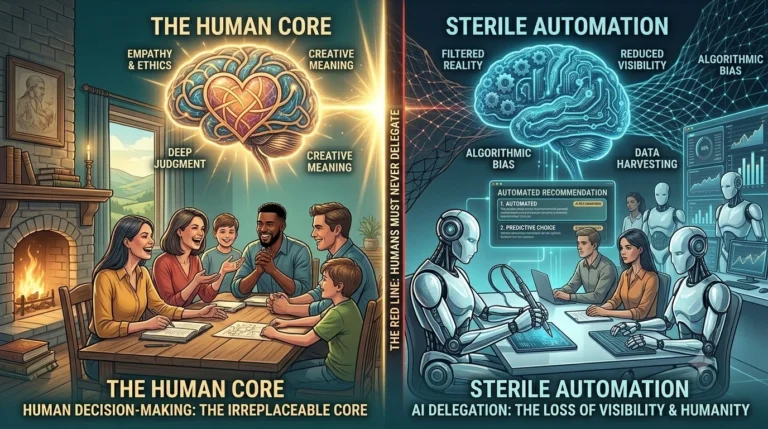
A 2026 Harvard Business Review report captures the contradiction with unusual bluntness: 77% of managers believe AI improves efficiency, but 88% of heavy AI users report increased burnout. Those two statistics are not in tension by accident. They describe the same system from two different vantage points — the view from the top, where AI is delivering measurable output gains, and the view from the inside, where the humans producing those gains are running on an increasingly depleted cognitive budget that nobody on the org chart is measuring.
Understanding what is actually happening — neurologically, structurally, and behaviourally — is the first step to doing something about it. And the answer is more specific than “AI is tiring.” It is about the particular kind of cognitive load that AI supervision creates, and why it is so much more depleting than the tasks it replaced.
The Brain Wasn’t Built to Supervise Machines All Day
The research framing that has gained the most traction in 2026 comes from a study conducted by Julie Bedard and colleagues at Boston Consulting Group, which surveyed nearly 1,500 full-time employees across industries and found a meaningful share reporting symptoms of what the researchers called “AI brain fry” — mental fatigue that occurs when interacting with AI exceeds cognitive capacity, characterised by mental fog, headaches, slower decision-making, and the strange sense that thinking had become crowded. The term is informal but the phenomenon it describes is precise, and it aligns with what neurologists studying cognitive load have been documenting for years in different contexts – George Mason University College of Public Health
The prefrontal cortex — the region governing executive function, working memory, and complex judgment — is the bottleneck. It processes one stream of deliberate information at a time, and it is metabolically expensive to run. What knowledge workers using AI tools spend most of their day doing is not generating — it’s supervising and verifying. Reviewing generated emails before sending. Checking summaries for accuracy.
Evaluating which of three AI-proposed solutions is actually correct. Each of those verification loops is a deliberate cognitive task. Each one draws on the same prefrontal cortex capacity that was supposed to be freed up by AI assistance. One of the least visible consequences of AI-enabled work is the rise of always-on judgment. Because AI continuously produces outputs, employees are required to continuously interpret, critically evaluate, and respond. The boundaries between tasks begin to blur, opportunities for cognitive recovery diminish, and the mental load does not reset — it accumulates – HR Executive
The METR study published in 2025, which tracked 16 experienced open-source developers completing 246 real-world coding tasks, found that when developers were allowed to use AI tools — primarily Cursor Pro with Claude 3.5/3.7 Sonnet — they took 19% longer to complete their work compared to when they worked without AI assistance. The developers, who had estimated they would be significantly faster with AI, were systematically wrong about the actual impact. The overhead of prompting, verifying, correcting, and integrating AI output added time that pure execution would not have. This finding is not an indictment of AI coding tools — it is a measurement of the supervision tax that everyone using AI for cognitively complex work is paying, whether they realise it or not – Medium
The Sphere of Accountability Problem Nobody Named Until Now
One of the most useful concepts to emerge from the BCG research is what the authors call the “sphere of accountability” — and the researchers observed precisely this dynamic: workers reported that AI did not simply reduce workloads. In many cases, it expanded the sphere of accountability, meaning that employees suddenly felt responsible for producing more work, monitoring more outputs, and managing more information in the same amount of time. This is the mechanism that explains why AI adoption correlates with increased burnout rather than decreased stress, even when it produces genuine output gains – George Mason University College of Public Health
When a knowledge worker could only research, write, and analyse at a certain pace, the natural ceiling of human throughput set the scope of what they felt accountable for. AI removes that ceiling. The same person who could previously produce two detailed reports a week can now produce ten — and the social and organisational expectation quietly recalibrates to ten. The tool expands capacity. The organisation expands expectation. The human absorbs the entire delta as additional cognitive load, without additional recovery time, without additional headcount, and often without any acknowledgment that the workload has structurally changed. When capacity expands, expectations quietly expand with it. The load compounds – Brad Hook
Engineering teams using AI coding assistants had their sprint velocity baselines recalibrated upward by an average of 40% within two quarters. Marketing departments using AI content generation were expected to produce 3.2 times more content pieces per month compared to pre-AI baselines. Neither of those figures represents an increase in team size. They represent an increase in the cognitive throughput demanded from the same number of human brains — brains that have a finite daily capacity for deliberate processing, regardless of what the AI can theoretically output – AI Magicx
DHR Global’s 2026 Workforce Trends Report, surveying 1,500 professionals across North America, Europe, and Asia, found that overwhelming workloads were the top burnout driver for 48% of respondents, with 40% pointing to excessive hours. Employee engagement has plummeted from 88% to 64% year-over-year, even as AI adoption has surged. The engagement collapse happening in parallel with AI adoption is not coincidental. It is the downstream effect of a workforce whose sphere of accountability has been expanded beyond sustainable limits, in organisations that are measuring output but not measuring cognitive cost – Medium
The patterns here connect directly to what the Quiet Burnout Recovery Playbook at Omnisly identifies as the defining feature of quiet burnout in 2026: the absence of visible collapse. Quiet burnout looks like sustained competent performance while the cognitive infrastructure underneath it silently degrades — until recovery time that used to be adequate stops being adequate, and the gap between performance and capacity becomes unbridgeable.
What AI Eliminated That Nobody Planned to Lose
There is a dimension to the AI cognitive cost problem that the productivity conversation consistently underestimates, and it concerns what was being produced during the tasks that AI replaced. Before AI-assisted work became standard, knowledge work contained what researchers now describe as natural cognitive breaks embedded in the workflow — waiting for a report to compile, manually formatting a spreadsheet, searching through documents for a specific data point. These tasks were not intellectually demanding, and they served as built-in recovery periods. AI eliminates these breaks. When every task that used to take twenty minutes now takes twenty seconds, the worker moves immediately to the next cognitively demanding task – AI Magicx
This is not a trivial problem. The default mode network — the brain system active during apparent rest, which consolidates memory, processes emotion, and restores executive function — requires genuine disengagement from active task processing to do its work. When the workflow is continuous and every transition is immediate, the default mode network never fully activates. Recovery doesn’t happen. Fatigue accumulates differently from ordinary tiredness — it’s not resolved by sleep alone, particularly when the cognitive pattern that’s depleting the system continues uninterrupted day after day.
Researchers at Carnegie Mellon University’s Human-Computer Interaction Institute confirmed in 2026 that the average focus recovery time after a digital interruption now stands at 26.8 minutes — up from 25 minutes in prior studies — and that workers experiencing three or more interruptions per hour required up to 38 minutes to return to deep focus. In an AI-augmented workflow where outputs are continuously arriving across multiple tools simultaneously, the number of effective interruptions per hour can be considerably higher than three. The practical consequence is a workday in which deep focus — the kind that produces the highest-quality cognitive work — becomes structurally impossible to sustain for more than brief intervals – Amra & Elma
Frontiers in Human Neuroscience in 2025 reported that lapses in sustained attention reduce connectivity within attention networks in less than two minutes of unregulated task switching. Two minutes. The structural change in a knowledge worker’s neural attention network, from sustained focus to degraded connectivity, happens in the time it takes to read an AI-generated email summary and decide whether it’s accurate – IOSM
The Stoic framework explored in our piece on Seneca and Marcus Aurelius as tools for AI decision fatigue addresses exactly this dynamic from the philosophical direction: Seneca’s criterion for evaluating any tool — does this return time and cognitive capacity to me, or does it create the illusion of productivity while consuming the very resource I’m trying to protect? — is now being vindicated empirically. The question of which AI tools to use, and how, is not just a productivity question. It’s a neuroscience question.
What Actually Helps — and What Makes It Worse
The organisational responses to AI-driven burnout in 2026 have, with a few meaningful exceptions, been inadequate in proportion to the scale of the problem. Most organisations are responding with benefits: meditation apps, wellness stipends, mental health days. But these interventions treat symptoms while the structural cause — workload expansion driven by AI capability — continues operating untouched – Brad Hook
The interventions with actual evidence behind them operate at the level of workflow architecture rather than individual resilience building. A completed clinical trial registered with ClinicalTrials.gov — the “Smart Breaks” study from West University of Timisoara, which ran from April to June 2025 — tested an AI-based application specifically designed to enforce active micro-breaks among office workers, measuring feasibility and impact on wellbeing. Optimal break schedules of 15 to 17 minutes hourly have been shown to prevent the cognitive fatigue that makes context switching progressively more damaging across the day. The paradox is that preventing AI cognitive fatigue requires intentional downtime from AI tools — which organisations optimising for output are structurally reluctant to build into workflows.
While organisations routinely measure engagement and productivity, very few currently measure cognitive load. That measurement gap is the most consequential oversight in how AI adoption is currently being managed. You cannot manage what you don’t measure, and cognitive load — the actual resource being consumed by the shift to AI-supervised work — is invisible in every standard productivity dashboard. Google Cloud reported in 2026 that frequent AI users are 45% more likely to experience high burnout than non-users. That figure is a lagging indicator of a cost that organisations are not yet equipped to see in real time – HR Executive
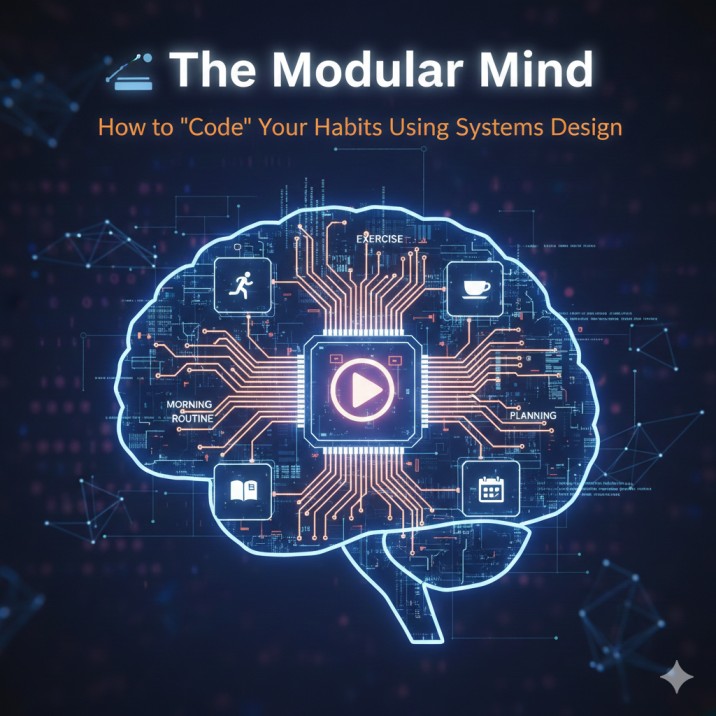
The modular approach — designing work in discrete blocks with protected transition time, anchoring recovery habits to natural workday junctures, and treating cognitive capacity as the primary metric of sustainable performance rather than output volume — is explored in practical detail in the Modular Habit Stacking guide at Omnisly. The principle is the same whether applied to personal routines or organisational workflow design: systems that don’t plan for recovery don’t recover.
A 2026 paper published in Frontiers in Psychology — “The Abstraction Habituation Model of Knowledge Worker Burnout” — offers a complementary explanation for why the standard rest-and-recover model fails for AI-related cognitive fatigue. The model argues that knowledge workers experience burnout not from resource depletion alone but from the habituation of cognitive flexibility — the gradual narrowing of the mental range available for novel, adaptive thinking that occurs when work becomes an unbroken stream of supervised abstraction. AI-supervised work, which involves constant evaluation of generated outputs against standards and expectations, is precisely the kind of sustained abstract task that drives abstraction habituation. Rest without changing the pattern of engagement doesn’t resolve it. The workflow itself needs to change.
Frequently Asked Questions
AI brain fry is a term coined by researchers at Boston Consulting Group to describe the specific cognitive fatigue that emerges from sustained AI supervision work — reviewing, verifying, correcting, and integrating AI-generated outputs across a workday. It is not a formal clinical diagnosis, but it maps onto well-documented mechanisms in cognitive neuroscience: the prefrontal cortex — which governs executive function, working memory, and complex judgment — operates as a bottleneck that is depleted by continuous deliberate decision-making regardless of whether those decisions concern AI outputs or traditional tasks. What distinguishes AI brain fry from ordinary work fatigue is the elimination of natural recovery breaks that were embedded in slower, more manual workflows. When AI accelerates every task, the transitions between cognitively demanding activities disappear, and the brain’s default mode network — which consolidates memory and restores executive function during apparent rest — never fully activates. The Harvard Business Review study of 1,488 workers found that workers performing similar cognitive tasks without AI involvement showed less fatigue and maintained more consistent decision quality throughout the day than their AI-supervised counterparts.
The primary mechanism is what researchers at BCG call “sphere of accountability expansion.” AI does not reduce the amount of work a knowledge worker is responsible for — it increases the amount they can produce, which causes organisational expectations to recalibrate upward to match the new capability ceiling. Engineering teams using AI coding assistants saw sprint velocity baselines rise 40% within two quarters, according to the 2026 GitLab Developer Survey. Marketing departments using AI content tools were expected to produce 3.2 times more content per month. The human cognitive budget required to supervise, verify, and integrate all that additional output is not proportionally smaller than the budget required to produce it manually — in many cases, research shows it is larger. The METR randomised controlled trial found that experienced developers using AI tools took 19% longer on tasks than the same developers working without AI. The overhead of AI supervision is real, it compounds across a workday, and it is not being offset by the recovery time that would be needed to sustain it.
A 2026 study from Carnegie Mellon University’s Human-Computer Interaction Institute, based on 3,800 knowledge workers, found that the average focus recovery time after a digital interruption now stands at 26.8 minutes — up from the 25-minute figure established by earlier UC Irvine research. Workers who experienced three or more interruptions per hour required up to 38 minutes to return to deep focus. In an AI-augmented workflow where multiple tools are producing outputs simultaneously — notifications from an AI assistant, suggestions in a code editor, summaries in a project management tool — the effective interruption rate can easily exceed three per hour, making sustained deep focus structurally impossible to maintain for meaningful stretches of the day. Frontiers in Human Neuroscience reported in 2025 that lapses in sustained attention reduce connectivity within the brain’s attention networks in less than two minutes of unregulated task switching.
The most evidence-based individual interventions operate at the workflow architecture level rather than the resilience level. Research consistently shows that planned attention shifts at natural stopping points — as opposed to reactive responses to AI-generated notifications — allow the brain’s default mode network to consolidate information and restore focus capacity. Specifically: batch processing AI outputs rather than reviewing them as they arrive, designating one AI tool per category of cognitive work to reduce context-switching load, enforcing micro-breaks of 15-17 minutes every hour (supported by a completed clinical trial from West University of Timisoara registered at ClinicalTrials.gov), and protecting at least one 90-minute block of genuine deep work per day where AI assistance is minimised. Deloitte’s 2025 Workforce Intelligence Report found that mental fatigue and cognitive strain have now surpassed workload volume as the leading predictors of burnout — meaning the quality of cognitive engagement matters more than the hours worked, and protecting the conditions for quality engagement is a practical intervention, not a luxury.
Yes, meaningfully so. The severity of AI cognitive fatigue correlates with the proportion of the workday spent in the AI supervision mode — reviewing, verifying, and integrating AI outputs — rather than in generative or relational work where AI assistance is minimal. Workers whose roles involve high volumes of AI-assisted text generation, code review, data analysis, or content verification show the highest fatigue markers. Gen Z workers show the highest overall burnout rates ever recorded, with 74% experiencing moderate or high burnout according to Aflac’s 15th annual WorkForces Report, which may partly reflect the intensity with which this cohort has adopted AI tools in its early career years. Creative professionals and those in roles with high relational demand — where human judgment and empathy drive the primary output — show lower AI-specific fatigue, because the supervision-to-generation ratio in those roles is more balanced. The abstraction habituation model of burnout, published in Frontiers in Psychology in 2026, suggests that the specific mechanism driving AI fatigue is the sustained narrowing of cognitive flexibility from an unbroken stream of evaluative abstraction — a pattern more pronounced in analytical and content roles than in roles with significant human interaction.
The Bottom Line
The narrative that AI is making knowledge workers more productive is true. The narrative that it is making them less exhausted is not — at least not yet, and not without deliberate design choices that most organisations and individuals are not currently making. A 2026 Harvard Business Review report found that while 77% of managers believe AI improves efficiency, 88% of heavy AI users report increased burnout. That contradiction explains the modern workplace better than most boardroom presentations ever will – itbusinesstoday
The output gains are real. The cost side of the ledger simply needs to be read as carefully as the benefit side.