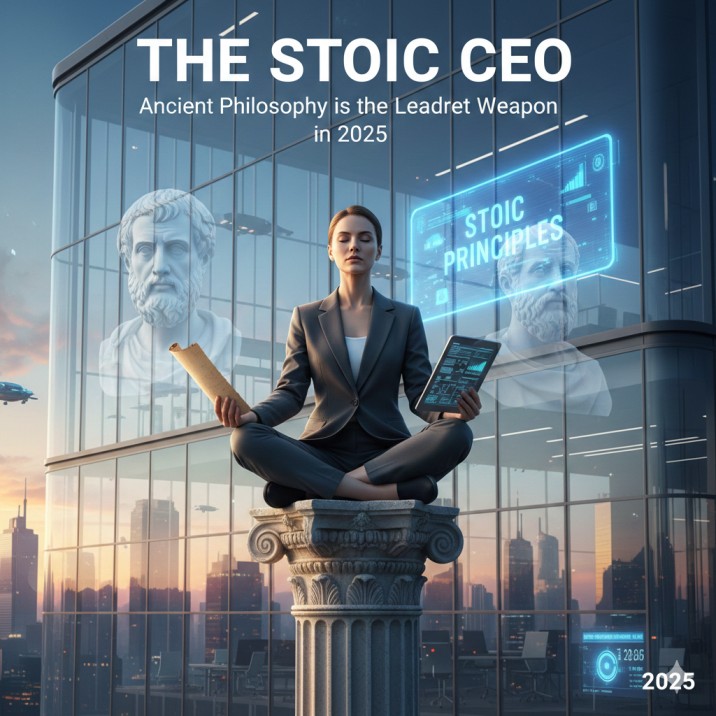
🏛️ The Stoic CEO: Why Ancient Philosophy is the Tech Leader’s Secret Weapon in 2025
In the dizzying, volatile world of 2025 technology – where innovation is relentless, disruption is the baseline, and public scrutiny is unyielding – a new kind of leader is emerging. This leader doesn’t find power in chaos; they find profound calm within it.
Forget the stereotypical Silicon Valley “guru” fueled by venture capital, ego, and endless caffeine. Today’s most resilient tech CEOs are turning to an ancient framework for mental fortitude: Stoicism.
This isn’t about sitting cross-legged or withdrawing from the world. It is a robust, practical operating system for navigating extreme pressure, making rational decisions, and maintaining equilibrium when the external world is swirling out of control. For CEOs steering giants through AI ethics dilemmas, geopolitical tensions, and market flash-crashes, Stoicism isn’t just a personal interest – it’s a competitive advantage.
The Unforgiving Arena of 2025 Tech Leadership
To understand why a 2,000-year-old Greco-Roman philosophy is trending in boardrooms, we must first analyze the unique, crushing pressures of the current landscape. The tech CEO of 2025 operates in a “high-entropy” environment where traditional management theories often fail.
1. Hyper-Volatility and “The Quarterly Pivot”
In the past, a five-year roadmap was a standard strategic document. Today, market trends no longer pivot annually; they shift quarterly. A breakthrough in Large Language Models (LLMs) or quantum computing can render a billion-dollar product line obsolete in a matter of weeks. The CEO must possess the mental agility to pivot without the emotional baggage of “sunk cost” attachment.
2. The Ethical AI Crucible
Leadership is no longer just about shipping code; it is about defining the moral boundaries of intelligence. As AI integrates into every facet of life, CEOs face intense, often conflicting pressure from regulators, privacy advocates, and hungry investors. The stakes aren’t just financial; they are existential.
3. The Talent Wars and Hybrid Cohesion
In a world of remote work and global competition, attracting top-tier engineering talent is a perpetual battle. Beyond compensation, today’s talent demands a leader with high emotional regulation and a clear purpose. A CEO prone to “Twitter-meltdowns” or reactive management is a liability to company culture.
4. The Burnout Epidemic
The 24/7 nature of global markets and the relentless pace of digital transformation have made mental fortitude a primary resource – one that is easily depleted. Without a sustainable “recharge” system, the most brilliant minds are prone to catastrophic burnout.
What is Stoicism? An Executive Summary
Originating in ancient Greece around 300 BC and reaching its height in the Roman Empire, Stoicism was never meant for the ivory tower. It was the philosophy of slaves like Epictetus and Emperors like Marcus Aurelius. It is, by design, a philosophy of action and resilience.
The Core Pillars of the Stoic Operating System:
- The Dichotomy of Control: The foundational realization that some things are “up to us” (our opinions, intentions, and actions) and everything else is not (the market, the weather, the opinions of others).
- Virtue (Arete) as the Highest Good: The belief that living with wisdom, justice, courage, and temperance is the only true way to achieve Eudaimonia (flourishing).
- Amor Fati (Love of Fate): The practice of not just tolerating reality, but embracing it – using every obstacle as fuel for growth.
- Premeditatio Malorum (Premeditation of Evils): The habit of visualizing potential disasters to remove the element of surprise and build psychological “scar tissue.”
- Rational Objectivity: Stripping away the “story” we tell ourselves about events to see the raw facts.
How Stoicism Powers the C-Suite: Four Case Studies in Resilience
1. Unflappable Decision-Making Amidst Crisis
Imagine a CEO facing a massive data breach. In a non-Stoic framework, the initial reaction is a cocktail of adrenaline, panic, and blame. This emotional cloud leads to poor communication and defensive posturing.
The Stoic CEO utilizes the Dichotomy of Control as a filter. They immediately categorize the event:
- The Uncontrollable: The breach has already happened. The stock price will dip. The media will be harsh.
- The Controllable: The transparency of the response, the technical fix, the support offered to affected users, and the internal morale of the engineering team.
By ruthlessly ignoring the “noise” of the uncontrollable, the CEO remains a calming anchor. They don’t waste mental CPU cycles on “Why did this happen to me?” Instead, they focus entirely on “What is the most virtuous next step?”
2. Resilience to Market Volatility (Amor Fati)
In 2025, stock prices can swing wildly based on a single algorithmic trade or a geopolitical rumor. A CEO who ties their self-worth to the ticker is destined for a volatile emotional life.
The Stoic CEO practices Amor Fati. If a product launch fails or a competitor steals market share, they don’t see it as a tragedy. They see it as data. Marcus Aurelius famously wrote: “The impediment to action advances action. What stands in the way becomes the way.” For the modern leader, a setback is simply a new set of parameters within which to innovate. This perspective creates a CEO who is “antifragile” – getting stronger with every stressor.
3. Ethical AI Governance (Virtue as the North Star)
The ethical dilemmas of 2025 are rarely black and white. Should a company sacrifice user privacy for a 10% gain in AI accuracy? For a leader driven purely by quarterly earnings, the choice is difficult. For the Stoic leader, the guiding star is Virtue.
- Wisdom to see the long-term consequences of current actions.
- Justice to ensure the technology serves humanity rather than exploiting it.
- Courage to stand up to board members who demand profit at the cost of ethics.
- Temperance to avoid the “move fast and break things” mania that leads to systemic risk.
A legacy is built on integrity. The Stoic CEO understands that being a “good person” and a “good leader” are not two different things; they are the same pursuit.
4. Neutralizing Burnout (Premeditatio Malorum)
Burnout often stems from the shock of unmet expectations. We expect things to go smoothly, and when they don’t, the friction causes mental exhaustion.
The Stoic practice of Premeditatio Malorum serves as a “pre-mortem” for the mind. Before a major launch, the Stoic CEO spends time visualizing the worst possible outcomes: the servers crash, the lead developer quits, and the press launch is a disaster.
This isn’t pessimism; it’s immunization. When a challenge inevitably arises, the Stoic CEO has already “lived it.” They are not caught off guard. This preparation preserves their limited supply of mental energy for solving the problem rather than processing the shock.
The Stoic “Leader-Manager” Framework
Stoicism also transforms how a CEO manages their team. A Stoic leader focuses on leading by example rather than through micromanagement or emotional manipulation.
Radical Objectivity (View from Above)
Stoics practice the “View from Above,” mentally zooming out from their current problems to see them in a global or even cosmic context. In the C-suite, this translates to radical objectivity. When two departments are at war, the Stoic CEO doesn’t take sides based on personality. They strip away the drama and look at the functional needs of the organization. They see the “architecture” of the problem rather than the “politics” of the people.
Communication with Temperance
In the age of instant social media amplification, a CEO’s words carry immense weight. A Stoic CEO employs Temperance in their speech. They are the last to speak in a meeting, ensuring they have gathered all facts. They don’t tweet in anger. They provide clear, reasoned logic that fosters trust and stability within the organization.
The Silent Revolution: Why Stoics Don’t Preach
One reason you don’t see “Stoicism” as a standard HR training module is that the philosophy emphasizes action over words.
The most effective Stoic CEOs in 2025 aren’t “preaching” Marcus Aurelius in their company-wide emails. Instead, their philosophy is observable through their behavior:
- They are the ones who remain calm during a “black swan” event.
- They are the ones who take responsibility for failures but share the credit for successes.
- They maintain a private practice – often journaling at dawn or dusk – to review their actions and align them with their values.
They recognize that their inner world is the only domain they truly govern. By mastering that domain, they are better equipped to navigate the external complexities of the global tech stage.
Implementing the Stoic Operating System: A 2025 Roadmap
For the executive looking to adopt this framework, it isn’t about reading a book once; it’s about daily practice. Here is how the modern CEO builds their “Inner Citadel”:
- Morning Reflection: Spend ten minutes visualizing the challenges of the day. Identify what is in your control. Set the intention to act virtuously regardless of the outcome.
- The Stop-Gap Rule: When a crisis occurs, implement a mandatory “rationality pause.” Ask: “Is this event itself bad, or is it my judgment of the event that is causing me pain?”
- The Evening Audit: At the end of the day, review your actions. Where did you lose your temper? Where did you act with courage? What can be improved tomorrow? This is the CEO’s version of Kaizen (continuous improvement) applied to the soul.
- Physical Discipline: Many Stoic CEOs use physical training (running, cold exposure, lifting) not just for health, but as a “voluntary hardship” to remind themselves that they can endure discomfort.
Conclusion: Code, Innovation, and Ancient Wisdom
The future of technology is being built on more than just neural networks and silicon; it is being built on a foundation of timeless philosophy. As the pace of change continues to accelerate toward 2030, Stoicism will likely transition from a “secret weapon” for the elite to a prerequisite for any leader aiming to survive.
The ultimate determinant of a CEO’s success in 2025 isn’t just their vision for the next product – it is their personal resilience. It is their ability to lead with an unshakeable inner compass in a world that is trying its best to spin them off course.
In the words of Marcus Aurelius: “Be like the promontory against which the waves continually break, but it stands firm and tames the fury of the water around it.” For the tech leaders of 2025, that promontory is Stoicism.