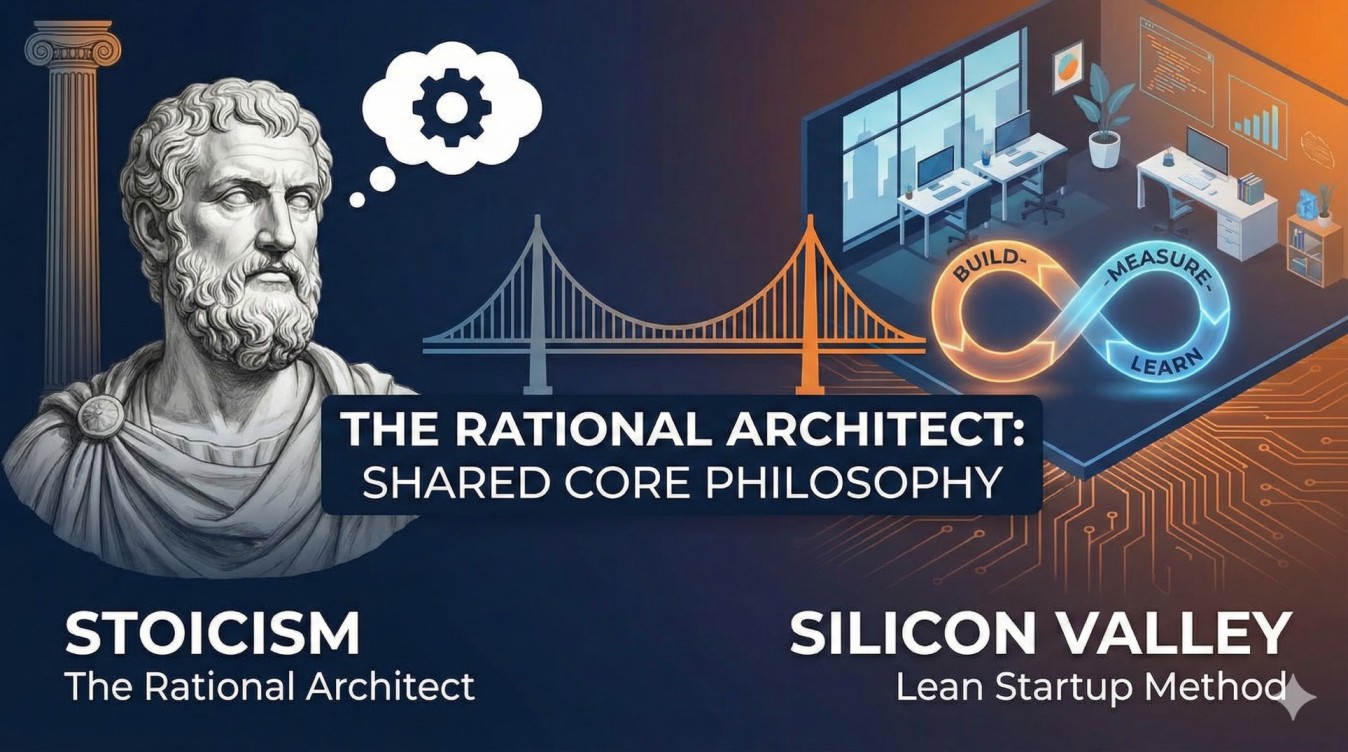
The Rational Architect: How Stoicism and Silicon Valley’s Lean Startup Method Share a Core Philosophy
The gulf between ancient Stoic philosophy and modern Silicon Valley entrepreneurship appears vast. On one side stands Stoicism, a school of thought founded in Athens around 300 BCE, focused on cultivating inner peace, moral virtue, and resilience through rational self-control. On the other is the Lean Startup methodology, a framework conceived in the early 21st century by Eric Ries, dedicated to building successful, scalable businesses amidst “extreme uncertainty.”
Yet, despite the two millennia separating their origins and their vastly different fields of application—the self versus the enterprise—a profound and illuminating symmetry emerges.
Both Stoicism and the Lean Startup are, at their core, prescriptive systems for navigating chaos. They are not doctrines of inaction or passive acceptance; rather, they are rigorous, methodical frameworks built for maximum effective action and minimal wasted effort (emotional or material). By dissecting their foundational principles—the Dichotomy of Control versus the Build-Measure-Learn loop, Premeditatio Malorum versus strategic pivoting, and the pursuit of virtue versus Validated Learning—we can clearly map the ancient, rational playbook shared by the Stoic sage and the successful startup founder.
1. The Discipline of Action: Dichotomy of Control vs. Build-Measure-Learn
The most powerful and immediate parallel between Stoicism and the Lean Startup is their shared instruction: rigorously define and focus solely on what is within one’s sphere of influence, thereby eliminating waste.
The Stoic Dichotomy of Control
For the Stoic, the first and most vital philosophical exercise is establishing the Dichotomy of Control. As Epictetus wrote in The Enchiridion, “Some things are in our control and others are not.” What is in our control are our opinions, judgments, desires, and actions; what is outside our control includes the market, the economy, other people’s opinions, and the final outcome of any endeavor.
The Stoic imperative is to apply 100% of one’s focus, energy, and emotional investment only to the controllable process, and to regard external outcomes with apatheia (a rational absence of irrational passion or suffering, not apathy). Worrying about a competitor’s funding or a customer’s buying decision is wasteful (external events); optimizing one’s pitch, work ethic, and product quality is the sole worthy application of effort (internal control).
The Lean Startup’s Build-Measure-Learn Loop
The Lean Startup methodology, developed by Eric Ries, is precisely a modern, digitized Dichotomy of Control applied to organizational design. It replaces the traditional, multi-year business plan—a massive leap-of-faith prediction about an uncontrollable future—with the Build-Measure-Learn (BML) feedback loop.
The BML loop is the entrepreneur’s sphere of control. The team is instructed to:
- Build the Minimum Viable Product (MVP)—an action entirely within the team’s power.
- Measure the response—a rigorous, objective process also controlled by the team’s choices in metric selection (using “Innovation Accounting“).
- Learn whether to pivot or persevere—a rational judgment based on the gathered data.
The startup cannot control whether the customer likes the product (the external outcome), but it can absolutely control the speed and rigor of the BML cycle (the internal process). Just as the Stoic finds tranquility by focusing on their judgment, the Lean founder finds efficiency by focusing on the iteration cycle time. Both systems channel energy away from uncontrollable external anxiety (Will we succeed? Will the market crash?) and into the manageable internal engine (What is the best next experiment? How quickly can we learn?). Waste, in both contexts, is defined as the effort spent on anything outside this controlled process.
2. The Discipline of Perception: Embracing Objectivity and Truth
A key tenet of Stoicism is the Discipline of Perception, which teaches that external events are inherently neutral; it is our irrational judgments and interpretations of those events that cause distress. Similarly, the Lean Startup demands a ruthless commitment to objectivity, replacing emotional narrative with empirical data.
The Neutrality of Data vs. Neutrality of Events
Marcus Aurelius frequently advised himself to “strip away the anecdote” and see things as they truly are. If a colleague criticizes his decision, the event itself (the criticism) is merely noise; the harm comes from the judgment (e.g., “This criticism means I am a failure”). The Stoic practice is to reframe the event neutrally: “A person expressed a negative opinion about my choice. This is information.”
The Lean Startup formalizes this same neutrality through Validated Learning and the strict rejection of Vanity Metrics. Founders are notoriously prone to emotional bias, seeing only what they want to see (e.g., celebrating high sign-ups while ignoring high churn). Validated Learning requires the entrepreneur to view a failed product launch not as a personal failure or a catastrophe, but as an empirical data point confirming that a specific hypothesis (the value hypothesis or the growth hypothesis) was false.
Metrics are only valuable if they are Actionable, Accessible, and Auditable. This is the modern, scientific analogue to the Stoic’s call for clarity of judgment:
- Actionable: The metric must allow the team to establish a cause-and-effect relationship between their action (e.g., changing a button color) and the measured result (e.g., conversion rate). This strips away emotional narrative and isolates the controllable variables.
- Accessible: The data must be understood by the whole team, fostering a culture of objective, shared truth rather than subjective, political interpretation.
The goal is the same: to avoid suffering (emotional distress or wasted resources) by ensuring that decisions are based on verifiable fact, not on comforting illusions or fear-driven interpretations.
3. The Discipline of Desire: Managing Expectations through Negative Visualization and Strategic Pivoting
The path of both the philosopher and the entrepreneur is littered with setbacks, unexpected disasters, and the constant threat of failure. Stoicism and the Lean Startup both provide tools to mentally inoculate the practitioner against the shock of reality, ensuring that setbacks lead to learning, not paralysis.
Premeditatio Malorum vs. The Pivot
The Stoic practice of Premeditatio Malorum (pre-meditation of evils, or negative visualization) is often misunderstood as pessimism. It is, in fact, a cognitive preparation for loss. Seneca encouraged meditating on the worst-case scenario—loss of wealth, health, or social standing—so that when fate inevitably delivers a blow, it is received not with shock, but with familiarity. This practice minimizes the emotional impact of external events, thereby preserving rational capacity for effective response.
In the startup world, the Pivot is the institutionalized, organizational equivalent of Premeditatio Malorum. A Pivot is defined as a “structured course correction designed to test a new fundamental hypothesis about the product, strategy, or engine of growth.” It is the moment when the data confirms the worst-case scenario—that the original vision (or a key component of it) is unviable.
Crucially, Ries insists that the Pivot should be celebrated as a moment of Validated Learning, not mourning. The entrepreneur, like the Stoic who has mentally prepared for adversity, avoids the emotional paralysis of denial and shame. By preemptively defining the metrics that would necessitate a pivot (the equivalent of meditating on the loss), the founder creates a detached, rational trigger for a strategic change. The pain of realizing the initial idea was flawed is mitigated because the failure was anticipated, documented, and immediately repurposed for the next iteration. The Pivot ensures that the entrepreneur, like the Stoic, turns the impediment to action into action itself.
Amor Fati and Embracing Necessary Change
The ultimate expression of Stoic resilience is Amor Fati—the love of one’s fate, the enthusiastic acceptance of all that happens. This acceptance is not resignation, but a deep appreciation for the unfolding of reality as necessary and useful for training character.
In the Lean context, Amor Fati manifests as the acceptance that the successful company will likely look nothing like the initial vision. Ries notes that the initial idea is merely a “leap-of-faith assumption.” The Lean founder must love the process of discovery, love the feedback from the market, and love the necessary destruction of the original idea if the data demands it. This means embracing necessary change (the Pivot) enthusiastically, recognizing that the current disaster (a failed feature, a missed market projection) is the very thing that reveals the true, viable path forward. The obstacle truly “becomes the way.”
4. The Discipline of Right Action: Efficiency and the Minimum Viable Product
The Stoic life is fundamentally about virtue—not moral righteousness, but excellence or right action rooted in wisdom (phronesis), justice, temperance, and courage. Every action must be deliberate, purposeful, and efficient.
The MVP as a Virtuous Tool
The Minimum Viable Product (MVP) is the epitome of efficiency and right action in the Lean methodology. The MVP is the version of a new product that allows a team to collect the maximum amount of validated learning about customers with the least amount of effort.
This definition is deeply virtuous in the Stoic sense:
- Temperance (Self-Control): The MVP counters the vice of over-indulgence—the temptation to build every feature, to seek perfection before launch (the “Think Progress, Not Perfection” tenet). It requires the temperance to withhold unnecessary effort and delay gratification.
- Wisdom (Prudence): The MVP is explicitly designed to test the riskiest, “leap-of-faith assumptions” first. This is an application of wisdom—identifying where knowledge is weakest and prioritizing the collection of the most crucial information. The MVP prevents the waste of months or years of engineering effort dedicated to an unproven idea.
- Justice (Fairness): The Lean approach emphasizes working with real customers from the outset (the early adopters). This avoids wasting the customer’s time or misleading them with a promise of a final product, ensuring the team deals ethically and transparently with its stakeholders.
For the Stoic, the virtuous action is the efficient action—the one that accomplishes its goal with minimal emotional cost and maximum rational benefit. For the founder, the MVP is the efficient action—the one that achieves the maximum validated learning with the minimum material cost and cycle time.
Conclusion: The Fortification Against Uncertainty
The connections between Stoicism and the Lean Startup methodology are more than coincidental; they reflect a universal human need for a rational framework to navigate uncertainty and change. Both systems recognize that the world is chaotic, unpredictable, and largely beyond our direct control.
The genius of Stoicism was to build an internal fortress—a psychology—based on logic and self-discipline to absorb external shocks and maintain the integrity of one’s judgment and action. The genius of the Lean Startup was to build an organizational fortress—a process—based on scientific experimentation and rapid iteration to absorb market shocks and maintain the integrity of the company’s learning engine.
In the end, both philosophies lead to the same practical outcome: a practitioner who is less emotional, more objective, relentlessly focused on process, and strategically prepared for failure. The Stoic seeks eudaimonia (human flourishing) through rational virtue; the Lean founder seeks a sustainable business model through rational experimentation. Both achieve their respective goals by relentlessly adhering to the principles of efficiency, self-awareness, and the fundamental wisdom of distinguishing between what can be acted upon and what must simply be accepted. The ancient wisdom of the Stoa remains the most resilient strategy for success in the volatile, high-stakes environment of modern Silicon Valley.