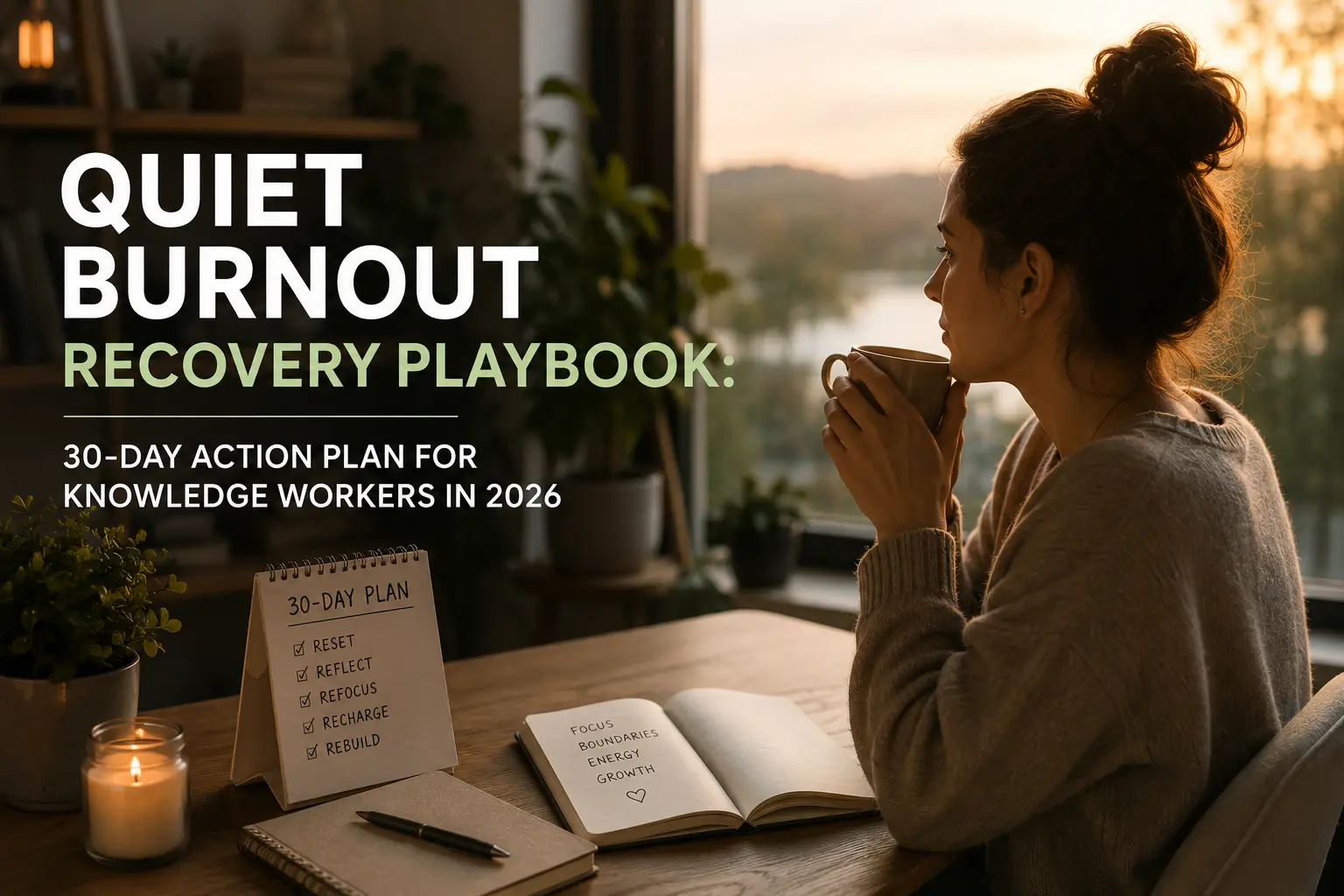
Quiet Burnout Recovery Playbook: 30-Day Action Plan for Knowledge Workers in 2026
It is 3:00 PM on a Tuesday in 2026. You have just finished a seamless 45-minute virtual meeting where your AI assistant, “Aura,” perfectly transcribed the notes, flagged your action items, and even suggested a polished follow-up email draft. To an outside observer, you are the picture of peak efficiency—a high-performance node in a global network.
But inside? You feel like a hollowed-out tree. You aren’t “exploding” with stress; you are quietly fading into the background of your own life. You are hitting your KPIs, your Slack “dot” is green, and your output is consistent, but the “you” that used to find joy in solving problems has gone offline.
This is Quiet Burnout. In the 2026 “Always-On” economy, it is the most insidious threat to knowledge workers. Unlike the spectacular meltdowns of the past, quiet burnout is a slow, cold desaturation of your passion. You aren’t quitting; you’re just disappearing while staying in your chair.
Part 1: The 2026 Burnout Architecture
In 2026, the variables have shifted. Burnout is no longer just about “too many hours.” According to recent studies from the American Psychological Association (APA), the primary driver of mid-decade burnout is “Cognitive Fragmentation.” We are now switching between human collaboration and AI-managed task lists every few seconds. This constant context switching creates a metabolic debt in the brain—specifically in the prefrontal cortex—that standard sleep cannot pay back. We aren’t just tired; our neural circuits are literally frayed from “over-optimization.”
Real Recovery Story: Mark, Senior Developer, Seattle
“I thought I was fine because I wasn’t crying at my desk. But then I realized I hadn’t listened to music in six months. I drove in silence. I ate in silence. I was performing ‘Mark’ for my team, but I was actually just a script running in the background. My ‘Nervous System Latency’ was so high I couldn’t even feel joy when we finally shipped our biggest project. I was a ghost in my own machine.”
Part 2: The 30-Day Recovery Playbook
Recovery isn’t a vacation; it’s a re-coding of your internal Operating System. This 30-day plan is designed to be a structural reset for the knowledge worker who feels they are running on 1% battery.
Phase 1: Days 1–10 — The Nervous System “Hard Reset”
The goal of the first ten days is to shift your body from a permanent Sympathetic (fight or flight) state into a Parasympathetic (rest and digest) state. Your brain currently treats a Slack ping like a digital predator. We need to lower that threat response.
The Action Items:
- The “8-to-8 Dark Rule”: No screens after 8:00 PM and no screens until 8:00 AM. This protects your circadian rhythm from the hyper-vibrant blue light of 2026 devices, allowing for actual neural repair during sleep.
- Sensory Deprivation Windows: Twice a day, sit in total silence for 10 minutes. No podcasts. No music. No AI assistants. Just the physical world. This clears the “cognitive cache” of your working memory.
- The Physiological Sigh: Every time you transition between tasks, take a double-inhale through the nose and a long exhale through the mouth. This is the fastest biological hack to lower your heart rate.
Phase 2: Days 11–20 — Cognitive Re-Calibration
Now that the ambient noise is lower, we fix the logic. Burnout in 2026 is often driven by Productivity Dysmorphia—the feeling that you are perpetually behind because the “Work Stream” is infinite.
The Action Items:
- The “Done” List: Instead of a To-Do list, keep a “Done” list. At the end of every day, write down three things you achieved that had nothing to do with your salary. Example: “Cooked a real meal,” “Spoke to a friend for 20 minutes,” “Walked the dog without my phone.”
- AI Boundaries: Stop using AI to “do more.” Start using it to “do less.” If an AI saves you an hour, do not fill that hour with work. Give that hour back to your nervous system.
- Analog Integration: Spend one hour a day doing something that requires your hands—gardening, cooking, or building. This “concrete” work provides a counterweight to the “abstract” work that drains knowledge workers.
Phase 3: Days 21–30 — Building the Firewall
Finally, we build the defenses. You are going back into the high-intensity world, but this time you will have an encrypted “Inner Citadel” that protects your energy.
The Action Items:
- The “Deep Work” Fortress: Schedule two blocks of 90 minutes per day where you are “Dark.” Use your AI to auto-reply: “In a deep-focus block. Will respond at [Time].”
- Standardized Interfaces (Social): Define your social contract. Tell your colleagues: “I am available on Slack from 9 AM to 5 PM. Outside of those hours, I am offline for maintenance.”
- The Weekly Audit: Every Sunday, ask yourself: “Where did my energy leak this week?” Identify the “Buggy Apps” (the toxic meetings or pointless tasks) and delete them from your schedule for the next week.
FAQ: Navigating the Recovery Process
Q: Won’t my career suffer if I set these boundaries?
A: In the AI-heavy economy of 2026, “Speed” is a commodity. “Judgment” is a luxury. You cannot have good judgment with a burnt-out brain. By protecting your energy, you are actually increasing your market value as a high-level thinker.
Q: Is Quiet Burnout a medical diagnosis?
A: The World Health Organization (WHO) classifies burnout as an occupational phenomenon. Quiet Burnout is the sub-clinical precursor. If your “battery” remains at 0% even after Phase 1, it is essential to consult a professional, as it may be masking clinical depression.
Q: How do I handle “AI Anxiety” during recovery?
A: Stop trying to keep up with every update. Focus on the tools that directly solve your “Gray Work” (admin). Let the AI be the intern; you remain the Architect. Architects don’t need to know how every brick is made; they need to know where the building is going.
The Power of the “Analog Dividend”
When you finish this 30-day plan, you will have what we call the “Analog Dividend”—extra time and mental energy reclaimed from the digital void. The temptation will be to reinvest that energy back into work to “catch up.”
Don’t do it. The Analog Dividend belongs to your family, your health, and your creative soul. In 2026, your worth is not defined by your responsiveness or your “uptime.” It is defined by the quality of your presence. Recovery isn’t a sign of weakness; it’s the ultimate act of self-management.
Saying “No” to the Always-On expectation is the most revolutionary thing you can do for your career.
7-Day Digital Detox Kickstart (The “First Week” Checklist)
Day 1: Disable all non-essential “Push” notifications.
Day 2: Delete “Work Apps” (Slack/Email) from your personal phone. Use the browser only.
Day 3: Buy a physical alarm clock. Leave your phone in the kitchen at night.
Day 4: Take a 20-minute walk with zero audio—no music, no podcasts.
Day 5: Re-read a physical book for 30 minutes before bed.
Day 6: Have a “Camera-Off” day. Tell your team you are doing a “Cognitive Load Reset.”
Day 7: Spend 4 hours completely offline. Observe the “Phantom Ring” itch—and let it pass.
References and Authoritative Sources:
- American Psychological Association (APA): 2026 Work and Well-being Survey.
- World Health Organization (WHO): ICD-11 Occupational Burnout Guidelines.
- Mayo Clinic: Strategies for Preventing Professional Burnout in Knowledge Workers.