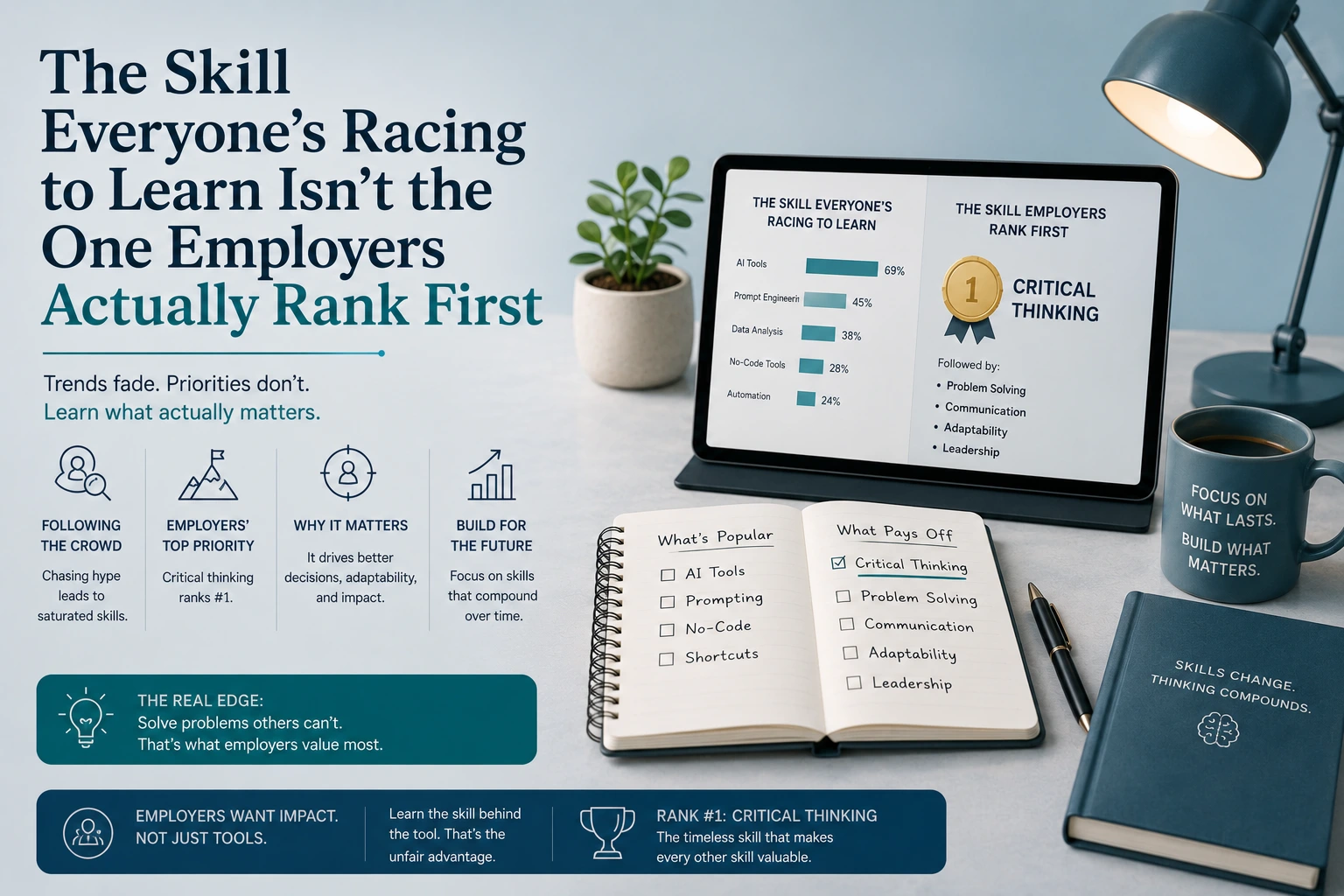
The Skill Everyone’s Racing to Learn Isn’t the One Employers Actually Rank First
Ask most people what skill matters most in an AI workplace and you’ll get some version of the same answer: learn to use the tools, get good at prompting, become “AI fluent.” That’s not wrong exactly, but it’s not what the largest employer survey on this exact question actually found. The single most in-demand skill, named essential by seven out of ten companies surveyed, isn’t AI literacy at all. It’s a much older, less flashy capability that AI happens to make more valuable, not less.
What Employers Are Actually Saying, at Scale
The most comprehensive data available on this question comes from a survey large enough to matter. The World Economic Forum’s Future of Jobs Report 2025, based on responses from more than 1,000 employers across 55 economies representing over 14 million workers, found that analytical thinking remains the single most sought-after core skill, considered essential by 70% of companies surveyed — ranking above resilience, flexibility and agility, and leadership and social influence, which rounded out the next tier of most-valued core skills. AI and big data literacy is real and rising fast, but it shows up in the report as the fastest-growing skill category, not the most currently essential one — a distinction that matters more than it sounds like it should.
That gap between “fastest-growing” and “most essential right now” is the whole story most casual coverage of this topic misses. Employers aren’t saying AI skills don’t matter. They’re saying that even in a workplace being reshaped by AI, the capacity to break down a complex problem, evaluate evidence, and reach a sound conclusion still sits above raw tool fluency in how essential it actually is to getting hired and staying valuable.
Why a Cluster of “Soft” Skills Is Rising Together, Not Just AI Literacy
Look past the single top-line skill and a pattern emerges that’s more useful than any individual ranking. The same WEF report found that alongside AI and big data, the skills employers expect to rise most in importance through 2030 include creative thinking, resilience, flexibility and agility, and curiosity and lifelong learning — a cluster of capabilities that share almost nothing in common with each other except that none of them are easily reducible to a repeatable, well-defined procedure. These aren’t skills that got more valuable despite AI’s rise. They’re rising specifically because AI is absorbing the routine, well-defined work that used to fill a large share of most jobs, leaving the non-routine remainder — judgment, adaptability, original thinking, and the willingness to keep learning as the ground shifts — as a proportionally larger and more visible share of what actually distinguishes one employee from another.
This connects directly to something worth understanding about how AI actually reshapes work day to day. The Bureau of Labor Statistics, in its analysis of how it incorporates AI’s impact into employment projections, surveyed legal, tax, and accounting professionals and found that 67% forecasted AI would have a transformational or high-impact effect on their profession within five years, with improved productivity cited as the top expected benefit rather than headcount reduction as the primary driver. That framing — productivity gain rather than pure replacement — is exactly the environment where the WEF’s rising skills cluster becomes valuable: when AI makes each person capable of producing more, the bottleneck shifts from raw output capacity to the judgment required to direct that increased capacity well.
The Skill Most Aligned With the Data but Least Talked About
Underneath the WEF’s headline categories sits a more specific capability worth naming directly, because it doesn’t have a catchy name of its own yet: the judgment to evaluate AI output rather than simply accept or reject it wholesale. As AI absorbs more of the actual production of text, code, analysis, and drafts, the remaining human bottleneck increasingly isn’t creating the first version of something — it’s deciding whether that first version is actually right, complete, and appropriate for the situation. That’s a distinct skill from either “using AI” or “not trusting AI.” It’s closer to editorial judgment, applied at scale, across far more raw material than any individual could have personally produced themselves a few years ago.
We’ve written about this specific skill directly, because it’s become load-bearing in a way that deserves more attention than it gets. Our guide to fact-checking AI answers covers the actual mechanics of doing this well — knowing which claims need scrutiny and which don’t, rather than either blind trust or blanket suspicion. That calibrated judgment is, in practice, a close cousin of the analytical thinking the WEF survey ranks first, just applied specifically to AI-generated material rather than raw information generally.
What “AI Literacy” Actually Means Beyond Knowing How to Prompt
It’s worth being specific about what the fastest-growing skill category actually involves, because “AI and big data literacy” gets flattened in casual usage into “knows how to use ChatGPT,” which understates what employers are actually asking for. It includes understanding what a given AI tool is structurally good and bad at, knowing when a task genuinely benefits from AI assistance versus when it doesn’t, recognizing the specific failure modes these tools have — confidently stated but incorrect information chief among them — and being able to integrate AI output into a broader workflow without either over-relying on it or refusing to use it out of unexamined caution. This looks less like a single technical skill and more like a working mental model of the technology’s actual strengths and blind spots, which explains why it clusters so naturally with analytical thinking rather than standing apart from it.
How to Actually Build These Skills, Not Just Know About Them
None of the skills on this list are acquired by reading about them, which makes the practical version of this advice more important than the ranking itself. Analytical thinking sharpens through repeated practice breaking down genuinely ambiguous problems, not tidy textbook exercises with a single correct answer — deliberately seeking out the messier, less-defined parts of your role does more for this skill than any course. Resilience and adaptability build through actually navigating change rather than reading about resilience, which means volunteering for the project whose outcome isn’t predetermined is more useful than it sounds. The judgment to evaluate AI output specifically builds through the habit covered in our fact-checking guide — deliberately verifying AI-generated claims often enough that spotting a plausible-but-wrong answer becomes closer to reflexive than effortful.
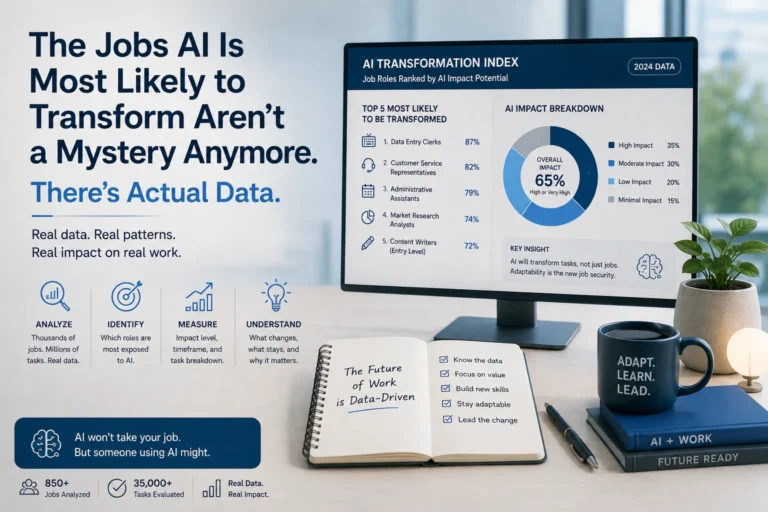
This all connects to a broader shift worth understanding in context. Our piece on how AI is changing knowledge work and our breakdown of which specific jobs show the highest real-world AI exposure both point toward the same underlying pattern the WEF skills data confirms from a different angle: the work that’s shrinking is disproportionately routine and well-defined, and the skills rising in value are disproportionately the ones that don’t reduce to a repeatable procedure. And since building a genuinely broad, connective skill set is different from just accumulating narrow technical competencies, our piece on why connecting ideas across domains is outcompeting narrow specialization is worth reading as a companion to this one.
Why This Isn’t Just Recycled Career Advice
It’s fair to be skeptical of a list like “analytical thinking, resilience, creative thinking” — it sounds close to generic career advice that’s been recycled for decades regardless of what technology happened to be trendy that year. The honest response is that the skills themselves aren’t new, but their relative weight is shifting in a specific, measurable way, and that shift is the actual news here. A decade ago, a large share of entry and mid-level roles could be genuinely successful built primarily around procedural competence — knowing the process, executing it reliably, and doing so faster or more accurately than peers. The WEF data suggests that competitive advantage is compressing fast, precisely because AI now handles a growing share of exactly that kind of procedural execution.
What’s left over, disproportionately, is the part of work that was always harder to teach and always took longer to develop — which is exactly why it’s becoming the actual differentiator rather than a supplementary nice-to-have. This isn’t the technology inventing new virtues out of nowhere. It’s the technology removing a layer of work that used to let procedural competence alone carry someone fairly far in a career, and leaving the judgment-heavy layer underneath it far more exposed and consequential than it used to be.
A Quick Audit of Your Own Skill Portfolio
A useful, honest exercise: list the skills you currently rely on most in your role, and sort them by how procedural versus how judgment-dependent each one is. A skill that mostly involves following a known process, applied consistently, sits closer to the category the labor data shows AI absorbing. A skill that involves weighing trade-offs, adapting to a genuinely new situation, or evaluating whether something produced by a tool or a person is actually right sits closer to the category both the WEF survey and the broader labor market data show rising in value. Most careers involve a mix, and deliberately shifting your own effort and visible reputation toward the second category, rather than assuming your existing procedural strengths will keep mattering the way they used to, is the practical translation of everything the data above actually says.
Frequently Asked Question
What is the single most valuable skill employers want right now?
According to the World Economic Forum’s Future of Jobs Report 2025, analytical thinking is the most sought-after core skill, considered essential by 70% of the more than 1,000 employers surveyed, ranking above resilience, leadership, and other core skills.
Is AI literacy the most important skill in an AI workplace?
AI and big data literacy is the fastest-growing skill category according to the WEF’s employer survey, but it isn’t currently ranked as the single most essential skill — analytical thinking holds that position. The distinction matters because a skill can be rapidly rising in importance without yet being the most established requirement for most roles.
Which other skills are rising in importance alongside AI literacy?
The WEF’s Future of Jobs Report 2025 found creative thinking, resilience, flexibility and agility, and curiosity and lifelong learning are all rising alongside AI and big data as top skills through 2030. These skills share the common trait of not reducing to a repeatable, well-defined procedure, which is exactly the kind of work AI currently absorbs least effectively.
Why are judgment-based skills becoming more valuable as AI adoption grows?
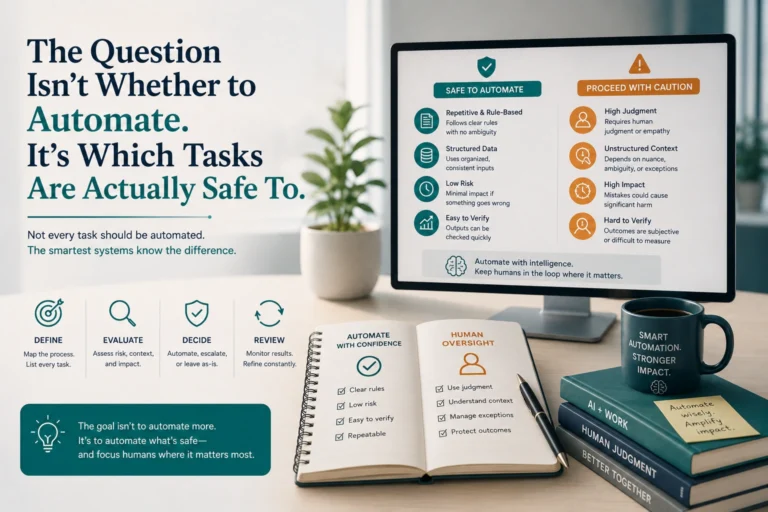
As AI absorbs routine, well-defined tasks, the bottleneck in most roles shifts from raw output capacity to the judgment required to direct and evaluate that increased output well. The Bureau of Labor Statistics found professionals expect AI’s biggest impact to come through improved productivity rather than simple headcount reduction, which is exactly the environment where judgment-heavy skills become the differentiator.
What does AI literacy actually mean beyond knowing how to write prompts?
Genuine AI literacy includes understanding what a given AI tool is structurally good and bad at, recognizing its common failure modes like confidently stated but incorrect information, knowing when a task genuinely benefits from AI assistance, and integrating AI output into a broader workflow without over-relying on it or avoiding it out of unexamined caution.
How can I actually build the skills that are rising in value?
These skills build through practice rather than study. Deliberately taking on ambiguous, less-defined problems builds analytical thinking and resilience more effectively than structured courses, and consistently verifying AI-generated claims before trusting them builds the judgment needed to evaluate AI output well, which is increasingly one of the most valuable applied skills in an AI-integrated workplace.
The Conclusion
The skill employers rank most essential in an AI workplace isn’t AI fluency itself — it’s analytical thinking, the older, more general capacity to break down a problem and reach a sound conclusion, with AI and big data literacy following close behind as the fastest-growing but not yet the most established requirement. A whole cluster of judgment-dependent, non-procedural skills is rising alongside it, precisely because AI is absorbing the routine work that used to crowd those skills out.
The practical response isn’t choosing between learning AI tools and building these broader skills — it’s recognizing they compound each other. Genuine AI fluency, paired with the analytical judgment to evaluate what these tools produce, is a stronger position than either one alone, and it’s exactly the combination the data suggests is becoming the actual differentiator going forward.