🛡️ The Silent Pandemic: Navigating “Quiet Burnout” in the 2026 Always-On Economy
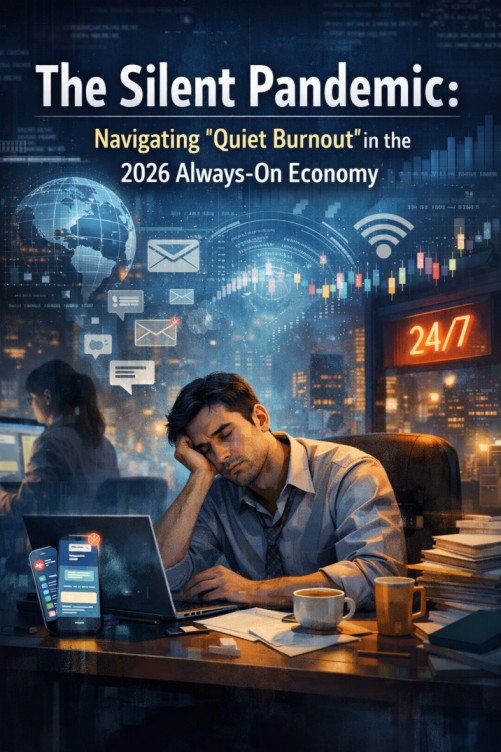
In 2026, the term “burnout” has undergone a radical and troubling evolution. It is no longer merely the predictable result of a grueling sixty-hour work week or a demanding boss. Instead, burnout has become a systemic byproduct of the “Always-On” Economy, the staggering cognitive load of rapid AI integration, and the “infinite workday” born from the final dissolution of remote work boundaries.
As we navigate this mid-decade landscape, recent data suggests that roughly 66% of the global workforce reports experiencing some form of chronic burnout. However, the most dangerous iteration of this condition isn’t the loud, explosive breakdown of the past. It is “Quiet Burnout” – a state of existence where you appear perfectly engaged on a high-definition screen, hitting your KPIs and responding to Slack threads, while your internal battery has been sitting at 1% for months.
If you feel “off”—a sense of hollowed-out exhaustion that sleep cannot fix – it is likely that your system is crashing. To recover, we must first diagnose the specific pathologies of the 2026 workplace.
Part 1: The 10 Signs of 2026 Burnout
The first step in any recovery roadmap is accurate detection. In the current era, burnout hides behind productivity tools and “flexibility.” Here are the ten specific markers that your professional life is cannibalizing your personal well-being.
1. The “Digital Hangover”
In 2026, we have moved beyond simple “Zoom fatigue.” We are now dealing with the Digital Hangover. This is a lingering state of mental fog that persists long after you have closed your laptop. It is characterized by “doom-scrolling” without retention – staring at a phone screen for thirty minutes while your brain fails to process a single sentence. If you feel a micro-surge of cortisol – a tiny, sharp prick of anxiety – every time a notification “ping” hits your ears, you are living in a state of sensory over-extension.
2. “Camera-Off” Syndrome
In the early 2020s, turning the camera off during a meeting was seen as a luxury or a casual choice. In 2026, it has become a diagnostic symptom. If you find yourself avoiding face-to-face video interaction because the mere thought of “performing” engagement – managing your facial expressions and maintaining eye contact with a lens – feels physically painful, your social battery is critically depleted. This is your brain’s way of shrinking its “bandwidth” to prevent a total system shutdown.
3. Decisions Feel Like Mountains
Burnout is, at its core, an attack on executive function. The prefrontal cortex, responsible for complex decision-making, is the first part of the brain to “brown out” under chronic stress. If deciding what to eat for dinner or determining which email to answer first feels as taxing as delivering a board presentation, your brain has entered “power-save mode.” You are no longer prioritizing; you are merely surviving the next ten minutes.
4. The “Second Shift” Resentment
As the physical lines between home and office have been completely erased by ubiquitous high-speed connectivity, the 2026 worker often feels they are starting a “second shift” the moment they log off. This shift involves handling domestic chores, family needs, or the “side hustles” that the current economy often demands. If you feel a deep, simmering resentment toward these once-joyful responsibilities, it is a sign that your capacity for care has been fully exhausted. You have nothing left to give because your “work-self” has already spent the entire day’s budget of patience.
5. AI Anxiety & “Task Paralysis”
The 2026 boom in generative AI tools has created a specific psychological phenomenon: Cognitive Overload Burnout. There is a constant, ambient pressure to “upskill or be replaced,” leading workers to spend more energy worrying about how to use new tools than actually using them. This results in task paralysis – a state where the sheer volume of “efficient” options leads to a total inability to finish even the simplest assignment.
6. Physical “Check Engine” Lights
The body often knows the mind is burnt out before the ego admits it. In 2026, this manifests in three distinct ways:
- Persistent Muscle Tension: Specifically a “locked” jaw (bruxism), and chronic tightness in the levator scapulae (the “tech neck” muscles).
- Sleep Fragility: You are physically exhausted, yet you wake up at 3:00 AM with a racing heart, your mind instantly indexing your “To-Do” list for a day that hasn’t even started.
- Lowered Immunity: Catching every “office bug” or seasonal cold despite working from home. Your stress hormones (cortisol) are suppressing your immune response.
7. Compassion Fatigue (Depersonalization)
One of the hallmark signs of deep burnout is depersonalization. You find yourself rolling your eyes at a colleague’s genuine personal struggle or feeling a chilling indifference to the company’s mission that you once championed. This isn’t because you have become a “bad person”; it is a primitive defense mechanism. Your brain is detaching from the world to protect itself from further emotional drain.
8. The “Weekend Recovery” Fallacy
If you spend your entire Saturday and Sunday in a state of near-catatonia – lying on the couch “recovering” – only to find that by Sunday night you feel just as drained as you did on Friday, you are in deep water. In 2026, we must recognize that rest is not recovery. If rest no longer feels restorative, you aren’t just tired; you are suffering from a systemic physiological imbalance.
9. Productivity Dysmorphia
Even when you hit your quarterly targets, clear your inbox, or finish a major project, you feel like a failure. You focus entirely on the three tasks you didn’t get done rather than the fifty you did. In 2026, “hustle culture” has morphed into a digital shadow that makes you feel perpetually behind, regardless of your actual output. This is the result of the “infinite scroll” mentality applied to work: there is always more to do, so you never feel “done.”
10. Withdrawal from the “Real” World
The final stage is a retreat into the digital cave. You start canceling plans with friends – not because you are “busy,” but because the effort of a real-world, unscripted conversation feels insurmountable. You prefer the “parasocial” comfort of watching a streamer or scrolling a feed over the actual effort of connecting with another human being. Your “relational bandwidth” has hit zero.
Part 2: The 2026 Burnout Recovery Roadmap
Fixing burnout in the modern era isn’t about taking a week-long vacation to a beach where you still check your emails. It requires a structural reset of your nervous system and a fundamental redesign of your “Human Operating System.”
Step 1: Conduct a “Nervous System Reset”
In 2026, your nervous system is likely stuck in the Sympathetic (fight or flight) branch. You are perpetually “revving the engine” in neutral. To heal, you must force a shift into the Parasympathetic (rest and digest) mode.
- The Physiological Sigh: This is the fastest biological hack to lower your heart rate. Inhale deeply through the nose, take a second shorter “sip” of air at the very top to fully expand the lungs, then exhale slowly through the mouth. Repeat this three times to signal to the brainstem that the “threat” has passed.
- Non-Sleep Deep Rest (NSDR): Spend 20 minutes a day in a “sensory neutral” environment. No podcasts, no white noise – just stillness. This allows the brain to clear out metabolic waste (adenosine) that builds up during high-intensity cognitive work.
Step 2: Implement the “Hard Boundary” Policy
The “Always-On” culture only stops when you build a physical and digital wall. In 2026, “soft boundaries” are no longer sufficient because our devices are designed to bypass them.
- The Digital Sunset: Set a firm “No Screens” rule at least 90 minutes before bed. In 2026, the blue light from our ultra-vibrant OLED screens is more disruptive to melatonin than ever before. Switch to an E-ink reader or a physical book to signal to your circadian rhythm that the workday is officially terminated.
- The “One-Hour Grace Period”: Do not check your phone for the first hour of your day. By checking Slack or email the moment you wake up, you are ceding control of your focus to the world’s priorities. Start your morning in a “proactive” state – movement, hydration, and sunlight – rather than a “reactive” one.
Step 3: Prioritize “Low-Stakes Flow”
Burnout often results from spending 100% of your time in “high-stakes” environments where failure has consequences. To heal, you must find an activity that induces a Flow State with zero stakes.
A flow state is when the challenge of an activity perfectly matches your skill level, causing time to “disappear.” In 2026, we recommend analog hobbies: gardening, LEGO building, or intricate cooking. These activities occupy the “task-positive network” of the brain enough to stop the “work-loop,” but they provide a sense of dopamine-fueled achievement that is entirely independent of your salary or status.
Step 4: Reframe Your Relationship with AI
Stop viewing AI as a competitor you must race against. This “Race Against the Machine” is a primary driver of 2026 anxiety. Instead, reframe AI as your “Cognitive Intern.”
- Delegate the “Gray Work”: Use AI to handle the non-creative, high-friction tasks – organizing meeting notes, drafting standard emails, or formatting spreadsheets.
- The Productivity Dividend: This is the most important rule of 2026: If an AI tool saves you two hours of work, do not fill those two hours with more work. This is your “Productivity Dividend.” Use that time to go for a walk, sit in the sun, or take a nap. If you use AI only to increase your volume of output, you are simply accelerating your journey toward a total crash.
Step 5: The “Analog Integration” Strategy
In 2026, we have forgotten that we are biological creatures, not data processors. Recovery requires “Analog Integration” – reconnecting with the physical world.
- Biophilia: Spend at least 30 minutes in “fractal” environments (nature). Studies show that looking at the complex, repeating patterns of trees and water naturally lowers cortisol levels in a way that urban environments cannot.
- Physical Mirroring: If your work is “abstract” (coding, writing, strategy), your hobby should be “concrete” (woodworking, pottery, weightlifting). This “cross-training” of the brain prevents the fatigue that comes from over-using one specific cognitive circuit.
Part 3: Long-term Maintenance—Building an “Anti-Burnout” Life
Recovery is the beginning; maintenance is the goal. To survive the rest of this decade, we must adopt a “Sustainable High-Performance” model.
1. The Power of “Selective Ignorance”
In an infinite information economy, your attention is your most valuable currency. You must learn the art of selective ignorance. You do not need to be “across” every new AI update, every viral discourse, or every industry rumor. By narrowing your focus to what truly moves the needle for your goals and your peace of mind, you drastically reduce your daily cognitive load.
2. Radical Transparency with Leadership
In 2026, the stigma around burnout is slowly dissolving because it has become so universal. If you are in a leadership position, the most powerful thing you can do is model “vulnerable productivity.” Admit when you are taking a “mental health afternoon.” When leaders normalize recovery, it gives the entire team permission to work at a sustainable pace, which ironically increases long-term retention and innovation.
3. Professional Intervention: Knowing When to Call for Help
Sometimes, the structural damage to the nervous system is too deep for a “digital detox” to fix. If you feel a persistent sense of “hopelessness” rather than just “exhaustion,” or if you find yourself using substances to “numb out” every evening, it is time for professional intervention.
- Psychotherapy: Specifically Cognitive Behavioral Therapy (CBT) or EMDR can help “re-wire” the stress triggers that lead to burnout.
- Medical Consultation: Chronic burnout can lead to adrenal fatigue and hormonal imbalances that require medical treatment.
Conclusion: The Revolutionary Act of Saying “No”
The most revolutionary act you can perform in 2026 is saying “No” to the expectation of infinite responsiveness. Your worth as a human being is not defined by your “uptime,” your responsiveness to a Slack notification at 9:00 PM, or your ability to “grind” through a 12-hour digital shift.
Fixing burnout is not a sign of weakness or an admission that you “can’t hack it.” On the contrary, in the hyper-complex world of 2026, recovery is a high-level management skill. It is an act of professional maturity to realize that a dead battery cannot power a lightbulb.
By protecting your energy today, you are not just “slacking off” – you are performing the necessary maintenance to ensure you actually have a functioning career, a healthy body, and a present mind tomorrow. The “Always-On” economy wants your attention; give it to yourself instead.