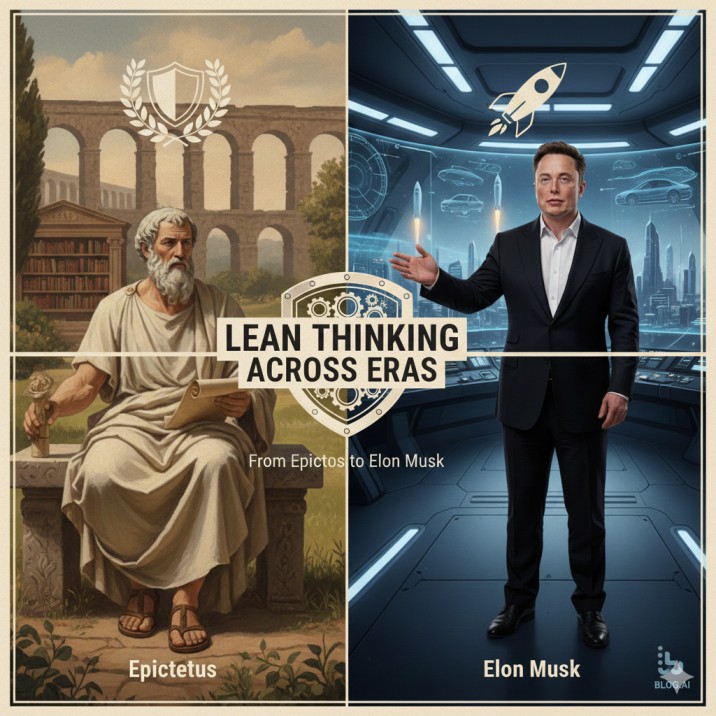
🛡️ Lean Thinking Across Eras: From Epictetus to Elon Musk
Imagine the dusty agora of ancient Rome. There, the Stoic philosopher Epictetus taught his students to distinguish between what is within their control and what is not – urging them to shed unnecessary desires and focus only on what truly mattered.
Now, fast-forward nearly two millennia to the gleaming Tesla Gigafactories, where robots hum in symphony, or to SpaceX launchpads, where rockets ascend to the stars. At the helm is Elon Musk, an engineer-visionary known for his relentless pursuit of efficiency and the ruthless elimination of waste.
At first glance, the chasm between a freed slave philosopher and a modern tech titan seems vast. Yet, an invisible thread connects them: a profound adherence to the principles of Lean Thinking.
What is Lean?
In contemporary business, Lean is a systematic approach to identifying and eliminating waste (muda) to maximize value. It’s about doing more with less and focusing relentlessly on the “Value Stream.” But Lean isn’t a modern invention; it is a formalized expression of a timeless human aspiration for purpose, efficiency, and mastery.
🏛️ Epictetus: The Stoic Roots of the “Lean Mindset”
Epictetus was a proponent of what we might call Internal Lean. His philosophy, captured in The Enchiridion, is fundamentally about maximizing the efficiency of one’s character.
- Value Stream Mapping for the Self: Epictetus emphasized distinguishing between things “up to us” (opinions, impulses, desires) and things that are not (body, reputation, external events). Wasting mental energy on the uncontrollable is the ultimate muda – a squandering of cognitive resources.
- Eliminating Psychological Waste: Stoicism teaches that suffering arises from desiring what we cannot control. By curbing these desires, Epictetus reduced the “rework” of anxiety and frustration.
- Continuous Improvement (Kaizen of Character): The Stoic path is one of perpetual refinement. This mirrors the Lean principle of Kaizen, where small, incremental changes in thought lead to significant gains in the quality of one’s life.
⚙️ The Industrial Evolution: Standardizing Efficiency
The instinct for efficiency grew from artisan workshops to the systemic overhauls of the Industrial Revolution:
- Adam Smith (1776): Introduced the Division of Labor, reducing the “waste” of transition time between tasks.
- Eli Whitney: Pioneered Interchangeable Parts, a monumental step in reducing waste from bespoke fitting and rework.
- Frederick Winslow Taylor: Developed Scientific Management, analyzing every human movement to eliminate “motion waste.”
The Toyota Gold Standard
The true birth of modern Lean came from the Toyota Production System (TPS). Taiichi Ohno and Eiji Toyoda developed two pillars that changed the world:
- Just-In-Time (JIT): Producing only what is needed, when it is needed.
- Jidoka (Autonomation): Building quality at the source by empowering workers to stop the line the moment a defect is found.
🚀 Elon Musk: Lean Thinking on Steroids
Elon Musk is arguably the most prominent Lean thinker of our time. Across Tesla and SpaceX, he applies Lean principles to extreme engineering.
First Principles Thinking
Instead of reasoning by analogy (“How do others build cars?”), Musk uses First Principles. He breaks problems down to their fundamental truths (the cost of raw materials) and builds up from there. This is the ultimate form of waste elimination in thought – stripping away historical baggage that leads to inefficient solutions.
The Five-Step “Algorithm”
Musk has publicly shared his decision-making process, which serves as a modern Lean manifesto:
- Question every requirement: Is this truly adding value, or is it legacy waste?
- Delete any part or process you can: If you aren’t adding back at least 10% of what you deleted, you aren’t deleting enough.
- Simplify or optimize: Never optimize something that should have been deleted.
- Accelerate cycle time: Reduce waiting and improve flow.
- Automate: Only after the first four steps are complete.
Extreme Waste Reduction
- SpaceX: Every gram on a rocket is a “waste” of fuel. Musk’s drive for reusability (Falcon 9) and part reduction (Raptor engines) is a direct application of Lean to aerospace.
- Tesla: The “Machine that builds the Machine.” Musk obsessively seeks to eliminate every second of wasted motion and every inch of excess inventory in his Gigafactories.
🔗 The Enduring Thread: Mastery Through Less
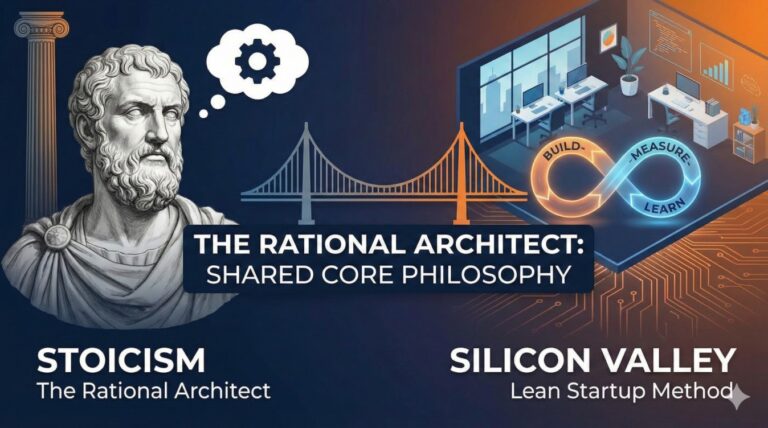
The connection between Epictetus and Elon Musk is profound. Mastery – whether of the inner self or the physical world – stems from a relentless focus on what truly matters.
- Epictetus sought efficiency in Being. He trimmed the fat of unnecessary desires to live a purposeful life.
- Elon Musk seeks efficiency in Doing. He strips away industrial waste to build a multi-planetary future.
Both teach us that true excellence is not found in accumulation, but in the art of doing more by first doing less of what doesn’t matter.