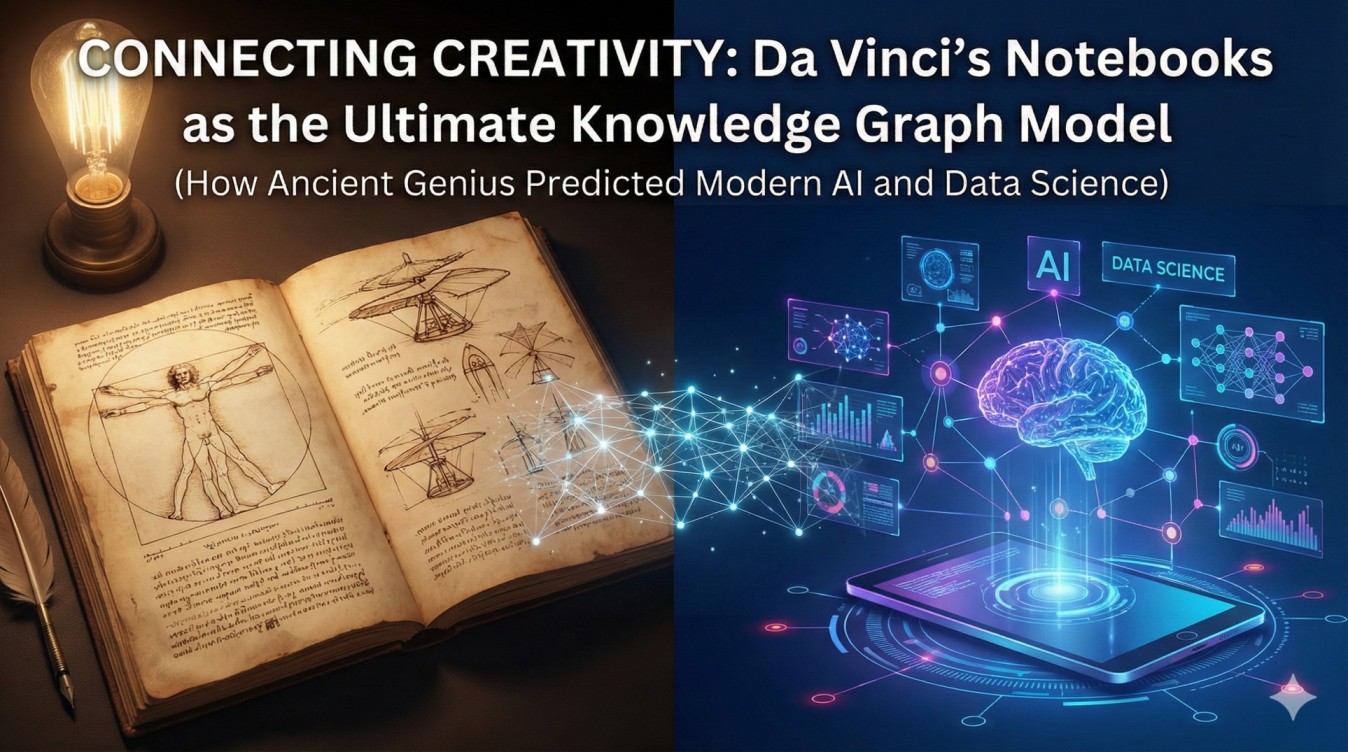
💡 Connecting Creativity: Da Vinci’s Notebooks as the Ultimate Knowledge Graph Model
(How Ancient Genius Predicted Modern AI and Data Science)
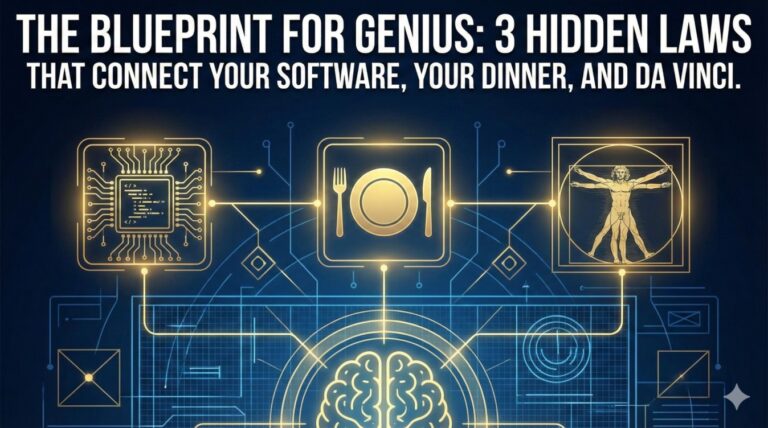
Leonardo da Vinci, the quintessential Renaissance polymath, wasn’t just a master of painting, science, and invention. He was, above all, a master connector. His genius lay not merely in his individual achievements across disparate fields, but in his unique ability to see the intricate web of relationships between them.
His famous notebooks, sprawling compendiums of observations, sketches, theories, and inventions, are more than historical artifacts; they are perhaps the earliest and most compelling prototypes of what we now call a Knowledge Graph.
In an age increasingly defined by data overload and specialized knowledge silos, the modern world grapples with a challenge Da Vinci inherently understood: how to make sense of vast amounts of information and, more importantly, how to foster true innovation by revealing the hidden connections within it.
This post explores Da Vinci’s notebooks as a foundational model for modern Knowledge Graphs, drawing parallels between his analog method of interconnected thought and today’s digital quest for integrated intelligence and AI-driven innovation.
The Unbounded Canvas: Decoding Da Vinci’s Analog Graph
Imagine a mind that never stopped observing, questioning, and recording. That was Da Vinci. For over 40 years, from roughly 1480 until his death in 1519, he filled thousands of pages with his insatiable curiosity. These notebooks are not linear journals; they are chaotic, yet profoundly organized, repositories of a mind in constant motion.
Within their pages, you find an entire integrated universe of data:
- Engineering Designs: Flying machines, war machines, hydraulic systems.
- Anatomical Studies: Detailed drawings of the human body, muscles, and organs (often from dissections).
- Scientific Observations: Notes on light, shadow, fluid dynamics, and botany.
- Artistic Techniques: Studies of perspective, human expression, and paint composition.
What makes them extraordinary isn’t the sheer breadth, but the way these disparate elements frequently intermingle. An anatomical drawing might be juxtaposed with a study of fluid dynamics, which in turn might inform the design of a canal system. His famous mirror writing, often seen as a quirk, subtly reinforces a deliberate, non-linear engagement with his thoughts, mirroring the very structure of interconnected knowledge.
Defining the Modern Knowledge Graph
Before diving deeper into Da Vinci’s analog method, let’s define what a modern Knowledge Graph is. At its heart, a Knowledge Graph is a way to represent knowledge in a structured, interconnected manner. It moves beyond simple databases by focusing on entities and the relationships between them.
Key characteristics that make a Knowledge Graph a powerful tool for semantic search and data integration include:
- Nodes (Entities): The individual “things” or concepts (e.g., “Mona Lisa,” “Human Heart,” “Florence,” “Aerodynamics”).
- Edges (Relationships): The meaningful connections between these nodes (e.g., “Mona Lisa was painted by Da Vinci,” “Flight involves aerodynamics”).
- Semantic Meaning: Relationships are precisely defined (e.g., “is a part of,” “influences,” “discovered”). This allows for much richer querying and inference.
- Graph Structure: The interconnected web allows for traversing complex relationships, discovering indirect links, and identifying patterns invisible in standard tabular data.
Think of Google’s Knowledge Panel that appears during a search; that’s a direct manifestation of a Knowledge Graph at work.
Da Vinci’s Notebooks as a Proto-Knowledge Graph
Now, let’s overlay these modern definitions onto Da Vinci’s work. The parallels are striking, revealing his analog graph structure:
1. Entities (Nodes) Everywhere
Every sketch, observation, and theory in Da Vinci’s notebooks serves as an entity waiting to be connected:
- Concrete Objects: “Wing design,” “Human Hand,” “Arno River,” “Tank.”
- Abstract Concepts: “Force,” “Motion,” “Perception,” “Proportion.”
- Processes: “Water Flow,” “Bird Flight,” “Muscle Contraction.”
He didn’t just list these things; he constantly sought to define and illustrate them from multiple perspectives – the first step in creating a robust knowledge node.
2. Relationships (Edges) Woven Intricately
This is where the true “graph” aspect shines. Da Vinci was obsessed with how things worked together, creating implicit and explicit edges between his nodes:
- Analogy/Similarity: “The mechanics of a bird’s wing are similar to a human arm bone structure.”
- Causality: “Water flow causes erosion.”
- Influence/Application: “Anatomical studies inform realistic painting.”
These relationships were often implicit in the proximity of his notes and drawings, or made explicit through captions and cross-references. He would conceptually draw lines connecting different parts of his sketches across entire notebooks.
3. Semantic Richness Through Interdisciplinary Inquiry
Da Vinci’s genius stemmed from his relentless pursuit of knowledge across disciplines, a practice that inherently imbues his connections with deep semantic meaning.
- Biology & Engineering: He saw the human body as a marvel of engineering, and engineering as an extension of natural principles. The relationship “Human Arm inspires Flying Machine Wing” is rich with meaning, moving beyond a simple “is related to” tag.
- Art & Science: His understanding of light and shadow, derived from scientific optics, directly enhanced the realism in his paintings. The relationship “Optics informs Sfumato Technique” is a powerful semantic link.
His mirror writing, requiring deliberate attention, subtly reinforces the need to actively traverse the graph, mirrors the process of exploring different facets of an entity in a semantic web.
4. Iteration and Evolution: A Dynamic Graph
Unlike a static encyclopedia, Da Vinci’s notebooks were living documents. He would revisit ideas, refine sketches, add new observations, and cross-reference earlier thoughts. This iterative process is crucial for a modern Knowledge Graph, which must be constantly updated and expanded with new information and newly discovered relationships to remain valuable. His insights were ongoing explorations, not final declarations.
The Power of Connecting: Why Da Vinci’s Model Matters Today
In our information age, Da Vinci’s method offers profound lessons for the development and application of modern Knowledge Graphs and AI systems.
1. Combating Information Silos
Modern organizations often suffer from data silos where information is fragmented across departments, databases, and formats. Knowledge Graphs, by explicitly linking entities across domains (e.g., connecting engineering data with market insights), can break down these artificial barriers, achieving the same unity of thought Da Vinci had in his single mind.
2. Fueling Innovation Through Serendipity
Da Vinci’s breakthroughs often came from connecting seemingly unrelated fields. His understanding of water movement might spark an idea for a blood pump. This “serendipitous discovery” is a hallmark of truly innovative thinking. Knowledge Graphs, by mapping indirect relationships, help digital systems and human analysts discover these unexpected links, leading to novel solutions and hypotheses – such as linking molecular structures, disease pathways, and agricultural compounds in a drug discovery graph.
3. Beyond Search: Empowering Intelligent Systems
While traditional search engines are powerful, they are largely based on keywords. Knowledge Graphs allow for semantic search (“Find all artists who influenced Picasso and also designed buildings in Barcelona”) and intelligent inference (“If A is related to B, and B is related to C, then what is the likely relationship between A and C?”). Da Vinci’s notebooks, with their inherent structure, allowed him to “query” his own mind and draw conclusions across his vast knowledge base.
4. A Model for Human-AI Collaboration
Da Vinci’s notebooks were a canvas for human creativity. Modern Knowledge Graphs, while powered by AI and machine learning for data extraction and structuring, still require human curation, domain expertise, and intuitive leaps to define meaningful relationships.
The best Knowledge Graphs will be those that empower humans to think more like Da Vinci -seeing the bigger picture, drawing unexpected connections – rather than simply replacing human thought. AI can build the graph, but human creativity defines its most valuable paths.
Conclusion: The Enduring Legacy of Connection
Leonardo da Vinci’s notebooks are more than historical curiosities; they are a timeless testament to the power of interconnected thought. His analog knowledge graph, meticulously crafted across thousands of pages, served as the engine of his unparalleled creativity and innovation.
In a world awash with data, where the next great breakthrough often lies at the intersection of disciplines, Da Vinci’s model of knowledge organization offers a guiding light.
By consciously adopting the principles embedded in his notebooks -focusing on entities and their meaningful relationships, fostering semantic richness, and embracing dynamic iteration – we can build modern Knowledge Graphs that not only store information but truly empower us to unlock profound insights and, perhaps, even inspire the next generation of Renaissance thinkers. The journey from ink-stained parchment to digital semantic web is long, but the underlying quest for understanding through connection remains brilliantly consistent.